Home
Class 12
MATHS
The number of real solutions of tan^(-1)...

The number of real solutions of `tan^(-1)sqrt(x(x+1))+sin^(-1)sqrt(x^2+x+1)=pi/2` is (a) zero b. one c. two d. infinite

Text Solution

Verified by Experts

The correct Answer is:
N/a

We have, `tan^(-1)sqrt(x(x+1))+sin^(-1)sqrt(x^(2)+x+1) = pi/2"......."(i)`
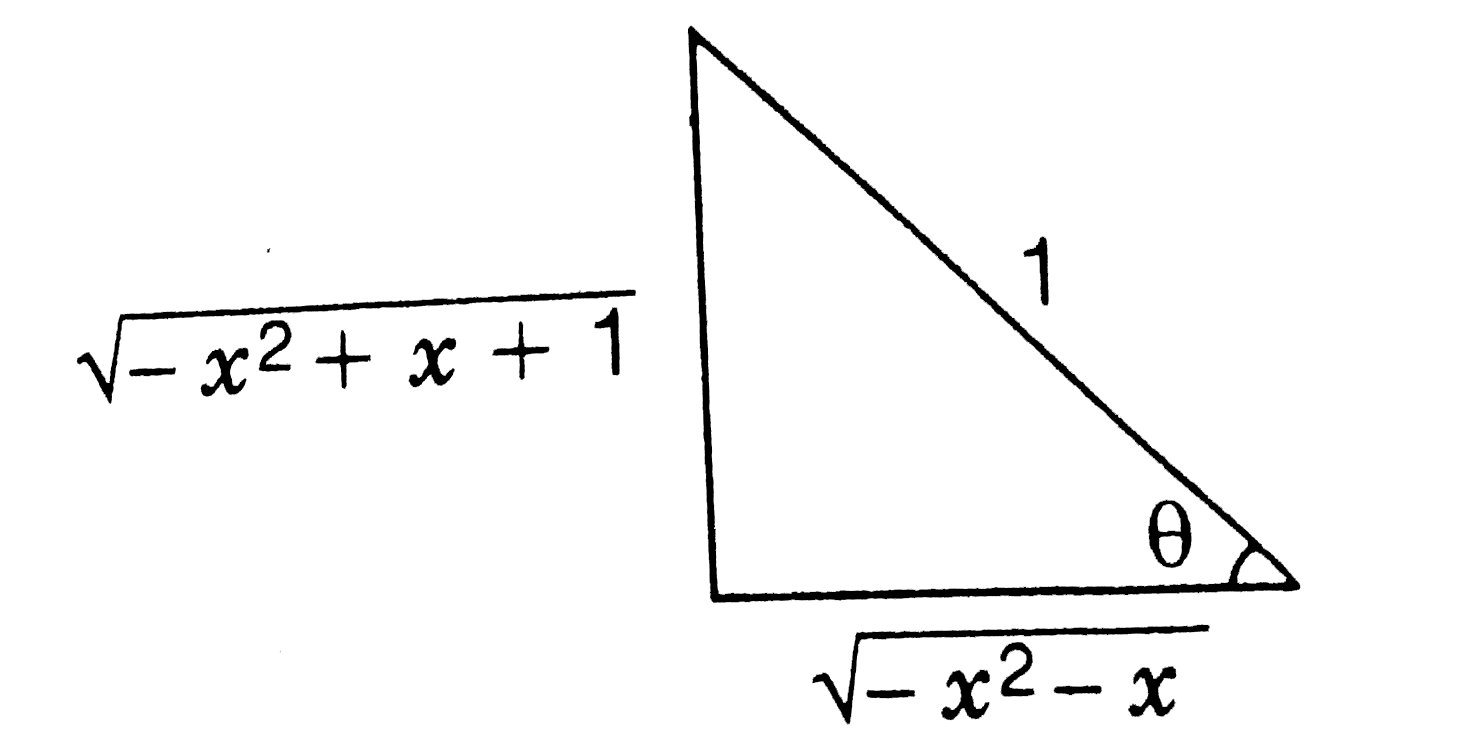
Let `sin^(-1) sqrt(x^(2)+x+1)=theta`
`rArr sin theta = sqrt((x^(2)+x+1)/(1))`
`rArr tantheta = (sqrt(x^(2)+x+1))/(sqrt(-x^(2)-x))`
`:' theta = tan^(-1)'(sqrt(x^(2)+x+1))/(sqrt(-x-x))`
`=sin^(-1)sqrt(x^(2)+x+1)`

On putting the value of `theta` in Eq. (i), we get
`tan^(-1)sqrt(x(x+1))+tan^(-1)'(sqrt(x^(2)+x+1))/(sqrt(-x^(2)-x)) = (pi)/(2)`
We know that, ` tan^(-1)x+tan^(-1)y=tan^(-1)((x+y)/(1-xy)), xy lt 1`
`:. tan^(-1)[(sqrt(x(x+1))+sqrt((x^(2)+x+1)/(-x^(2)-x)))/(1-sqrt(x(x+1)).sqrt((x^(2)+x+1)/(-x^(2)-x)))]=(pi)/(2)`
`rArr tan^(-1)[(sqrt(x^(2)+x)+sqrt((x^(2)+x+1)/(-1(x^(2)+x))))/(1-sqrt((x^(2)+x).((x^(2)+x+1))/(-1(x^(2)+x))))] = (pi)/(2)`
`rArr (x^(2)+x+sqrt(-(x^(2)+x+1)))/([1-sqrt(-(x^(2)+x+1))]sqrt((x^(2)+x))) = tan'(pi)/2 = 1/0`
`rArr [1-sqrt(-(x^(2)+x+1))]sqrt((x^(2)+x))= 0`
`rArr - (x^(2)+x+1) = 1` or `x^(2) + x = 0`
`rArr -x^(2)-x-1=1` or `x(x+1)=0`
`rArr x^(2)+x+2 = 0` or `x(x+1)=0`
`:. x = (-1+-sqrt(1-4xx 2))/(2)`
`rArr x = 0` or `x = - 1`
For real solution, we have `x = 0, -1`.
Promotional Banner

Topper's Solved these Questions

  • INTEGRALS

    NCERT EXEMPLAR|Exercise Integrals|62 Videos
  • LINEAR PROGRAMMING

    NCERT EXEMPLAR|Exercise Linear Programming|45 Videos

Similar Questions

Explore conceptually related problems

The number of solution of tan^-1(sqrt(x(x-1)))+sin^-1(sqrt(x^2+x+1))=pi/2 are

The number of real solution of cot^(-1)sqrt(x(x+3))+sin^(-1)sqrt(x^(2)+3x+1)=(pi)/(2) is /are

The number of real solution of cot^(-1)sqrt(x(x+4))+cos^(-1)sqrt(x^(2)+4x+1)=(pi)/(2) is equal to

The number of real roots of the equation tan^(-1)sqrt(x(x+1))+sin^(-1)sqrt(x^(2)+x+1)=(pi)/(4) is :

The number of real solutions of the equations x+sqrt(x^(2)+sqrt(x^(3)+1))=1

The number of real solution of the equation tan^(-1)sqrt(x^(2)-3x+7)+cos^(-1)sqrt(4x^(2)-x+3)=pi is

Solve the equation: tan^(-1)sqrt(x^(2)+x)+sin^(-1)sqrt(x^(2)+x+1)=(pi)/(2)

The number of solutions for the equation sin^(-1) sqrt((x^(2)-x+1))+cos^(-1)sqrt((x^(2)-x))=pi is :

The number of real solution(s) of the equation sin^(-1)sqrt(x^(2)-5x+5)+cos^(-1)sqrt(4x-x^(2)-3)=pi is/are

NCERT EXEMPLAR-INVERSE TRIGONOMETRIC FUNCTIONS-Inverse Trigonometric Functions
  1. Find the value of tan^(-1)(tan'(2pi)/(3)).

    Text Solution

    |

  2. Show that 2tan^-1 (-3)=-pi/2+tan^-1(-4/3)

    Text Solution

    |

  3. The number of real solutions of tan^(-1)sqrt(x(x+1))+sin^(-1)sqrt(x^2+...

    Text Solution

    |

  4. Find the value of expression: sin(2tan^(-1)(1/3))+cos(tan^(-1)2sqrt(2)...

    Text Solution

    |

  5. If 2 tan^(-1)(costheta) = tan^(-1)(2 cosec theta), then show that the...

    Text Solution

    |

  6. Show that: cos(2tan^(-1)1/7)=sin(4^(-1)1/3)

    Text Solution

    |

  7. Solve the equation cos(tan^(-1)x) = sin(cot^(-1)'3/4).

    Text Solution

    |

  8. Prove that tan^(-1)[(sqrt(1+x^2)+sqrt(1-x^2))/(sqrt(1+x^2)-sqrt(1-x^2...

    Text Solution

    |

  9. Simplify each of the following: cos^(-1)(3/5cosx+4/5sinx) , where -(3p...

    Text Solution

    |

  10. Prove that sin^(- 1)(8/17)+sin^(- 1)(3/5)=sin^(- 1)(77/85)

    Text Solution

    |

  11. Show that sin^(-1)'5/13+cos^(-1)'3/5=tan^(-1)'63/16.

    Text Solution

    |

  12. Prove: tan^(-1)(1/4)+tan^(-1)(2/9)=sin^(-1)(1/sqrt(5))

    Text Solution

    |

  13. Find the value of 4 tan^-1 (1/5) - tan^-1 (1/239)

    Text Solution

    |

  14. Show that: tan(1/2sin^(-1)3/4)=(4\ sqrt(-7))/3

    Text Solution

    |

  15. If a1, a2,a3, ,an is an A.P. with common difference d , then prove th...

    Text Solution

    |

  16. Which of the following of the principal value branch of cos^(-1)...

    Text Solution

    |

  17. Which of the following is the principal value branch of cosec^(-1)x ?

    Text Solution

    |

  18. If 3tan^(-1)x +cot^(-1)x=pi, then x equals to

    Text Solution

    |

  19. The value of sin^(-1)(cos(33pi)/5) is (3pi)/5 (b) pi/(10) (c) pi/(10) ...

    Text Solution

    |

  20. The domin of the function cos^(-1) (2x-1) is

    Text Solution

    |

