
Home
Class 10
MATHS
The following are the ages of 300 patien...

The following are the ages of 300 patients getting medical treatment in a hospital on a particulat day

Form
(i) Less than type cumulative frequency distribution.
(ii) More than type cumulative frequency distribution.

Text Solution

Verified by Experts
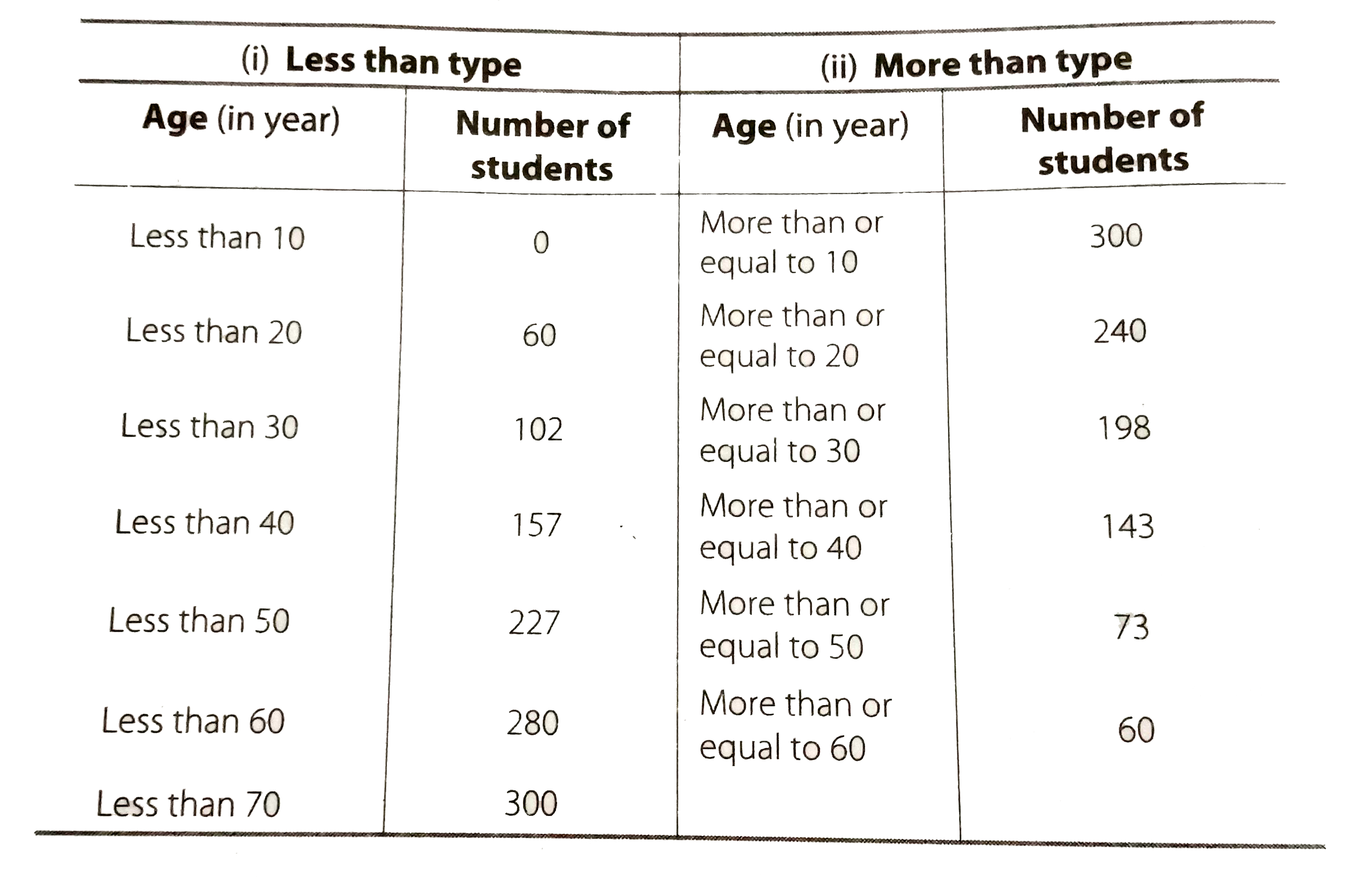
(i) We observe that the number of patients which take medical treatment in a hospital on a particular day less than 10 is 0. Similarly, less than 20 includes the number of patients which take medical treatment from 0-10 as well as the number of patients which take medical treatment from 10-20. So, the total of patients less than 20 is 0+60=60, we say that the cumulatives frequency of the class 10-20. Similarly for other class.
(ii) Also, we observe that all 300 patients which take medical treatment more than or equal to 10. Since, there are 60 patients which takes medical treatment in the interval 10-20 this means that there are 300-60=240 patients which take medical treatment more than or equal to 20. Continuing in the same manner.
Promotional Banner

Topper's Solved these Questions

  • STATISTICS AND PROBABILITY

    NCERT EXEMPLAR|Exercise VERY SHORT ANSWERS QUESTIONS|2 Videos
  • STATISTICS AND PROBABILITY

    NCERT EXEMPLAR|Exercise LONG ASWERS QUESTIONS|5 Videos
  • REAL NUMBERS

    NCERT EXEMPLAR|Exercise Real Numbers|39 Videos
  • SURFACE AREAS AND VOLUMES

    NCERT EXEMPLAR|Exercise Surface Areas And Volumes|62 Videos

Similar Questions

Explore conceptually related problems

The following are the ages of 300 patients getting medical treatment in a hospital on a particular day: Form less than type cumulative frequency distribution.

The following are the ages of 300 patients getting medical treatment in a hospital on a particular day: Form more than type cumulative frequency distribution.

The following table shows ages of 300 patients getting medical treatment in a hospital on a particular day: Find the median age of the patient.

Convert the following cumulative frequency distribution into a simple frequency distribution

Convert the following cumulative frequency distribution into a simple frequency distribution

In Case Of Less Than Cumulative Frequency Series

Write the following data into less than cummulative frequency distribution table.

Draw a less than ogive for the following frequency distribution.

