Home
Class 10
MATHS
50 students enter for a school javeloin ...

50 students enter for a school javeloin throw competition. The distance (in metre) thrown are recorded below

(i) Construct a cumulative frequency table.
(ii)Calculate the median distance by using the formula for median.

Text Solution

Verified by Experts
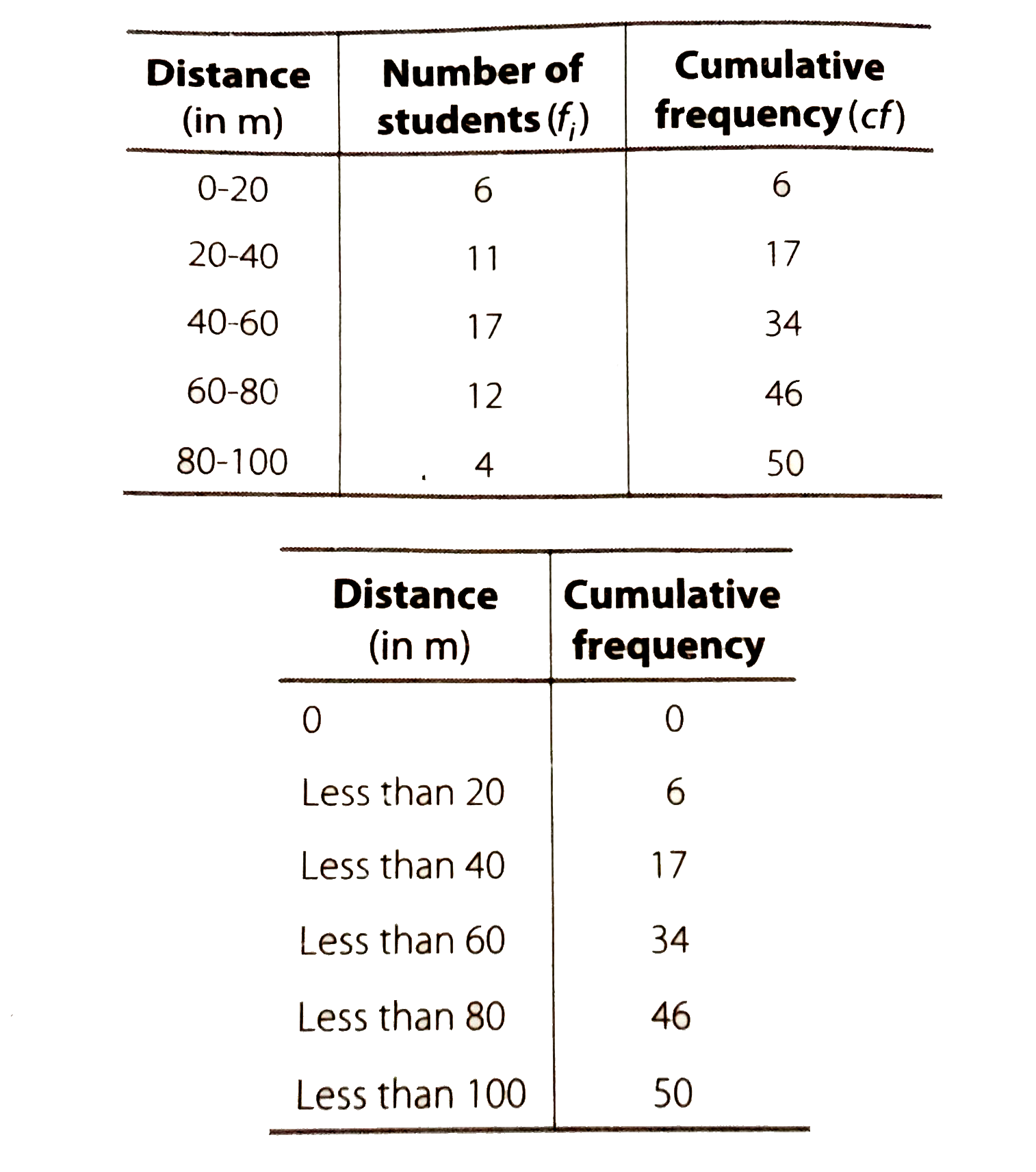

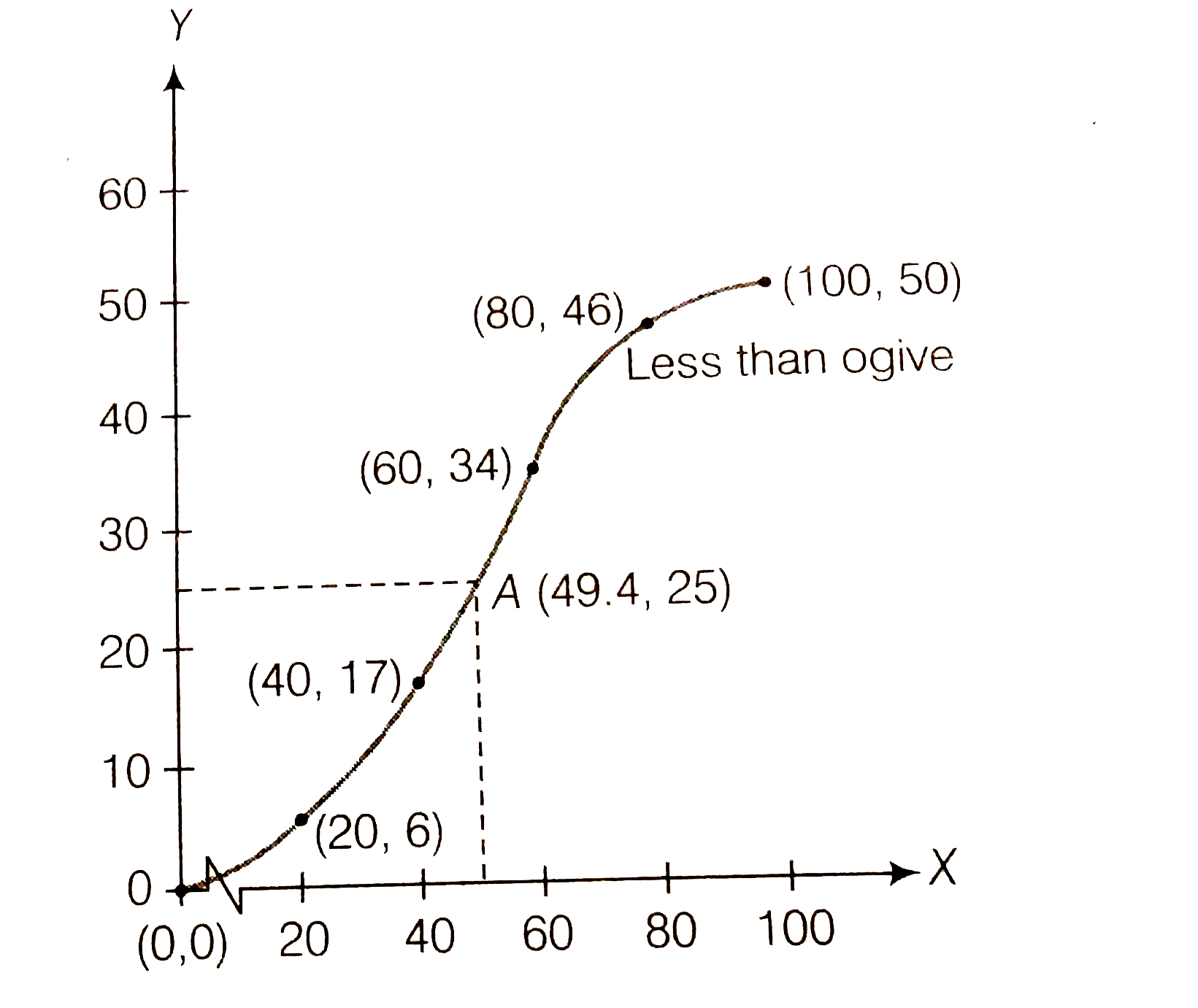
To draw less than type ogive, we plot the points (0,0),(20,6),(40,17),(60,34),(80,46), (100,50) join the all these points by free hand

Taking Y=25cm on Y-axis and draw a line parallel to X-axis, which meets the curve at point A. From points A, we draw a line perpendicular to X-axis, where this meets that point is the required median i.e.49.4
(iii) Now, `(N)/(2)=(50)/(2)=25`
Which lies is the interval 40-60 l=40, h=20, cf=17 and f=17
`"Median"=l+(((N)/(2)-cf))/(f)xxh`
`40+((25-17))/(17)xx20`
`=40+(8 xx20)/(17)`
`=40+9.41`
`=49.41`
(iv) Yes, median distane calculated by parts, (ii) and (iii) are same.
Promotional Banner

Topper's Solved these Questions

  • STATISTICS AND PROBABILITY

    NCERT EXEMPLAR|Exercise VERY SHORT ANSWERS QUESTIONS|2 Videos
  • STATISTICS AND PROBABILITY

    NCERT EXEMPLAR|Exercise LONG ASWERS QUESTIONS|5 Videos
  • REAL NUMBERS

    NCERT EXEMPLAR|Exercise Real Numbers|39 Videos
  • SURFACE AREAS AND VOLUMES

    NCERT EXEMPLAR|Exercise Surface Areas And Volumes|62 Videos

Similar Questions

Explore conceptually related problems

The annual rainfall record of a city for 66 days is given below in the table : Calculate the median rainfall ,using the formula .

The construction of cummulative frequency table is useful in determining the (i)Mean (ii)Median (iii)Mode (iv)All of the above

a) A small object is placed 150 mm away from a diverging lens of focal length 100 mm. i) Copy the figure below and draw rays to show how an image is formed by the lens. ii) Calculate the distance of the image from the lens by using the lens formula. b) The diverging lens in part a) is replaced by a converging lens also of focal length 100 nm. The object remains in the same position and an image is formed by the converging lens. Compare two properties of this image with those of the image formed by the diverring lens in part a)

The following frequency distribution table shows the distances travelled by some rickshaws in a day. Observe the table and answer the following question: (a) which is the modal class? Why? (b) which is the median class and why? (c) write the cumulative frequency (c.f.) of the class preceding the median class. (d) what is the class interval (h) to calculate median?

Consider a block of conducting material of resistivity 'rho' shown in the figure. Current 'I' enters at 'A' and leaves from 'D'. We apply superposition principle to find voltage DeltaV developed between 'B' and 'C'. The calculation is done in the following steps: (i) Take current 'I' entering from 'A' and assume it to spread over a hemispherical surface in the block. (ii) Calculate field E(r) at distance 'r' from A by using Ohm's law E = rhoj, where j is the current per unit area at 'r'. (iii) From the 'r' dependence of E(r), obtain the potential V(r) at r. (iv) Repeat (i), (ii) and (iii) for current 'I' leaving 'D' and superpose results for 'A' and 'D'. For current entering at A, the electric field at a distance 'r'

Water from a tank issues into air through a horizontal nozzle and striken a fixed wall at right angles to the nozzle and 50 cm from it. If the depth of the nozzle below the free surface of water in the tank is 32 cm, calculate (i)velocity of efflux of water and (ii) the vertical distance below the nozzle of the point where the jet strikes the wall.

Consider a block of conducting material of resistivity 'rho' shown in the figure. Current 'I' enters at 'A' and leaves from 'D'. We apply superposition principle to find voltage DeltaV developed between 'B' and 'C'. The calculation is done in the following steps: (i) Take current 'I' entering from 'A' and assume it to spread over a hemispherical surface in the block. (ii) Calculate field E(r) at distance 'r' from A by using Ohm's law E = rhoj, where j is the current per unit area at 'r'. (iii) From the 'r' dependence of E(r), obtain the potential V(r) at r. (iv) Repeat (i), (ii) and (iii) for current 'I' leaving 'D' and superpose results for 'A' and 'D'. Delta V measured between B and C is

(a)State and explain Newton's second law of motion. (b) A 1000 kg vehicle moving with a speed of 20 m/s is brought to rest in a distance of 50 metres: (i) Find the acceleration. (ii) Calculate the unbalanced force acting on the vehicle.