Home
Class 11
PHYSICS
In the co-efficinet of friction between ...

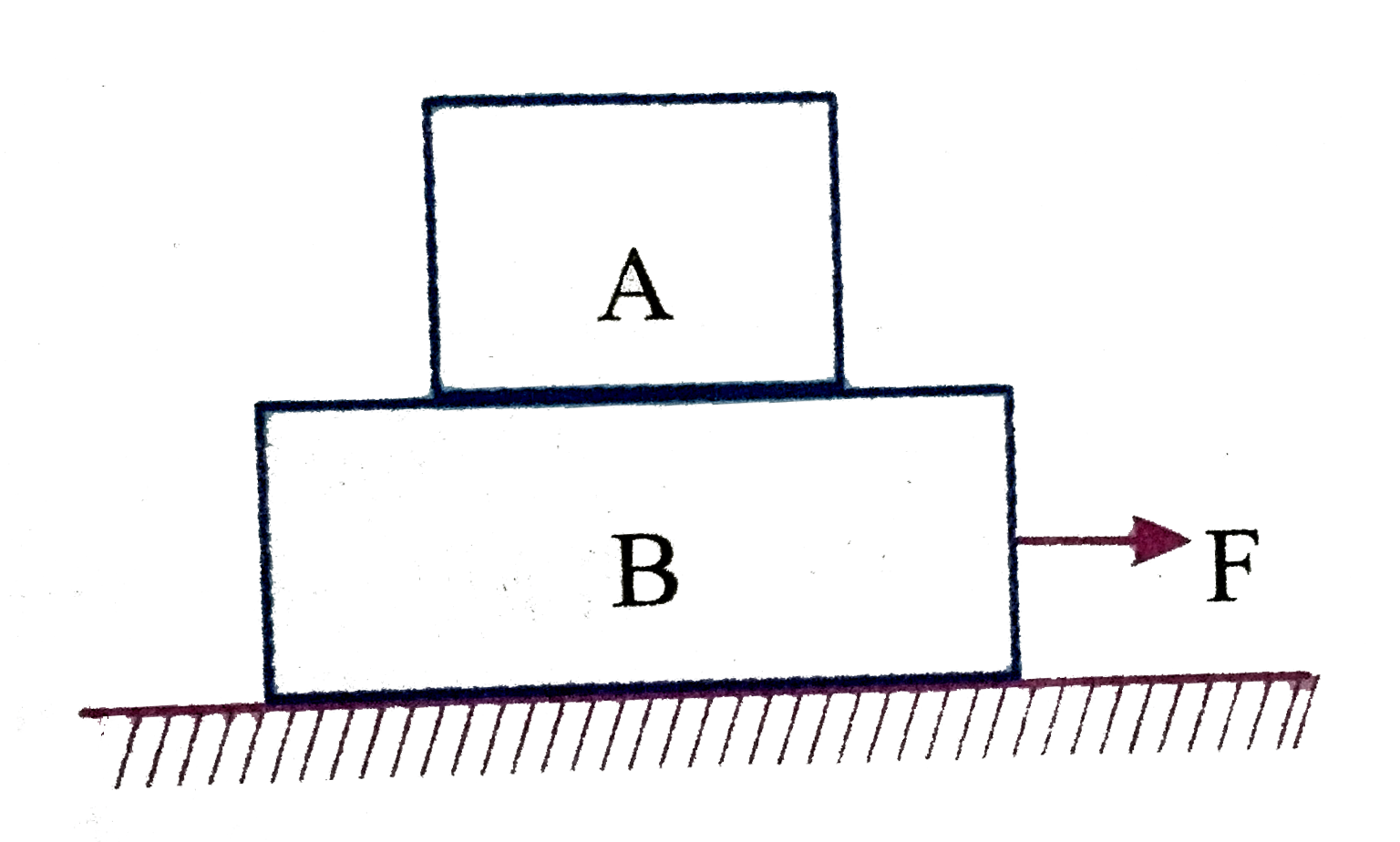
In the co-efficinet of friction between the floor and the body `B` is 0.1. The co-efficient of friction beteen the bodies `B` and `A` is 0.2 A fore `F` is applied as shown `B` The mass of `A` is `m//2` and of `B` is m Which of the following statements are ture ?
.

A

The bodies will move together if F = `0.25` mg

B

The body A will slip with respect to B if F = `0.5` mg

C

The bodies will be rest if F = `0.1` mg

D

The maximum value of F for which the two bodies will move together is `0.45` mg

Text Solution

Verified by Experts

The correct Answer is:
A, B, D

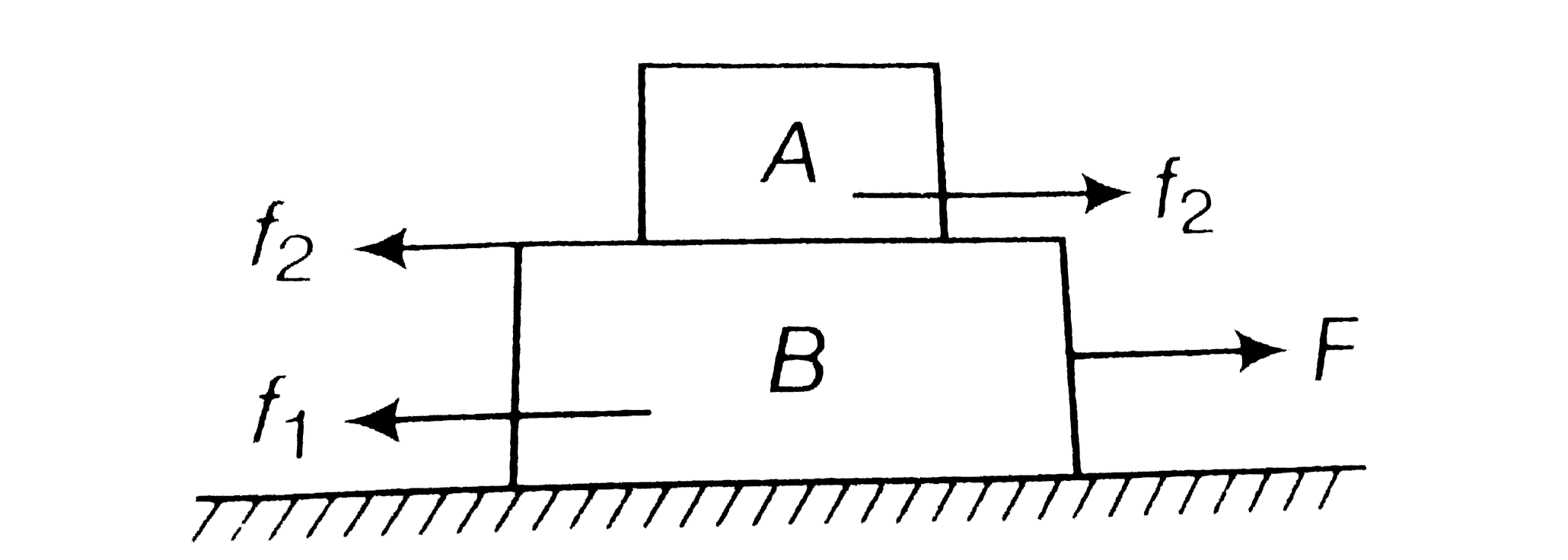
Consider the adjacent diagram . Frictional force on `B(f_(1))` and frictional force on A `(f_(2))` will be as shown.
Let A and B are moving together `a_("common") = (F-f_(1))/(m_(A) + m_(B)) = (F - f_(1))/((m//2) + m) = (2(F- f_(1)))/( 3m)`
Pseudo force on A = `(m_(A)) xx a_("common")`
=` m_(A) xx (2(F- f_(1)))/(3m) = (m)/(2) xx (2(F-f_(1)))/(3m) = ((F - f_(1)))/(3)`

The force (F) will be maximum when
Pseudo force on A = Frictional force on A
`implies " " (F_("max") - f_(1))/(3) = mu m_(A) g `
= `0.2 xx (m)/(2) xx g = 0.1` mg
`implies " " F_("max") = 0.3 mg + f_(1)`
=`0.3` mg + `(0.1) (3)/(2) mg = 0.45` mg
`implies` Hence , maximum force upto which bodies will move together is `F_("max") = 0.45` mg
(a) Hence for F = `0.25` mg `lt F_("max")` bodies will move together .
(b) For F = `0.5 mg gt F_("max") ` , body A will slip with respect to B .
(c) For F = `0.5` mg `gt F_("max")` , bodies slip
`(f_(1))_("max") = mu M_( B) g = (0.1) xx (3)/(2) m xx g = 0.15` mg
`(f_(2))_("max") = mu m_(A) g = (0.2) ((m)/(2)) (g) = 0.1` mg
Hence , minimum force required for movement of the system (A + B)
`F_("min") = (f_(1))_("max") + (f_(2))_("max") `
= `0.15` mg + `0.1` mg = `0.25` mg
(d) Given , force F = `0.1` mg `lt F_("min")`
Hence , the bodies will be at rest .
(e) Maximum force for combined movement `F_("max") = 0.45` mg .
Promotional Banner

Topper's Solved these Questions

  • LAWS OF MOTION

    NCERT EXEMPLAR|Exercise Very short answer type Questions|12 Videos
  • LAWS OF MOTION

    NCERT EXEMPLAR|Exercise Short answer type questions|6 Videos
  • LAWS OF MOTION

    NCERT EXEMPLAR|Exercise Long answer Type Questions|9 Videos
  • KINETIC THEORY

    NCERT EXEMPLAR|Exercise Multiple Choice Questions (MCQs)|31 Videos
  • MECHANICAL PROPERTIES OF FLUIDS

    NCERT EXEMPLAR|Exercise Long Answer Type Questions|3 Videos

Similar Questions

Explore conceptually related problems

The block each of mass 1 kg are placed as shown .They are connected by a string which passes over a smooth (massless) pulley. There is no friction between m_(1) and the ground.The coefficient of friction between m_(1) and m_(2) is 0.2 A force F is applied to m_(2) . Which of the fpllowing statement is/are correct?

A body of mass 2 kg at rest on a horizontal table. The coefficient of friction between the body and the table is 0.3 . A force of 5N is applied on the body. The force of friction is

The coefficient of friction between the block A of mass m & block B of mass 2m is mu . There is no friction between A & B is released from rest & there is no slipping between A & B then:

In the situation shown coefficient of friction between A and B is 0.5 and between B and C is 0.3 . Friction acting between B and C is xN then (9x)/7 is

A body of mass 2 kg is placed on rough horizontal plane. The coefficient of friction between body and plane is 0.2 Then,

The coefficient of friction between the block A of mass m and the triangular wedge B of mass M is mu . There in no friction between the wedge and the plane if the system (block A+ wedge B) is released so that there is no stiding between A and B find the inclination theta

