Home
Class 12
MATHS
Let nge3 and let C(1),C(2),....,C(n) be...

Let `nge3` and let `C_(1),C_(2),....,C_(n)` be circles witht radii, `r_(1),.r_(2),....,r_(n),` respectively. Assume that `C_(1) and C_(i+1)` touch external for `2leilen-1`. It is also given that the x-axis and the line `y=2sqrt(2)x+10` are tangential to each of the ci rcles. Then `r_(1),r_(2),....,r_(n),` are in-

A

ana arithmetic progeression with common difference `3+sqrt(3)`

B

a geometric progeression with common ratio `3+sqrt(3)`

C

an arithmetic progeression with common difference `2+sqrt(3)`

D

a geometric progeression with common ratio `2+sqrt(3)`

Text Solution

Verified by Experts

The correct Answer is:
D


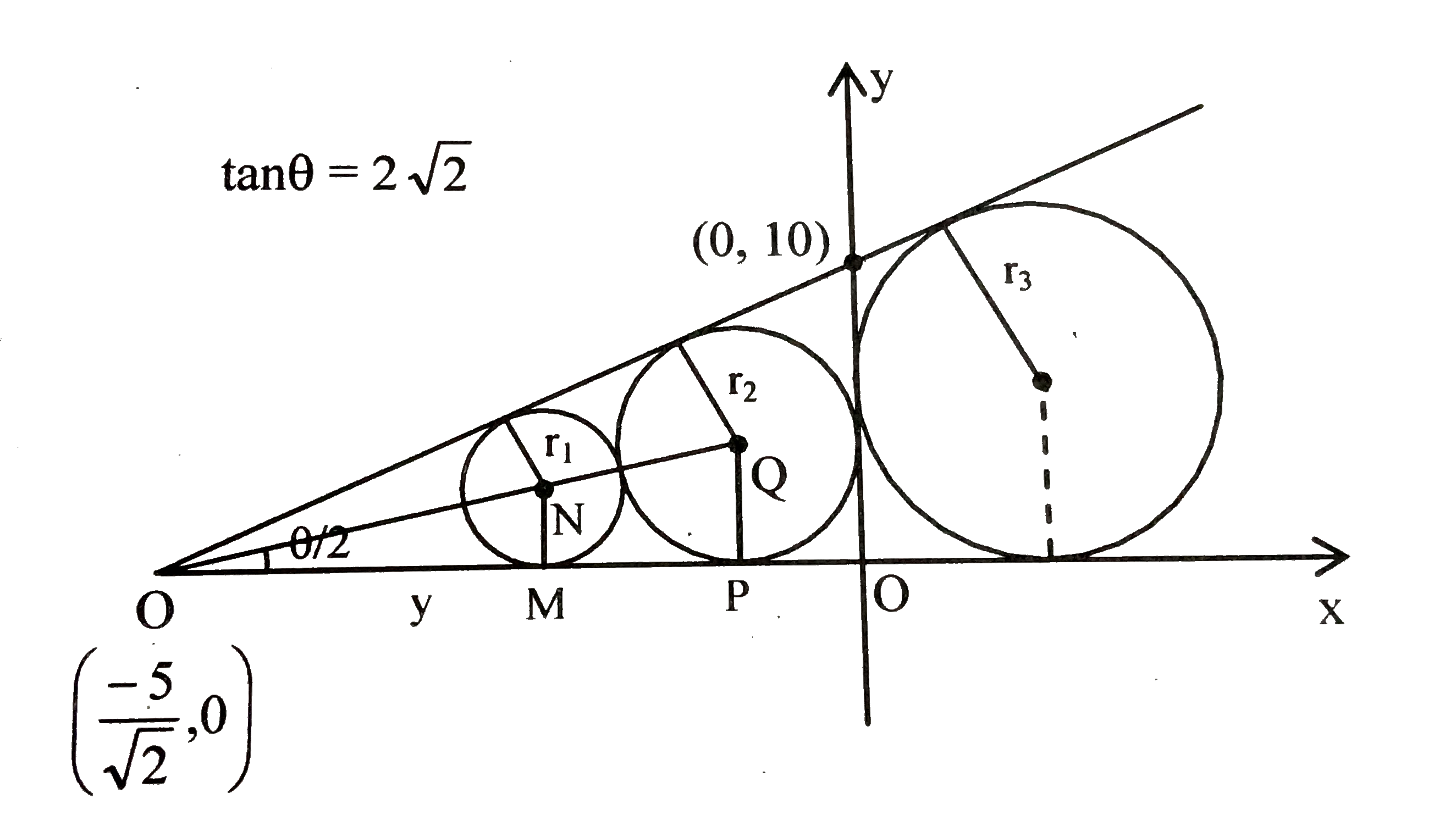
`((-5)/(sqrt(2)),0)`
`tantheta=(2-tan theta//2)/(1-tan ^(2)theta//2)`
`2sqrt(2)=(2-tan theta//2)/(1-tan ^(2)theta//2)`
`sqrt(2)tan^(2) theta//2+tan theta-sqrt(2)=0`
`tan theta//2 =(-1+-sqrt(1+8))/(2sqrt(2))`
`=(-1+-3)/(2sqrt(2))=(1)/(sqrt(2))or -sqrt(2)`
`:. tan theta//2=(1)/(sqrt(2))`
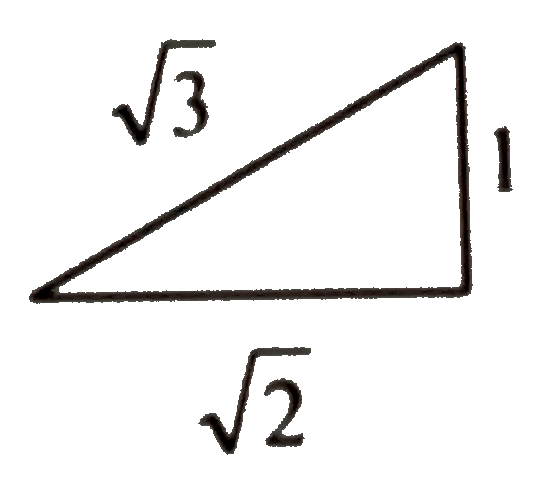
`In DeltaOMN sin theta//2=(r_(1))/(ON) sin theta//2 =(1)/(sqrt(2))`
`ON=sqrt(3r_(1))`
In `DeltaOMNsin theta//2=(r_(1))/(ON+r_(1)+r_(2))rArr(1)/(sqrt(3))=(r_(2))/(sqrt(3)r_(1)+r_(1)+r_(2))`
`sqrt(3)r_(1)+r_(1)+r_(2)=sqrt(3)r_(2)`
`r_(1)(sqrt(3)+1)=r_(2)(sqrt(3)-1)`
`(r_(2))/(r_(1))=(sqrt(3)+1)/(sqrt(3)-1)`
`=((sqrt3+1)^(2))/(2)=2+sqrt(3)`
Promotional Banner

Topper's Solved these Questions

  • KVPY

    KVPY PREVIOUS YEAR|Exercise Part A - Mathematics|20 Videos
  • KVPY

    KVPY PREVIOUS YEAR|Exercise Part B- Mathematics|10 Videos
  • KVPY

    KVPY PREVIOUS YEAR|Exercise PART -I MATHEMATICS|20 Videos
  • KVPY 2021

    KVPY PREVIOUS YEAR|Exercise PART II MATHEMATICS|4 Videos

Similar Questions

Explore conceptually related problems

Let nge3 and let C_1, C_2, ...., C_n, be circles with radii r_1, r_2,... r_n, respectively. Assume that C_i and C_(i+1) touch externally for 1leilen-1. It is also given that the x-axis and the line y = 2sqrt(2)x+10 are tangential to each of the circle . Then r_1,r_2.r_n are in (A) an arithmetic progression with common difference 3+sqrt(2) (B) a geometric progression with common ratio 3+sqrt(2) (C) an arithmetic progression with common difference 2+sqrt(3) (D) a geometric progression with common ratio 2+sqrt(3)

Three circles with centres C_(1),C_(2) and C_(3) and radii r_(1),r_(2) and r_(3) where *r_(-)1

Consider a series of 'n' concentric circles C_1, C_2, C_3, ....., C_n with radii r_1, r_2, r_3, ......,r_n respectively, satisfying r_1 > r_2 > r_3.... > r_n and r_1= 10. The circles are such that the chord of contact of tangents from any point on C_1 to C_(i+1) is a tangent to C_(i+2) (i = 1, 2, 3,...). Find the value of lim_(n->oo) sum_(i=1)^n r_1, if the angle between the tangents from any point of C_1 to C_2 is pi/3.

Three circles C_(1),C_(2),C_(3) with radii r_(1),r_(2),r_(3)(r_(1)ltr_(2)ltr_(3)) respectively are given as r_(1)=2 , and r_(3)=8 they are placed such that C_(2) lines to the right of C_(1) and touches it externally C_(3) lies ot the right of C_(2) and touches it externally. There exist two stratight lines each of whic is a direct common tangent simultaneously to all the three circles then r_(2) is equal to

Circles C_(1) and C_(2) of radii r and R respectively, touch each other as shown in the figure. The lime l, which is parallel to the line joining the centres of C_(2) and C_(2) is tangent to C_(1) at P and intersects C_(2) at A,B.If R^(2)=2r^(2) , then angleAOB equals-

C_1 and C_2 are fixed circles of radii r_1 and r_2 touches each other externally. Circle 'C' touches both Circles C_1 and C_2 extemelly. If r_1/r_2=3/2 then the eccentricity of the locus of centre of circles C is

Two circles of radii r_(1) and r_(2)(r_(1)>r_(2)) touch each other exterally.Then the radius of circle which touches both of them externally and also their direct common tangent is (A) ( sqrtr_(1)+sqrt(r)_(2))^(2) (B) sqrt(r_(1)r_(2))(C)(r_(1)+r_(2))/(2) (D) (r_(1)-r_(2))/(2)

Prove that C(n,r)+C(n-1,r)+C(n-2,r)+......+C(r,r)=C(n+1,r+1)

Given that C(n, r) : C(n,r + 1) = 1 : 2 and C(n,r + 1) : C(n,r + 2) = 2 : 3 . What is r equal to ?

Given that C(n, r) : C(n,r + 1) = 1 : 2 and C(n,r + 1) : C(n,r + 2) = 2 : 3 . What is n equal to ?