Home
Class 10
BIOLOGY
Even a hard solid food also becomes smoo...

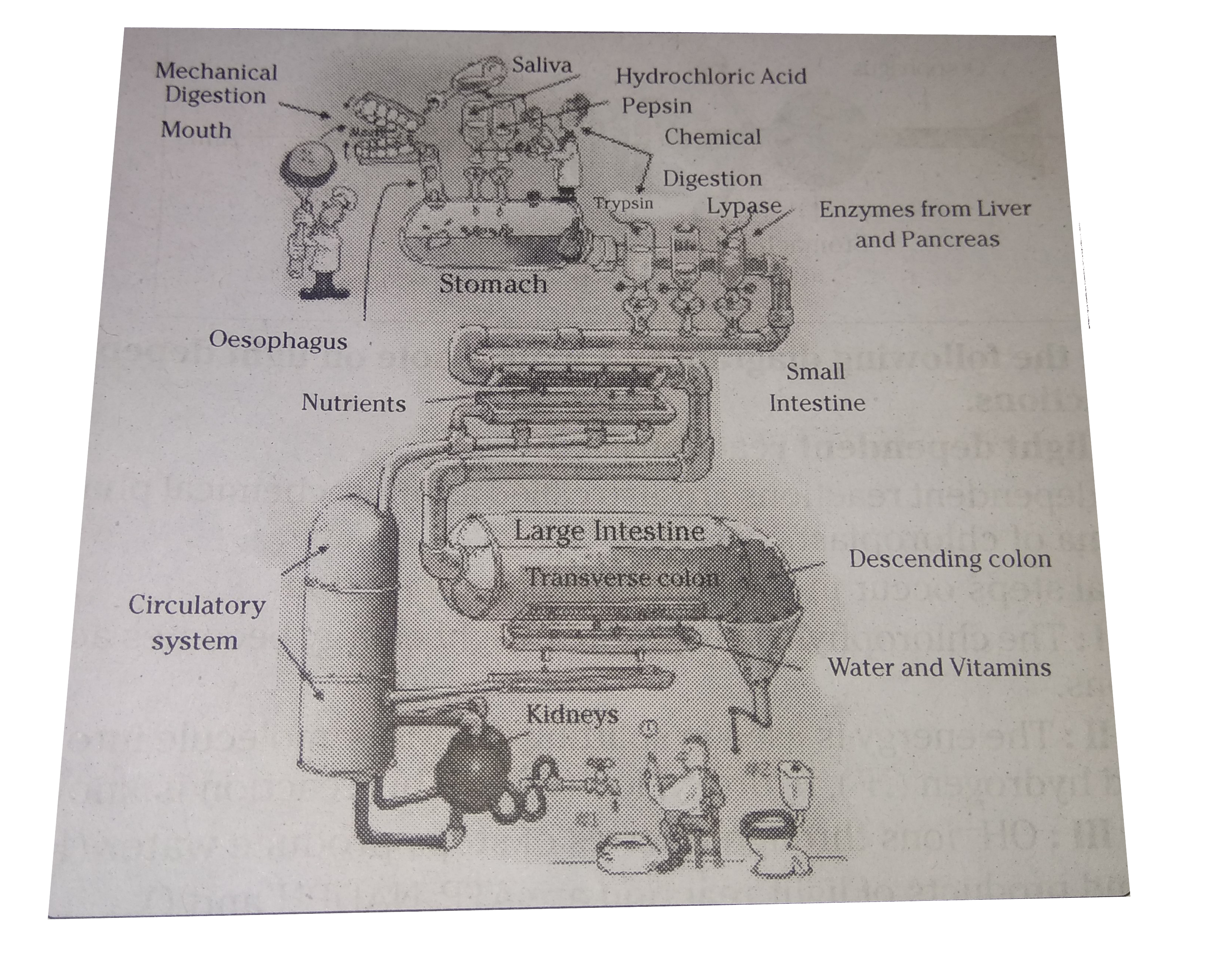
Even a hard solid food also becomes smooth slurry in the digestive system by the enzymes released at a particular time. This mechanism is an amazing fact. Prepare a cartoon on it.

Text Solution

Verified by Experts
Promotional Banner

Topper's Solved these Questions

  • NUTRITION- FOOD SUPPLYING SYSTEM

    VGS PUBLICATION-BRILLIANT|Exercise IMPROVE YOUR LEARNING (APPLICATION TO DAILY LIFE, CONCERN TO BIODCERSITY)|1 Videos
  • NUTRITION- FOOD SUPPLYING SYSTEM

    VGS PUBLICATION-BRILLIANT|Exercise FILL IN THE BLANKS|6 Videos
  • NUTRITION- FOOD SUPPLYING SYSTEM

    VGS PUBLICATION-BRILLIANT|Exercise IMPROVE YOUR LEARNING (COMMUNICATION THROUGH DRAWING, MODAL MAKING)|6 Videos
  • NUTRITION

    VGS PUBLICATION-BRILLIANT|Exercise EXERCISE|446 Videos
  • OBSERVING 4 'R' S

    VGS PUBLICATION-BRILLIANT|Exercise CHOOSE THE CORRECT ANSWERS|3 Videos

Similar Questions

Explore conceptually related problems

It is very commonly thought that the sciences and humanities are producing two cultures which are opposed to each other. Science is even accused of not being sympathetic to the well-being of society. All this is due to the debatable use made by some scientists of their discoveries. However, science has now become increasingly aware of its responsibility towards society. Consequently, many scientists are of the opinion that science should be defined in humanistic terms. According, I.I. Rabi defines science as follows : "Science is an adventure of the whole human race to learn to live in and perhaps to love the universe in which they are. To be a part of it is to understand it, to understand oneself, to begin to feel that there is a capacity within man far beyond that he felt he had, of an infinite extension of human possibilities - not just on the material side..." Rabi proposes that science be taught “with a certain historical understanding, with a certain philosophical understanding, with a social understanding and a human understanding". At the moment, we are dealing with physics and one might well ask if we can define physics also in humanistic terms. Gerald Halton provides us with a relevant definition of physics. According to him : "Physics is a sequence of related ideas whose pursuit provides one with the cumulative effect of an even higher vantage point and a more encompassing view of the working of nature. Physics is neither an isolated bloodless body of facts and theories with mere vocational usefulness, nor a glorious entertainment restricted to an elite of specalists. Rather students of physics may leave them unprepared for their own time. They can be neither participants nor even intelligent spectators in one of the great adventures”. It will be no exaggeration if we say that the fate of society is linked to physics as whatever is thought or discovered in physics immediately affects the society. Our intellegence lies in applying physics to solve the pressing problems that the society faces and not to annihilate it. According to I.I Rabi

