Home
Class 12
CHEMISTRY
The bond dissociation energy of B-F in B...

The bond dissociation energy of `B-F` in `BF_(3)` is `646 kJ mol^(-1)` whereas that of `C-F` in `CF_(4)` is `515 kJ mol^(-1)`. The correct reason for higher `B-F` bond dissociation energy as compared to that of `C-F` in `CF_(4)` is

A

Smaller size of `B`-atom as compared to that of `C` atom

B

Stronger the bond between `B` and `F` in `BF_(3)` as compared to `C-F` in `CF_(4)`

C

Significant `p pi-p pi` interaction between `B` and `F` in `BF_(3)` whereas there is no possibility of such interaction between `C` and `F` in `CF_(4)`

D

Lower degree of `p pi- p pi` interaction between `B` and `F` in `BF_(3)` than that between `C` and `F` in `CF_(4)`

Text Solution

Verified by Experts

The correct Answer is:
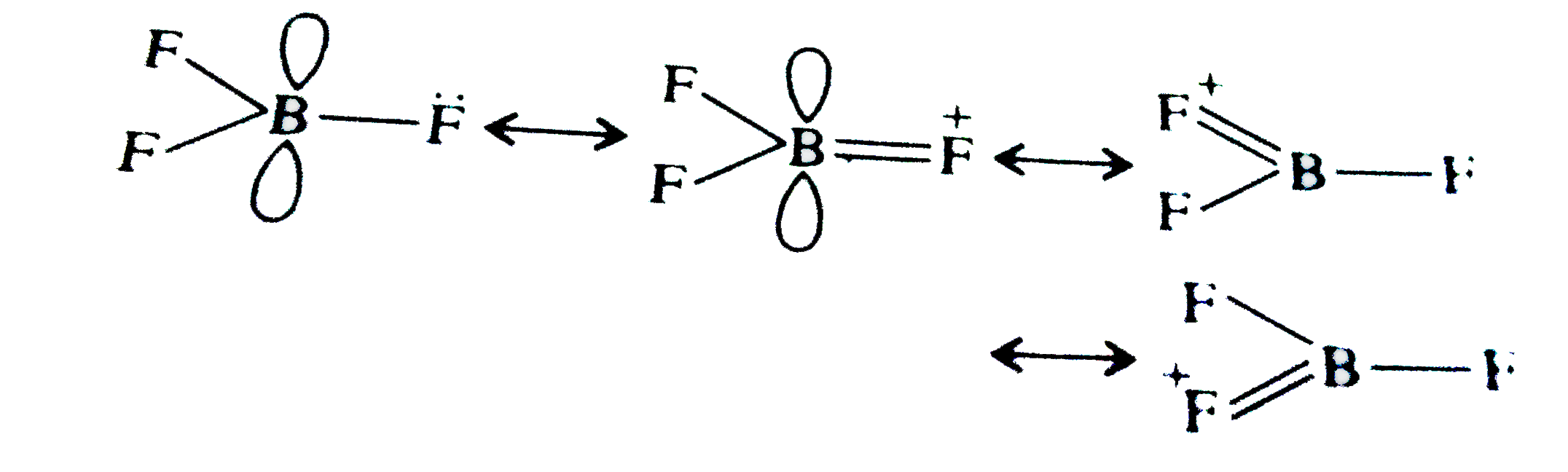
C

In `BF_(3)` there is considerable `p pi- p pi` interaction between unfilled `p`-orbital (having no electron) over boron and the lone pair of electrons over fluorine in `2p` orbital
Promotional Banner

Topper's Solved these Questions

  • CHEMICAL KINETICS

    DINESH PUBLICATION|Exercise Additional Numerical Problems For Practice|16 Videos
  • CHEMISTRY IN EVERY DAY LIFE

    DINESH PUBLICATION|Exercise Unit test-9|50 Videos

Similar Questions

Explore conceptually related problems

The bond dissociation energy of B-F in BF_(3) is "646 kJ mol"^(-1) whereas that of C-F in CF_(4) is "515 kJ mol"^(-1) . The correct reason for higher B-F bond dissociation energy as compared to that of C-F is

The bond dissociation energy of -F in BF_(3) is 646 kJ mol^(-1) whereas that of C-F in CF_(4) is 515kJ mol^(-1) . The correct reason for higher B-F bond dissociation energy as compared to that of C-F is

The bond dissociation energy of B-F bond in BF_3 is kJmol^(-1) whereas that of C-F in CF_4 is 515kJmol^(-1) . The correct reason for higher B-F bond dissociation energy as compared to that of C-F is

Bond dissociation energy of F_(2) is less that of Cl_(2) give reason.

DINESH PUBLICATION-CHEMICAL THERMODYNAMICS AND CHEMICAL ENERGETICS -Exercise
  1. Bond dissociation enthalpy of H(2) , Cl(2) and HCl are 434, 242 and 43...

    Text Solution

    |

  2. Oxidising power of chlorine in aqueous solution can be determined by t...

    Text Solution

    |

  3. The bond dissociation energy of B-F in BF(3) is 646 kJ mol^(-1) where...

    Text Solution

    |

  4. From the following bond energies H-H bond energy 431.37 kJ mol^(-1) ...

    Text Solution

    |

  5. The values of DeltaH and DeltaS for the reaction C("graphite")+CO(2)...

    Text Solution

    |

  6. For a particular reversible reaciton at temperature T, DeltaH and Delt...

    Text Solution

    |

  7. The standard enthalpy of formation of NH(3) is -46.0KJ mol^(-1) . If t...

    Text Solution

    |

  8. Standard entropy of X(2) , Y(2) and XY(3) are 60, 40 and 50JK^(-1)mol...

    Text Solution

    |

  9. The bond energy (in kcal mol^(-1)) of a C -c single bond is approximat...

    Text Solution

    |

  10. The entropy change involved in the isothermal reversible expansion of ...

    Text Solution

    |

  11. If the enthaply change for the transition of liquid water to steam is...

    Text Solution

    |

  12. Enthalpy change for the reaction 2H(2)(g)rarr4H(g) is -869.6kJ Th...

    Text Solution

    |

  13. A sample consisting of 1mol of a mono-atomic perfect gas (C(V) = (3)/(...

    Text Solution

    |

  14. A sample consisting of 1mol of a mono-atomic perfect gas (C(V) = (3)/(...

    Text Solution

    |

  15. A sample consisting of 1mol of a mono-atomic perfect gas (C(V) = (3)/(...

    Text Solution

    |

  16. A sample consisting of 1mol of a mono-atomic perfect gas (C(V) = (3)/(...

    Text Solution

    |

  17. Entropy has great importance in thermodynamics. It is a state function...

    Text Solution

    |

  18. Entropy has great importance in thermodynamics. It is a state function...

    Text Solution

    |

  19. Entropy has great importance in thermodynamics. It is a state function...

    Text Solution

    |

  20. Entropy has great importance in thermodynamics. It is a state function...

    Text Solution

    |

