Home
Class 11
PHYSICS
A cricket ball of mass 150 g is moving w...

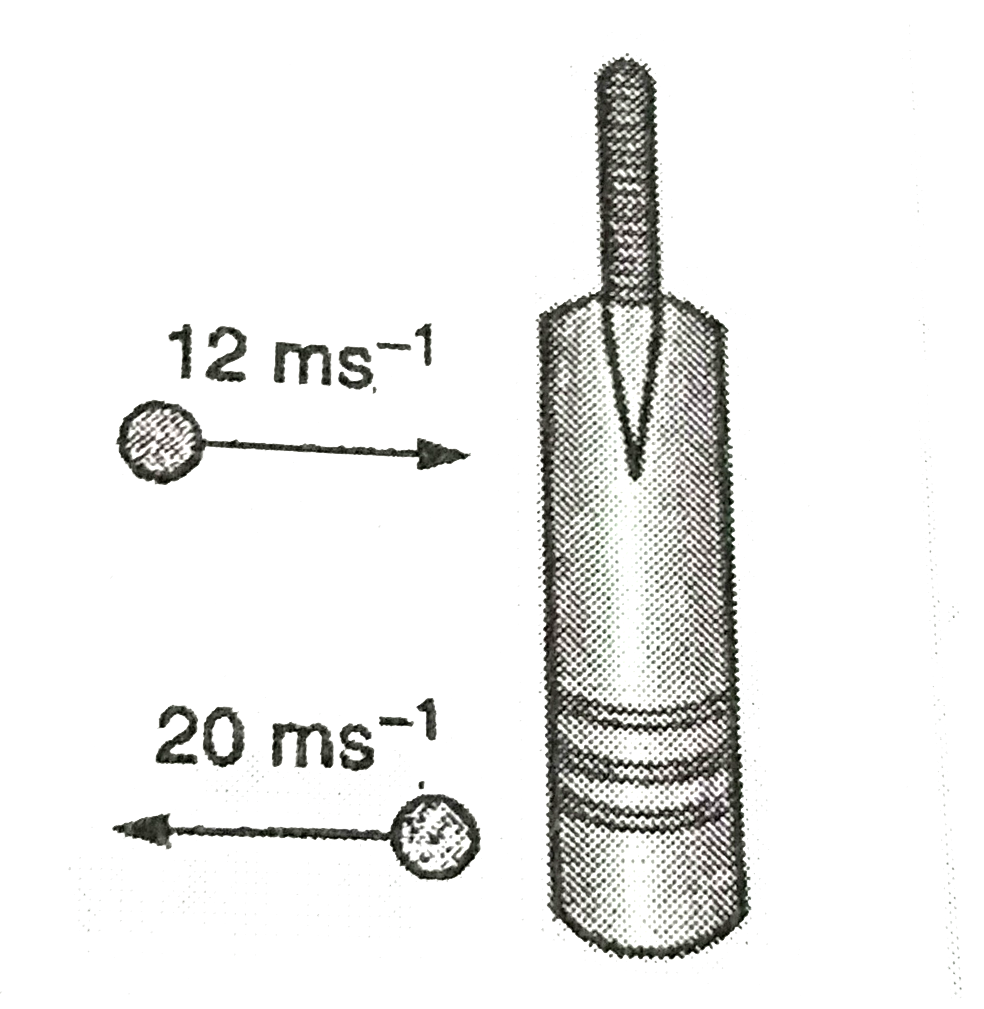
A cricket ball of mass 150 g is moving with a speed of `12ms^(-1)` and is hit by a bat so that the ball is turned back with velocity of `20ms^(-1)` if duration of contact between bat and ball is 0.01 s then:

A

`120N`

B

`280N`

C

`380N`

D

`480N`

Text Solution

Verified by Experts

The correct Answer is:

D

According to given question, change in momentum of the ball
`Deltap=p_(f)-p_(i)=m(v-u)=15xx10^(-3)[20-(-12)]`
So, by impulse- momentum theorem, impulse `I=Deltap=4.8Ns`
And by time averaged definition of force in case of impulse
`F_(av)=(I)/(Deltat)=(Deltap)/(Deltat)=(4.80)/(0.01)=480N`
Promotional Banner

Topper's Solved these Questions

  • LAWS OF MOTION

    DC PANDEY|Exercise Check point 5.1|20 Videos
  • LAWS OF MOTION

    DC PANDEY|Exercise Check point 5.2|15 Videos
  • LAWS OF MOTION

    DC PANDEY|Exercise Subjective Question|27 Videos
  • KINEMATICS 1

    DC PANDEY|Exercise INTEGER_TYPE|15 Videos
  • LAWS OF THERMODYNAMICS

    DC PANDEY|Exercise Level 2 Subjective|18 Videos

Similar Questions

Explore conceptually related problems

According to Newton s second law of motion F =ma where F is the force required to produce an acceleration a in a body of mass m If a = 0 then F = 0 no external force is required to move a body uniformly along a straight line If a force F acts on a body for t seconds the effect of the force is given by Impulse =F xx t = change in linear momentum of the body A cricket ball of mass 150g is moving with a velocity of 12m//s and is hit by a bat so that the ball is turned back with a velocity of 20m//s if duration of contact between the ball and the bat is 0.01sec The impulse of the force is .

cricket ball of mass 150 g is moving with a velocity of 12m//sec and is hit by a bat so that the ball is turned back with a velocity of 20 m//sec, the force on the ball acts for 0.01 sec, then the average force exerted by the bat on the ball will b

A cricket ball of mass 150 kg is moving with a velocity of 12 m//s and is hit by a bat so that ball is turned back with a velocity of 20 m//s . The force of the blow acts for 0.01 s on the ball . Find the average force exerted by the bat on the ball.

A cricket ball of 0.5 kg is moving with a velocity of 100ms^(-1) . The wavelength associated with its motion is :

6A cricket ball of mass 250 gm moving with a velocity of 24 m/s is hit by a bat so that it acquires a velocity of 28 m // s in the opposite direction. The force acting on the ball, if the contact time is 1//100 of a second, will be -

A ball of mass 0.5 kg moving with a velocity of 2 ms^(-1) strikes a wall normally and bounces back with the same speed. If the time of contact between the ball and the wall is one millisecond, the average force exerted by the wall on the ball is

A cricketer catches a ball of mass 150 gm. in 0.1 second moving with speed 20 ms^(–1) . Then he experiences force of : -

DC PANDEY-LAWS OF MOTION-example
  1. A batsman hits back a ball straight in the direction of the bowler wit...

    Text Solution

    |

  2. A hammer of mass 1 kg moving with speed of 6 ms^(-1) strikes a wall an...

    Text Solution

    |

  3. A cricket ball of mass 150 g is moving with a speed of 12ms^(-1) and i...

    Text Solution

    |

  4. Fig. shows an estimated force-time graph for a base ball struck by a b...

    Text Solution

    |

  5. A block of mass 25 kg is raised by a 50kg man in two different ways as...

    Text Solution

    |

  6. A bullet mass 10gm is fired from a gun of mass 1 kg . If the recoil ve...

    Text Solution

    |

  7. An explosion blows a rock into three parts. Two parts go off at right ...

    Text Solution

    |

  8. Two objects each of mass 5 kg are moving in the same straight line but...

    Text Solution

    |

  9. A riding ball of mass m strikes a rigid wall at 60^(@) and gets reflec...

    Text Solution

    |

  10. Resolve horizontally and vertically a force F= 8N which makes an angle...

    Text Solution

    |

  11. Resolve a weight of 10N in two directions which are parallel and perpe...

    Text Solution

    |

  12. An object is in equilibrium under four concurrent forces in the direct...

    Text Solution

    |

  13. Determine the tensions T(1) and T(2) in the string as shown in figure.

    Text Solution

    |

  14. One end of a string 0.5 m long is fixed to a point A and the other end...

    Text Solution

    |

  15. A block of mass m is at rest on a rough wedge as shown in figure. What...

    Text Solution

    |

  16. A cylinder of weight W is resting on a V-groove as shown in figure.Dr...

    Text Solution

    |

  17. Three blocks A,B and C are placed one over the other as shown in figur...

    Text Solution

    |

  18. A block of mass m is attached with two strings as shown in figure .Dra...

    Text Solution

    |

  19. All surfaces are smooth in following figure. Find F, such that block r...

    Text Solution

    |

  20. A bob of mass m is suspended from the ceiling of a train moving with a...

    Text Solution

    |
