Home
Class 11
PHYSICS
Block A and B of masses 5 kg and 10 kg a...

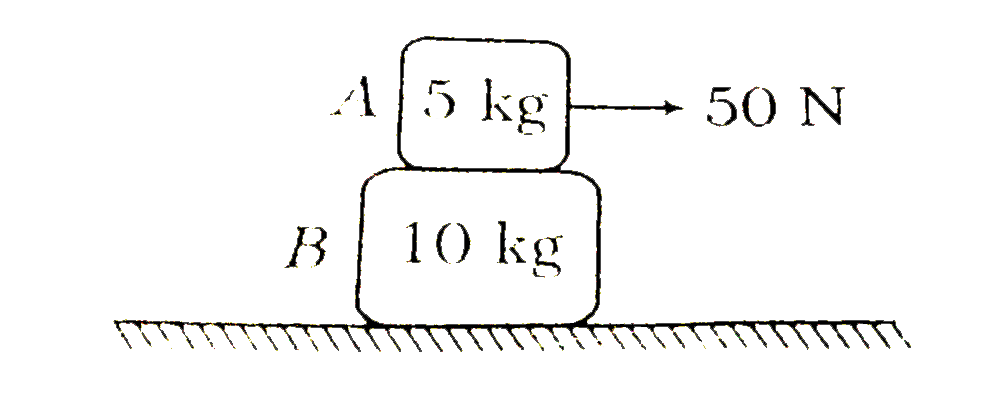
Block A and B of masses 5 kg and 10 kg are placed as shown in figure. If block A is pulled with 50 N. Find out acceleration of the A and B. If coefficient of friction between A and B is 0.5 and between B and ground is 0.4.

A

5.1 and 0

B

4 and 0

C

3 and 2

D

3.2 and 5

Text Solution

Verified by Experts

The correct Answer is:

A

Limiting friction between A and B
`f_(1)mu_(1)R_(1)=0.5xx5g=24.5N`
Limiting friction between B and ground
`f_(2)=mu_(2)R_(2)=0.4xx15g=58.8 N`
For block A, `50-f_(1)=5xxa`
`implies 50-24.5=5xxa implies a=5.1 ms^(-2)`
For block B accelerating force `f_(1)=24.5 N` is less than limiting friction `f_(2)=58.8 N`

so, block B will remain at rest.
Promotional Banner

Topper's Solved these Questions

  • LAWS OF MOTION

    DC PANDEY|Exercise Check point 5.1|20 Videos
  • LAWS OF MOTION

    DC PANDEY|Exercise Check point 5.2|15 Videos
  • LAWS OF MOTION

    DC PANDEY|Exercise Subjective Question|27 Videos
  • KINEMATICS 1

    DC PANDEY|Exercise INTEGER_TYPE|15 Videos
  • LAWS OF THERMODYNAMICS

    DC PANDEY|Exercise Level 2 Subjective|18 Videos

Similar Questions

Explore conceptually related problems

Blocks A and B of masses 5 kg and 10kg are placed as shown in figure. If block A is pulled with 50 N. Find out acceleration of the A and B. if coefficient of friction between A and B is 0.5and between B and ground is 0.4.

A is a 100kg block, and B is a 200kg block. As shown in figure the block A is attached to a string tied to a wall. The coefficient of friction between A and B is 0.2 and the coefficient of fricition between B and floor is 0.3. Then calculate the minimum force required to move the block B. (take g=10m//s^(2) ).

A block A with mass 100kg is resting on another block B of mass 200kg. As shown in figure a horizontal rope tied to a wall hold it. The coefficient of friction between A and B is 0.2 while coefficient of friction between B and the ground is 0.3 . the minimum required force F to start moving B will be.

A block A of mass 200 kg rest on a block B of mass 300 kg . A is tied with a horizontal string to a wall. Coefficient of friction between A and B is 0.25 and that between B and floor is 0.2 . The horizontal force F needed to move the block B is

Two block A and B are arrenged as shown in figure (m_(A) = 5 kg and m_(B) = 10 kg) Find the acceleration of blocks if F = 40 N

A plank of mass 10 kg and a block of mass 2 kg are placed on a horizontal plane as shown in the figure. There is no friction between plane and plank. The coefficient of friction between block and plank is 0.5 .A force of 60 N is applied on plank horizontally. In first 2 s the work done by friction on the block is

Block A and B shown in the figure are connected with a bar of negligible weight. A and B each has mass 170 kg , the coefficient of friction between A and the plane is 0.2 and that between B and the plane is 0.4 (g = 10 ms_(-2)) What is the total force of friction between the blocks and the plane?

Two blocks A and B of masses 10 kg and 15 kg are placed in contact with each other rest on a rough horizontal surface as shown in the figure. The coefficient of friction between the blocks and surface is 0.2. A horizontal force of 200 N is applied to block A. The acceleration of the system is ("Take g"=10ms^(-2))

DC PANDEY-LAWS OF MOTION-example
  1. The pulley is light and smooth: the strings are inextensible and light...

    Text Solution

    |

  2. A 2 kg mass placed on a level table and is attached by a string passin...

    Text Solution

    |

  3. A 3000 kg truck is on a cliff and is tied with a rope to a 78 kg pers...

    Text Solution

    |

  4. The strings are inextensible and light: the pulleys are smooth and li...

    Text Solution

    |

  5. Consider the situation shown in the figure. The surface is smooth and ...

    Text Solution

    |

  6. In the arrangement shown, inclined plane is smooth, strings and pulley...

    Text Solution

    |

  7. In the arrangement shown, all the surface are smooth, strings and pull...

    Text Solution

    |

  8. In the adjacent figure, mass of A, B and C are 1 kg , 3 kg and 2 kg, r...

    Text Solution

    |

  9. Calculate the net acceleration produced in the arrangement shown below...

    Text Solution

    |

  10. Suppose a block of mass 1kg is placed over a rough surface and a horiz...

    Text Solution

    |

  11. Block A and B of masses 5 kg and 10 kg are placed as shown in figure. ...

    Text Solution

    |

  12. A block A of mass 4 kg is placed on another block B of mass 5 kg , and...

    Text Solution

    |

  13. A body of mass 10 kg is kept on a horizontal floor of coefficient of s...

    Text Solution

    |

  14. In the adjoining figure, the coefficient of friction between wedge ( o...

    Text Solution

    |

  15. If the coefficient of friction between an insect and bowl is mu and th...

    Text Solution

    |

  16. A block of mass 5 kg rests on a inclined plane at an angle of 30^(@) w...

    Text Solution

    |

  17. A block of wood of 1 kg resting on an inclined plane of angle 30^(@), ...

    Text Solution

    |

  18. A rod AB rests with the end A on rough horizontal ground and the end B...

    Text Solution

    |

  19. A 4 m long ladder weighing 25 kg rests with its upper end against a sm...

    Text Solution

    |

  20. A block of mass 1kg is pushed against a rough vertical wall with a for...

    Text Solution

    |
