Home
Class 11
PHYSICS
The stress versus strain graphs for wire...

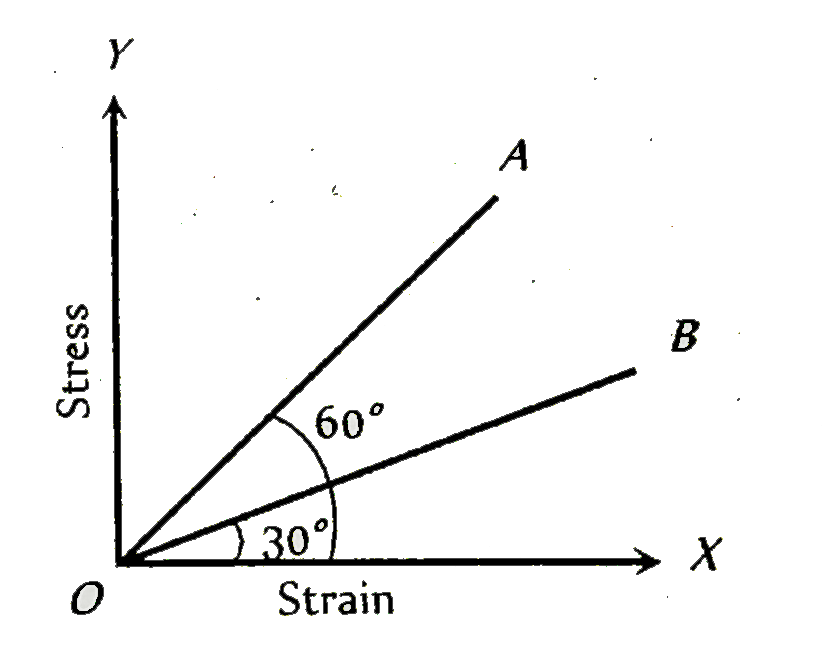
The stress versus strain graphs for wires of two materials A and B are as shown in the figure. If `Y_(A) and Y_(B)` are the younng's moduli of the materials, then

A

`Y_(B)=2Y_(A)`

B

`Y_(A)=Y_(B)`

C

`Y_(B)=3Y_(A)`

D

`Y_(A)=3Y_(B)`

Text Solution

Verified by Experts

The correct Answer is:

D

(d) `(Y_(A))/(Y_(B))=("tan"theta_(A))/("tan"theta_(B))=("tan"60^(@))/("tan"30^(@))=(sqrt(3))/(1//sqrt(3))=3 implies Y_(A)=3Y_(B)`
Promotional Banner

Topper's Solved these Questions

  • ELASTICITY

    DC PANDEY|Exercise Match the columns|4 Videos
  • ELASTICITY

    DC PANDEY|Exercise Medical entrances s gallery|21 Videos
  • ELASTICITY

    DC PANDEY|Exercise Check point 12.3|15 Videos
  • CURRENT ELECTRICITY

    DC PANDEY|Exercise All Questions|434 Videos
  • ELECTROSTATICS

    DC PANDEY|Exercise Integer|17 Videos

Similar Questions

Explore conceptually related problems

The stress versus strain graphs for wires of two materials A and B are as shown in the figure. If YA and YB are the Young's moduli of the materials then

The stress- strain graphs for materials A and B are as shown. Choose the correct alternative

The stress and strain graphs for two materials, A and B are shown here. Answer the following: give reasons

The stress versus strain graph for two materials A and B are shown in fig. the graph are on the same scale. ltbr. (a) Which materail has greater Young's modulus? (b) which of the two is stronger materail?

The stress-strain graphs for two materials A and B are shown in the figure. The graphs are drawn to the same scale. (a) Which material has a greater Young's modulus ? (b) Which material is more ductile ? (c) Which material is more brittle? (d) Which of the two is the stronger material ?

The stress-strain graphs for two materials are shown in Fig. 7(EP).3 (assume scale).

The stress-strain graphs for two materials A and are shown in figure. The graphs are drawn to the same scale. Select the correct statement

The strain stress curves of three wires of different materials are shown in the figure. P, Q and R are the elastic limits of the wires. The figure shown that

The load versus elongation graph for four wires of the same material is shown in the figure. The thickest wire is represented by

Materials get deformed when force is applied. Some of them regain their status when the applied force is removed. They are termed as elastic. Those of which not regaining are called plastic. There may be delay in the regaining in some materials. They are said to have got elastic aftereffect, since they have gone beyond the elastic limit. Repeated application and removal of force leads to fatigueness in the material. Fatigued materials may break at any point time and so are avoided. The stress strain graph for two materials A and B is shown in the following figure: The time in which the two materials regain their original status is t_(A) and t_(B) related as t_(B)=2t_(B) . Then the material under elastic aftereffect (relatively) is

DC PANDEY-ELASTICITY-Chapter Exercise
  1. A rubber pipe of density 1.5 xx 10^(3) N//m^(2) and Young's modulus 5 ...

    Text Solution

    |

  2. In the given Fig. 7(CF).2, if the dimensions of the two wires are the ...

    Text Solution

    |

  3. The stress versus strain graphs for wires of two materials A and B are...

    Text Solution

    |

  4. An elevator cable is to have a maximum stress of 7xx10^(7) Nm^(-2) to ...

    Text Solution

    |

  5. The following four wires are made of same material. Which of these wil...

    Text Solution

    |

  6. A copper wire (Y=10^(11) Nm^(-2)) of length 8 m and a steel wire (Y=2x...

    Text Solution

    |

  7. The strain stress curves of three wires of different materials are sho...

    Text Solution

    |

  8. The extension in a string obeying Hooke's law is x. The speed of sound...

    Text Solution

    |

  9. The potential energy U between two molecules as a function of the dist...

    Text Solution

    |

  10. The diagram shows a forc-extension graph for a rubber band. Consider...

    Text Solution

    |

  11. Consider two cylindrical rods of indentical dimesnions, one of rubber ...

    Text Solution

    |

  12. The adjacent graph shows the extension Deltal of a wire of length 1m...

    Text Solution

    |

  13. A brass of length 2 m and cross-sectional area 2.0 cm^(2) is attached ...

    Text Solution

    |

  14. One end of uniform wire of length L and of weight W is attached rigidl...

    Text Solution

    |

  15. The wire of a Young's modules appartus is elongated by 2 mm when a bri...

    Text Solution

    |

  16. A rigid bar of mass M is supported symmetrically by three wires each o...

    Text Solution

    |

  17. A cord of mass m length L, area of cross section A and Young's modulus...

    Text Solution

    |

  18. The density of a metal at normal pressure is rho. Its density when it ...

    Text Solution

    |

  19. One end of a long metallic wire of length (L) is tied to the ceiling. ...

    Text Solution

    |

  20. The length of an elastic string is a metre when the longitudinal tens...

    Text Solution

    |
