Home
Class 12
PHYSICS
A ray of light passes through four trans...

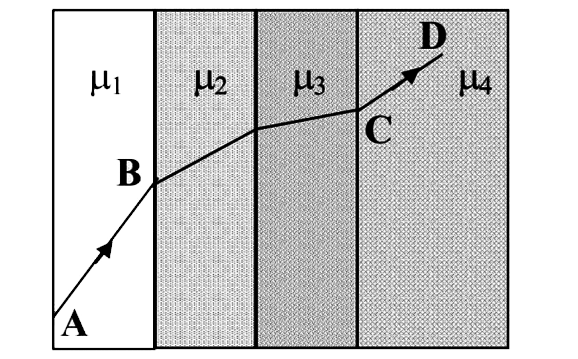
A ray of light passes through four transparent media with refractive indices`mu_1`,`mu_2`,`mu_3` and `mu_4` as shown in the figure. The surfaces of all media are parallel. If the emergent ray CD is parallel to the incident ray AB, we must have

A

`mu_(1) = mu_(2)`

B

`mu_(2) = mu_(3)`

C

`mu_(3) = mu_(4)`

D

`mu_(4) = mu_(1)`

Text Solution

Verified by Experts

The correct Answer is:
D

Applying Snell's law at B and C ,

`mu "sin"1 ` = constant or `mu_(1) "sin" I_(B)= mu_(4) "sin" i_(C)`
But `AB || CD therefore i_(B) = i_(C) "or" mu_(1) = mu_(4)`
Promotional Banner

Topper's Solved these Questions

Similar Questions

Explore conceptually related problems

A ray of light passes through four transpar ent media with refractive indices mu_(1),mu_(2), mu_(3) and mu_(4) as shown in figure. The surfaces of all media are parallel. If the emergent ray is parallel to the incident ray, we must hav

Path of ray of light passing through three liquids of refractive indices mu_1,mu_2,mu_3 is as shown in Fig. Which liquid has the smallest index of refraction ? .

Path of a ray of light passing through three liquids of reflective indices mu_(1), mu_(2), mu_(3) is as shown in Fig. Which liquid has the smallest index of reflection ?

A ray of light passes through a transparent sphere of refractive index mu and radius R. If b is the distance between the incident ray and diameter of the sphere which is parallel to that ray, What is the value of the deviation?

A rectangular block is composed of three different glass prisms (with refractive indices mu_(1), mu_(2) and mu_(3) ) as shown in the figure below. A ray of light incident normal to the left face emerges normal to the right face. Then the refractive indices are related by

What is the relation between the refractive indices mu,mu_(1) and mu_(2) if the behaviour of light rays is shown in Figure.

A ray of light passes through a plane boundary separating two media whose refractive indics are mu_(1) = 3//2 and mu_(2) = 4//3 . (i) If the ray travels from medium 1 to medium 2 at an angle of incidence of 30^(@) , what is the angle of refraction ? (ii) If the ray travels form medium 2 to medium 1 at the same angle of incidence, what is the angle of refraction ?

A ray of light falls on a transparent sphere with centre at C as shown in figure. The ray emerges from the sphere parallel to line AB. The refractive index of the sphere is

ALLEN-GEOMETRICAL OPTICS-EXERCISE-05 (B)
  1. A point source of light ,S is placed at a distance L in front of th...

    Text Solution

    |

  2. A rectangular glass slab ABCD of refractive index n(1) is immerged in ...

    Text Solution

    |

  3. A ray of light passes through four transparent media with refractive i...

    Text Solution

    |

  4. A given ray of light suffers minimum deviation in an equilateral prism...

    Text Solution

    |

  5. An observer can see through a pin-hole the top end of a thin rod of he...

    Text Solution

    |

  6. Which one of the following spherical lenses does not exhibit dispersio...

    Text Solution

    |

  7. Two plane mirrors A and B are aligned parallel to each other, as shown...

    Text Solution

    |

  8. The size of the image of an object, which is at infinity, as formed by...

    Text Solution

    |

  9. A ray of light is incident at the glass-water interface at an angle I,...

    Text Solution

    |

  10. White light is incident on the interface of glass and air as shown in ...

    Text Solution

    |

  11. An equilateral prism is placed on a horizontal surface. A ray PQ is in...

    Text Solution

    |

  12. A point object is placed at the centre of a glass sphere of radius 6cm...

    Text Solution

    |

  13. A container is filled with water (mu=1.33) upto a height of 33.25 cm. ...

    Text Solution

    |

  14. A convex lens if in contact with concave lens. The magnitude of the ra...

    Text Solution

    |

  15. A point object is placed at distance of 20 cm from a thin plane - con...

    Text Solution

    |

  16. A biconvex lens of focal length f forms a circular image of radius r o...

    Text Solution

    |

  17. A ray of light travelling in water is incident on its surface open to ...

    Text Solution

    |

  18. In an experiment to determine the focal length (f) of a concave mirror...

    Text Solution

    |

  19. Two beams of red and violet colours are made to pass separately throug...

    Text Solution

    |

  20. A light beam is traveling from Region I to region IV (refer figure). T...

    Text Solution

    |

