Home
Class 12
PHYSICS
A given ray of light suffers minimum dev...

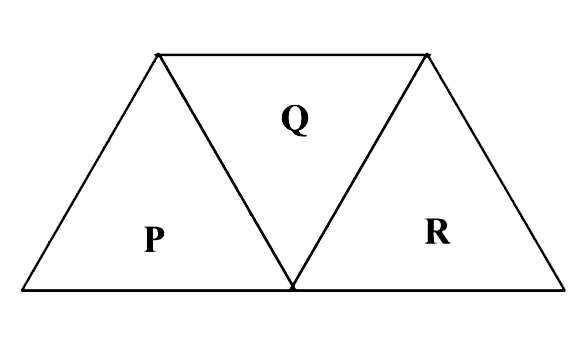
A given ray of light suffers minimum deviation in an equilateral prism P. Additional prism Q and R of identical shape and of the same material as P are now added as shown in the figure. The ray will now suffer

A

greater deviation

B

no deviation

C

same deviation

D

Total internal reflection at point P ceases if the refractive index of water is increased to 5/6 by dissolving some substance

Text Solution

Verified by Experts

The correct Answer is:
C

Figure (a) is part of an equilateral prism of figure(b) as shown in figure which is a magnified image of figure(c).

Therefore , the ray will suffer the same deviation in figure (a) and figure (c).
Promotional Banner

Topper's Solved these Questions

Similar Questions

Explore conceptually related problems

A given ray of light suffers minimum deviation in an equilateral prism P. Additional prism Q and R of identical shape and of the same material as P are now added as shown in figure. The ray will now suffer

A ray of light suffers a minimum deviation when incident on equilateral prism of refractive index sqrt2 The angle of deviation is

A ray of light suffers minimum deviation when incident on an equilateral prism of refractive index sqrt2 . What is the angle of incidence ?

A ray of light suffers a minimum deviation when incident on an equilateral prism of refractive index sqrt(2) The angle of incidence is

A ray of light suffers a deviation of 3.2^(@) on passing through a thin prism of angle 5^(@) . What is the refractive index of the material of the prism ?

A ray of light suffers minimum deviation while passing through a prism of refracting angle A . If the angle of incidence i = Refractive angle and n = sqrt3 , find the angle of the prism .

A ray of monochromatic light suffers minimum deviation of 38^(@) while passing through a prism of refracting angle 60^(@) . Refracting index of the prism material is

ALLEN-GEOMETRICAL OPTICS-EXERCISE-05 (B)
  1. A rectangular glass slab ABCD of refractive index n(1) is immerged in ...

    Text Solution

    |

  2. A ray of light passes through four transparent media with refractive i...

    Text Solution

    |

  3. A given ray of light suffers minimum deviation in an equilateral prism...

    Text Solution

    |

  4. An observer can see through a pin-hole the top end of a thin rod of he...

    Text Solution

    |

  5. Which one of the following spherical lenses does not exhibit dispersio...

    Text Solution

    |

  6. Two plane mirrors A and B are aligned parallel to each other, as shown...

    Text Solution

    |

  7. The size of the image of an object, which is at infinity, as formed by...

    Text Solution

    |

  8. A ray of light is incident at the glass-water interface at an angle I,...

    Text Solution

    |

  9. White light is incident on the interface of glass and air as shown in ...

    Text Solution

    |

  10. An equilateral prism is placed on a horizontal surface. A ray PQ is in...

    Text Solution

    |

  11. A point object is placed at the centre of a glass sphere of radius 6cm...

    Text Solution

    |

  12. A container is filled with water (mu=1.33) upto a height of 33.25 cm. ...

    Text Solution

    |

  13. A convex lens if in contact with concave lens. The magnitude of the ra...

    Text Solution

    |

  14. A point object is placed at distance of 20 cm from a thin plane - con...

    Text Solution

    |

  15. A biconvex lens of focal length f forms a circular image of radius r o...

    Text Solution

    |

  16. A ray of light travelling in water is incident on its surface open to ...

    Text Solution

    |

  17. In an experiment to determine the focal length (f) of a concave mirror...

    Text Solution

    |

  18. Two beams of red and violet colours are made to pass separately throug...

    Text Solution

    |

  19. A light beam is traveling from Region I to region IV (refer figure). T...

    Text Solution

    |

  20. A ball is dropped from a height of 20 m above the surface of water in ...

    Text Solution

    |

