Home
Class 12
PHYSICS
Figure shows a system consisting of a ma...

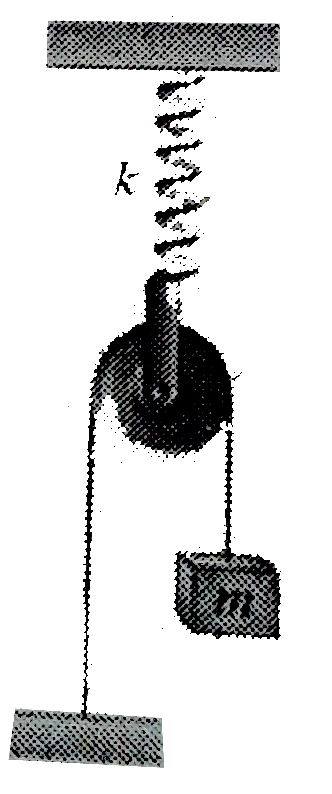
Figure shows a system consisting of a massless pulley, a spring of force constant k and a block of mass m. If the block is slightly displaced vertically down from is equilibrium position and then released, the period of its vertical oscillation is

Text Solution

Verified by Experts

Case (A)
As the pully is fixed and string in inexrensible, if mass m is displaced by y the spring will stretch by y, and as there is no mass between string and spring (as pully is massless) `F = T = ky` i.e., restoring force is linear and so motion of mass m will be linear simple harmonic with frequnecy
`n_(A) = (1)/(2pi) sqrt((k)/(m)) = 1/(2pi) sqrt((4000)/(1)) ~~ 10 Hz`

Case (B) :
The pulley is mobale and string inetensible, so if mass m moves down a distance y, the pulley will move down by `(y//2)`.
Now as pulley is massless `F = 2T, rArr T = f//2 = (k//4y)`.
So the force in the spring `F = k(y//2)`
So, `n_(B) = (1)/(2pi)sqrt((k)/(m)) = (1)/(2pi) sqrt((k)/(4m)) = (n_(A))/(2) = 5 Hz`

Case (C) :
In this sitution if the mass m moves by y the pulley will also move by y and so the string will stretch by `2y` (as string is inextensible) and so `T' = F = 2ky`.Now as pulley is massless so `T = F + T' = 4ky`, i.e., the restoring force on the mass m
`T = 4ky = k' = 4k`
so `n_(C) = (1)/(2pi)sqrt((k')/(m)) = (1)/(2pi)sqrt((4k)/(m)) = 2n_(A) = 20 Hz`
Promotional Banner

Topper's Solved these Questions

  • SIMPLE HARMONIC MOTION

    ALLEN|Exercise Exercise-01|117 Videos
  • SIMPLE HARMONIC MOTION

    ALLEN|Exercise Exercise-02|19 Videos
  • RACE

    ALLEN|Exercise Basic Maths (Wave Motion & Dopplers Effect) (Stationary waves & doppler effect, beats)|25 Videos
  • TEST PAPER

    ALLEN|Exercise PHYSICS|4 Videos

Similar Questions

Explore conceptually related problems

Figure shows a system consisting of a massless pulley, a spring of force constant k and ablock of mass m. If the block is slightly displaced vertically down from its equillibrium position and then released, find the period of its vertical oscillation in cases (a) & (b).

Figure shows a system consisting of a massles pulley, a spring of force constant k and a block of mass m . If the block is sligthtly displaced vertically down from its equilibrium and released, find the period of its vertical oscillation in cases (a) and (b).

Figure shows a system consisting of pulley having radius R, a spring of force constant k and a block of mass m. Find the period of its vertical oscillation.

In the following arrangements, bock is slightly displaced vertically down from its equilibrium position and released. Find time period of vertical oscillations. The pulley is light.

A system shown in the figure consists of a massless pulley, a spring of force constant k displaced vertically downwards from its equilibrium position and released, then the Period of vertical oscillations is

A block of mass m hangs from a vertical spring of spring constant k. If it is displaced from its equilibrium position, find the time period of oscillations.

A rectangular tank having base 15 cm xx 20 cm is filled with water (density rho = 1000 kg//m^(2)) up to 20 cm and force constant K = 280 N//m is fixed to the bottom of the tank so that the spring remains vertical. This sysytem is in an elevator moving downwards with acceleration a = 2 m//s^(2) . A cubical block of side l = 10 cm and mass m = 2 kg is gently placed over the spring and released gradually, as shown in the figure. a. Calculate compression of the spring in equilibrium position. b. If the block is slightly pushed down from equilibrium position and released, calculate frequency of its vertical oscillations.

Find the time period of mass M when displaced from its equilibrium position and then released for the system shown in figure.

A block of mass m is connected with two ideal pullies and a massless spring of spring constant K as shown in figure. The block is slightly displaced from its equilibrium position. If the time period of oscillation is mupisqrt(m/K) . Then find the value of mu .