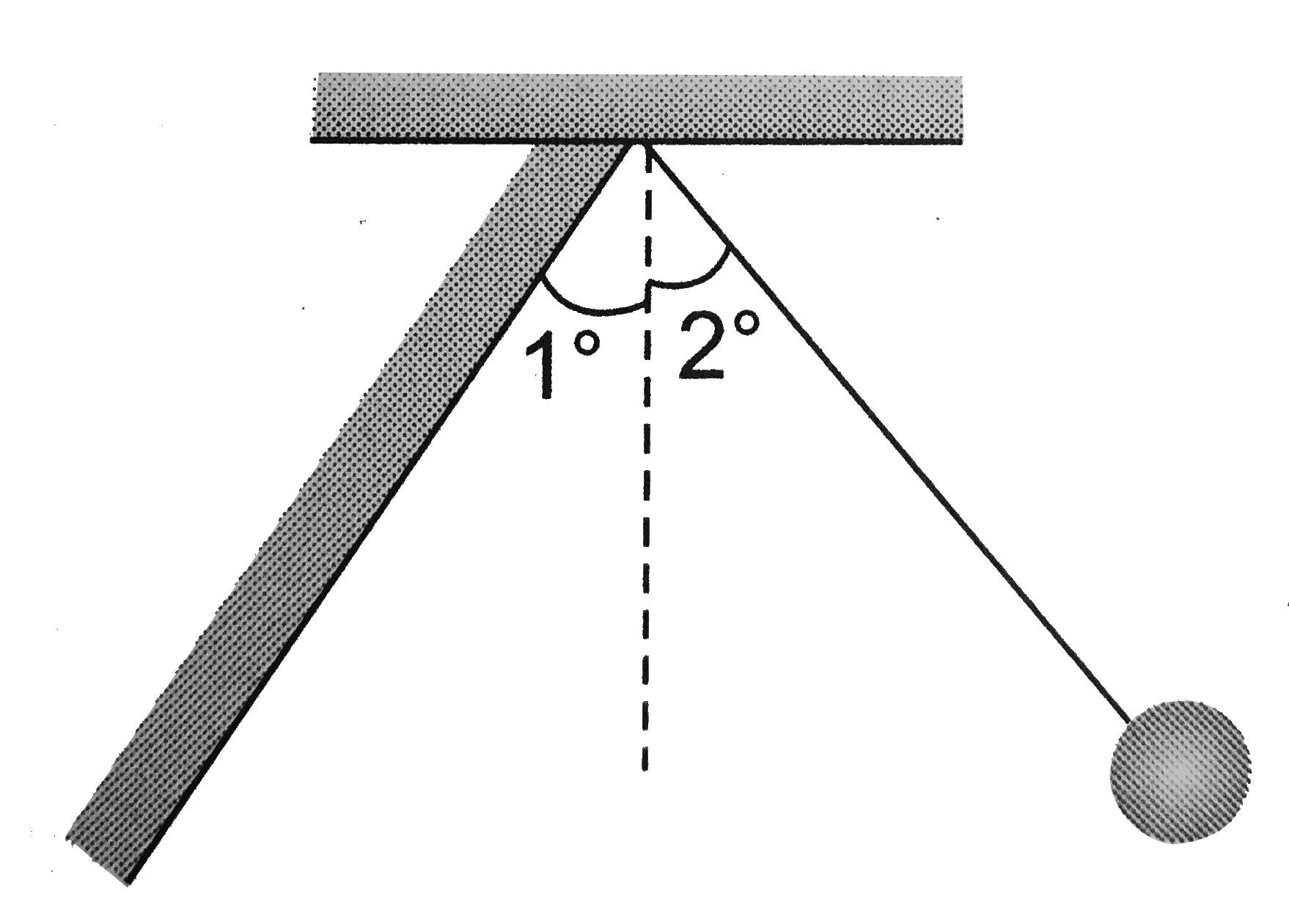
A simple pendulum of length `1m` is allowed to oscillate with amplitude `2^(@)`. it collides at `T` to the vertical its time period will be (use `g = pi^(2)`)
A
`2//3 sec`
B
`4//3 sec`
C
`2 sec`
D
None of these
Text Solution
Verified by Experts
The correct Answer is:
B
Time period for half part : `T = 2pi sqrt((l)/(g)) = 2pisqrt((1)/(g)) = (2pi)/(pi) = 2` sec. So `2^(@)` part will be covered in a time `t = (T)/(2) = 1 sec`. For the left `1^(@)` part : `theta = theta_(0) sin(omegat) rArr 1^(@) = 2^(@)sin((2pi)/(T) xxt) rArr (1)/(2) = sin ((2pi)/(2) xx t) rArr (pi)/(6) = pi xx t rArr t = 1//6 sec` Total time `= T/2 + 2t rArr 1 + 2 xx (1)/(6) = 1 + 1/3 = 4/3 ` sec.
A simple pendulum of length 1m is allowed to oscillate with amplitude 2^(@) . it colliates at T to the verticle its time period will be (use g = pi^(2) )
A simple pendulum of length l is made to oscillate with an amplitude of 45 degrees. The acceleration due to gravity is g. Let T_(0) = 2pi sqrt(l//g) . The time period of oscillation of this pendulum will be -
A simple pendulum of length 'L' has mass 'M' and it oscillates freely with amplitude energy is (g = acceleration due to gravity)
A simple pendulum of length 1 m, and energy 0.2 J, oscillates with an amplitude 4 cm. When its length is doubled then the energy of oscillation will be
A simple pendulum oscillates in air with time period T and amplitude A . As the time passes
The periodic time of a simple pendulum of length 1 m and amplitude 2 cm is 5 seconds. If the amplitude is made 4 cm , its periodic time in seconds will be