Home
Class 12
PHYSICS
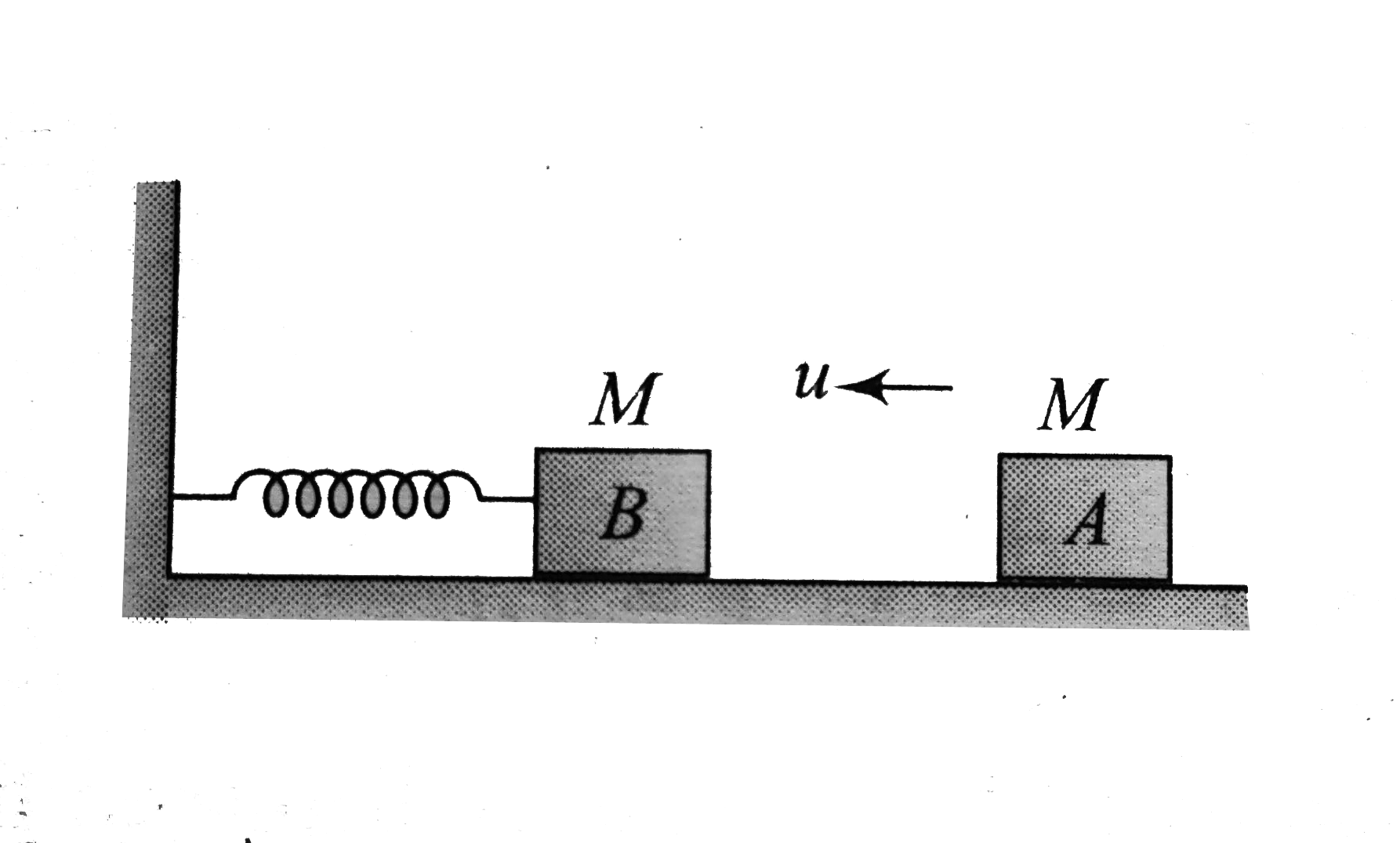
In the figure shown, the block A of mass...

In the figure shown, the block A of mass m collides with the identical block B and after collision they stick together. Calculate the amplitude of resulatant vibration.

Text Solution

Verified by Experts

The correct Answer is:

B

Common velocity after collision be v than by COLM
`2Mv = Mu rArr v = (u)/(2)`
Hence, kinetic energy
`= 1/2` energy
`= 1/2(2M)(u/2)^(2) = 1/4Mu^(2)`
It is also the total energy of vibration because the spring is unstretched at this moment, hence if A is the amplitude, then
`1/2 KA^(2) = 1/4 Mu^(2) rArr A = (sqrt((M)/(2K)))u`
Promotional Banner

Topper's Solved these Questions

  • SIMPLE HARMONIC MOTION

    ALLEN|Exercise Exercise-05 [A]|39 Videos
  • SIMPLE HARMONIC MOTION

    ALLEN|Exercise Exercise-05 [B]|12 Videos
  • SIMPLE HARMONIC MOTION

    ALLEN|Exercise Comprehension Base Questions (5)|3 Videos
  • RACE

    ALLEN|Exercise Basic Maths (Wave Motion & Dopplers Effect) (Stationary waves & doppler effect, beats)|25 Videos
  • TEST PAPER

    ALLEN|Exercise PHYSICS|4 Videos

Similar Questions

Explore conceptually related problems

The left block in figure collides inelastically with the right block and sticks to it. Find the amplitude of the resulting simple harmonic motion.

The left block in filgure collides inelastically with the right block and sticks to it. Find the amplitude of the resulting simple harmonic motion.

The left block in figure collides inelastically with the right block and striks to it. Find the amplitude of the resulting simple harmonic motion

A block of mass 'm' collides perfectly inelastically with another identical block connected to a spring of of force constant 'K'. The amplitude of resulting SHM will be

In the figure shown the block A collides head on with another block B at rest. Mass of B is twice the mass of A. The block A stops after collision. The co-efficient of restitution is :

On a friction surface a block a mass M moving at speed v collides elastic with another block of same mass M which is initially at rest . After collision the first block moves at an angle theta to its initial direction and has a speed (v)/(3) . The second block's speed after the collision is

A ball of mass 0.50 kg moving at a speed of 5.0 m/s collides with another ball of mas 1.0 kg. After the collision the balls stick together ane remain motionless. What was the velocity of the 1.0 kg block before the collision?

A block having mass m collides with an another stationary block having mass 2m. The lighter block comes to rest after collision. If the velocity of first block is v, then the value is coefficient of restitution will must be

On a frictionless surface,a block of mass M moving at speed v collides elastically with another block of same mass M which is initially at rest.After collision the first block moves at an angle theta to its initial direction and has a speed (v)/(3) .The second block's speed after the collision is ?

ALLEN-SIMPLE HARMONIC MOTION-Exercise-04 [A]
  1. A particle simple harmonic motion completes 1200 oscillations per minu...

    Text Solution

    |

  2. Find the resulting amplitude A' and the phase of the vibrations delta ...

    Text Solution

    |

  3. A particle is executing SHM given by x = A sin (pit + phi). The initia...

    Text Solution

    |

  4. The shortest distance travelled by a particle executing SHM from mean ...

    Text Solution

    |

  5. Two particle A and B execute SHM along the same line with the same amp...

    Text Solution

    |

  6. A body executing S.H.M. has its velocity 10cm//s and 7 cm//s when its ...

    Text Solution

    |

  7. A particle executing a linear SHM has velocities of 8 m/s 7 m/s and 4 ...

    Text Solution

    |

  8. A particle is oscillating in a stright line about a centre of force O,...

    Text Solution

    |

  9. The displacement of a particle varies with time as x = 12 sin omega t ...

    Text Solution

    |

  10. A point particle if mass 0.1 kg is executing SHM of amplitude 0.1 m. W...

    Text Solution

    |

  11. A body of mass 1 kg suspended an ideal spring oscillates up and down. ...

    Text Solution

    |

  12. The potential energy (U) of a body of unit mass moving in a one-di...

    Text Solution

    |

  13. A body of mass 1.0 kg is suspended from a weightless spring having for...

    Text Solution

    |

  14. In the figure shown, the block A of mass m collides with the identical...

    Text Solution

    |

  15. A block of mass 1kg hangs without vibrations at the end of a spring wi...

    Text Solution

    |

  16. A small ring of mass m(1) is connected by a string of length l to a sm...

    Text Solution

    |

  17. Calculate the time period of a uniform square plate of side 'a' if it ...

    Text Solution

    |

  18. Two identical rods each of mass m and length L, are tigidly joined and...

    Text Solution

    |

  19. A half ring of mass m, radius R is hanged at its one end its one end i...

    Text Solution

    |

  20. The two torsion pendula differ only by the addition of cylindrical mas...

    Text Solution

    |
