Home
Class 10
CHEMISTRY
From the part of the periodic table give...

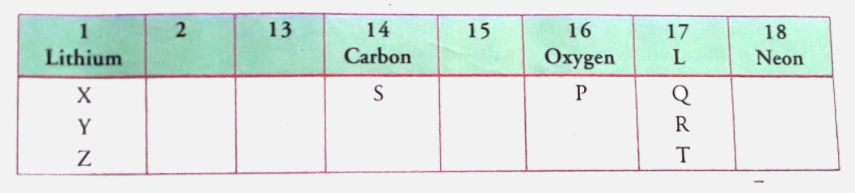
From the part of the periodic table given, answer the following questions.

(a) Which is the most reactive metal ? (b) Name the family of L, Q, R, T.
(c) Name one element of group 2 and 15, (d) Name one member of group 18 other than neon. (e) Give the name of the element S placed below carbon in group 14.

Text Solution

Verified by Experts

(a) The element Z is the most reactive metal. (b) The elements are present in group 17. The family is that of halogens. (c) One element belonging to group 2 is ~0cium (Ca) while one present in to group 15 is nitrogen (N). (d) The element argon (Ar) is also present m group 18.
(e) The element is silicon (Si).
Promotional Banner

Topper's Solved these Questions

  • PERIODIC CLASSIFICATION OF ELEMENTS

    DINESH PUBLICATION|Exercise HIGHER ORDER THINKING SKILL BASED QUESTIONS|4 Videos
  • PERIODIC CLASSIFICATION OF ELEMENTS

    DINESH PUBLICATION|Exercise Test Your Knowledge (Very Short Answer Questions)|15 Videos
  • PERIODIC CLASSIFICATION OF ELEMENTS

    DINESH PUBLICATION|Exercise Short Ansewer Questions|41 Videos
  • METALS AND NON-METALS

    DINESH PUBLICATION|Exercise MCQ|64 Videos

Similar Questions

Explore conceptually related problems

Name the element P placed below Carbon in group 14:

(a) Electropositive nature of the element(s) increases down the group and decreases across the period (b) Electronegativity of the element decreases down the group and increases across the period (c) Atomic size increase down the group and decreases across a period (left to right) (d) Metallic character increases down the group and decreases across a period On the basis of the above trends of the periodic table, answer the following about the electron with atomic number 3 to 9 (a) Name the most electropositive element among them (b) Name the most electronegative element (c) Name of the element with smallest atomic size (d) Name the element which is a metalloid (e) Name the element which shows maximum valency.

Study the following table in which positions of six elements A,B,C,D,E and F are shown as they are in the modern periodic table. On the basis of the above table, answer the following question : (i) Name the element which form only covalent compounds. (ii) Name the element which is a metal with valency three. (iii) Name the element which is a non-metal with valency three. (iv) Out of D and E, which is bigger in size and why ? (iv) Write the common name for the family to which the elements C and F belongs.

Consider the elements of period 2 in the modern periodic table. Answer the following questions with explanation. Name the element in which both the shells are completely filled with electrons.

Devendra was told that the elements P,Q and R belong to group 2 , group 14 and group 17, respectivelhy, of the long form of periodic table. Based on this information, he was asked to answer the following questions: (a) What is the valency of (i) element P (ii) element Q and (iii) element R ? Give reasons for your answer. (b) What is nature of oxide of (i) element P (ii) element Q and (iii) element R ? Give reasons for your answer. (c) Give one example each of (i) element P (ii) element Q and (iii) element R . (d) Name three elements which occur in the same group as element R but exist in three different physical states at room temperature. (e) What values are displayed by Devendra in answering these question?

A group of materials 'P' can be sub-divided into three groups 'Q', 'R' and 'S' as the basis of their characteristics The substance belonging to group 'Q' may be solid, liquids and gases. These are poor conduction of electricity. The substances included in group 'R' are solids which are good conductors of electricity. Group 'S' consists of substances which have the characteristics common to the substances belonging to groups 'Q' and 'R'. Based upon the above observations, answer the following questions : (a) To which class of substances materials present in group 'P' belong ? (b) Name the type of substances 'Q'. Give two examples. (c ) Name the type of substances 'R'. Give two examples. (d) Name the type of substances 'S'. Give two examples.

DINESH PUBLICATION-PERIODIC CLASSIFICATION OF ELEMENTS-Long Answer Questions
  1. The atomic radii of the elements of second period are given below: ...

    Text Solution

    |

  2. 'The atomic number of Cl is 17. On the basis of this information, answ...

    Text Solution

    |

  3. The list of the elements present in the same period but in different g...

    Text Solution

    |

  4. An element E has following electronic configuration : {:(K,L,M,),(2,...

    Text Solution

    |

  5. From the part of the periodic table given, answer the following questi...

    Text Solution

    |

  6. Atomic number of an element is 16. Predict. (i) the number of valenc...

    Text Solution

    |

  7. (a) How are the following related ? (i) Number of valence electrons ...

    Text Solution

    |

  8. The position of some elements A, B, C, D, E, F, and G in the Modern Pe...

    Text Solution

    |

  9. (a) The modern periodic table has been evolved through the early ...

    Text Solution

    |

  10. An element is placed in 2^("nd") group and 3^("rd") period of the peri...

    Text Solution

    |

  11. An element X (atomic number 17) reacts with an element Y (atomic numbe...

    Text Solution

    |

  12. Atomic number of few elements are given below 10, 20, 7, 14 (a) Iden...

    Text Solution

    |

  13. (a) In this ladder (Figure) symbols of elements are jumbled up. Rearra...

    Text Solution

    |

  14. Complete the following crossword puzzle (Figure) Across (1) An ele...

    Text Solution

    |

  15. Mendeleev predicted the existence of certain elements not known at tha...

    Text Solution

    |

  16. (a) Electropositive nature of the element(s) increases down the group ...

    Text Solution

    |

  17. An element X which is a yellow solid at room temperature shows catenat...

    Text Solution

    |

  18. An element X of group 15 exists as diatomic molecule and combines with...

    Text Solution

    |

  19. Which group of elements could be placed in mendeleev's periodic table ...

    Text Solution

    |

  20. Give an account of the process adopted by Mendeleev for the classifica...

    Text Solution

    |
