Home
Class 10
CHEMISTRY
The position of some elements A, B, C, D...

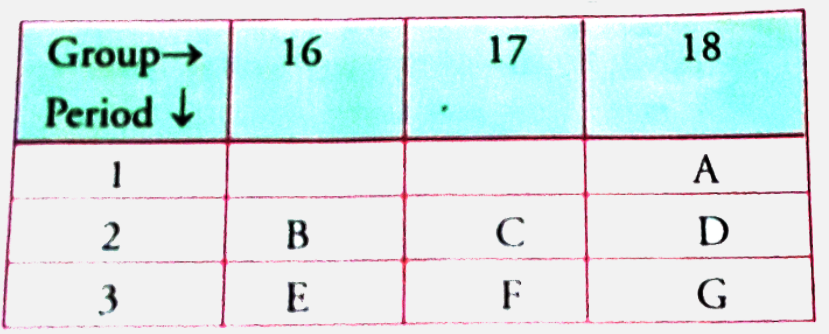
The position of some elements A, B, C, D, E, F, and G in the Modern Periodic Table is given as under.

(a) In which group are inert elements placed ?
(b) What type of ions would B, C, E, and F form ?
(c) Which element would have chemical properties similar to C ?
(d) How many shells can A have ?
(e) What is the similarity between A and D ?
(f) Identify the most abundant element in the earth's crust.

Text Solution

Verified by Experts

(a) Inert elements are placed in group 18. These are A, D, G.
(b) All the elements are expected to form anions Since their atoms tend to achieve noble gas configuration by accepting electrons. These are : `B^(2-),C^(-),E^(2-)" and "F^(-)` ions.
(c) Element F would have chemical properties similar to C because both belong to the same group (17).
(d) Since element A belongs to 1st period, it has only one shell.
(e) Both elements A and D have completely filled valence shells.
(f) The element B (oxygen) is the most abundant (46.6%) in earth's crust.
Promotional Banner

Topper's Solved these Questions

  • PERIODIC CLASSIFICATION OF ELEMENTS

    DINESH PUBLICATION|Exercise HIGHER ORDER THINKING SKILL BASED QUESTIONS|4 Videos
  • PERIODIC CLASSIFICATION OF ELEMENTS

    DINESH PUBLICATION|Exercise Test Your Knowledge (Very Short Answer Questions)|15 Videos
  • PERIODIC CLASSIFICATION OF ELEMENTS

    DINESH PUBLICATION|Exercise Short Ansewer Questions|41 Videos
  • METALS AND NON-METALS

    DINESH PUBLICATION|Exercise MCQ|64 Videos

Similar Questions

Explore conceptually related problems

The position of some elements A, B, C, D, E, F and G in the Modern Periodic Table is given as under: (a) In which group are inert elements placed? (b) What type of ions would B, C, E and F form? (c) Which elements would have chemical properties similar to C? (d) How many shells would A have? (e) What is the similarity between A and D? (f) Identify the most abundant element in the earth's crust.

The positions of four elements A, B, C and D in the modern periodic table are shown below. Which element is most likely to form an acidic oxide?

The positions of four elements A, B, C and Din the modern periodic table are shown below. Which element is most likely to form an acidic oxide?

The position of three elements A, B and C in the Periodic table are shown below : Which type of ion, cation or anion, will be formed by element A?

In the modern periodic table, which group elements have a complete outer shell ?

The following table shows the position of six elements A, B, C, D, E and F in the period table. Using the above table answer the following questions : (a) Which element will form only covalent compounds ? (b) Which element is a metal with valency 2 ? (c) Which element is a non-metal with valency of 3 ? (d) Out of D and E, which one has more atomic radius and why? (e) Write a common name for the family of elements C and F.

The following table shows the position of five elements A, B, C, D and E in the modern periodic table. Answer the following giving reasons: (i) Which element is a metal with valency two? (ii) Which element is least reactive? (iii) Out of D and E which element has a smaller atomic radius?

DINESH PUBLICATION-PERIODIC CLASSIFICATION OF ELEMENTS-Long Answer Questions
  1. The atomic radii of the elements of second period are given below: ...

    Text Solution

    |

  2. 'The atomic number of Cl is 17. On the basis of this information, answ...

    Text Solution

    |

  3. The list of the elements present in the same period but in different g...

    Text Solution

    |

  4. An element E has following electronic configuration : {:(K,L,M,),(2,...

    Text Solution

    |

  5. From the part of the periodic table given, answer the following questi...

    Text Solution

    |

  6. Atomic number of an element is 16. Predict. (i) the number of valenc...

    Text Solution

    |

  7. (a) How are the following related ? (i) Number of valence electrons ...

    Text Solution

    |

  8. The position of some elements A, B, C, D, E, F, and G in the Modern Pe...

    Text Solution

    |

  9. (a) The modern periodic table has been evolved through the early ...

    Text Solution

    |

  10. An element is placed in 2^("nd") group and 3^("rd") period of the peri...

    Text Solution

    |

  11. An element X (atomic number 17) reacts with an element Y (atomic numbe...

    Text Solution

    |

  12. Atomic number of few elements are given below 10, 20, 7, 14 (a) Iden...

    Text Solution

    |

  13. (a) In this ladder (Figure) symbols of elements are jumbled up. Rearra...

    Text Solution

    |

  14. Complete the following crossword puzzle (Figure) Across (1) An ele...

    Text Solution

    |

  15. Mendeleev predicted the existence of certain elements not known at tha...

    Text Solution

    |

  16. (a) Electropositive nature of the element(s) increases down the group ...

    Text Solution

    |

  17. An element X which is a yellow solid at room temperature shows catenat...

    Text Solution

    |

  18. An element X of group 15 exists as diatomic molecule and combines with...

    Text Solution

    |

  19. Which group of elements could be placed in mendeleev's periodic table ...

    Text Solution

    |

  20. Give an account of the process adopted by Mendeleev for the classifica...

    Text Solution

    |
