Home
Class 10
MATHS
AB is a diameter of a circle and AC is i...

AB is a diameter of a circle and AC is its chord such that `angleBAC=30^(@)`. If the tangent at C intersects AB extended at D, then BC=BD.

Text Solution

Verified by Experts
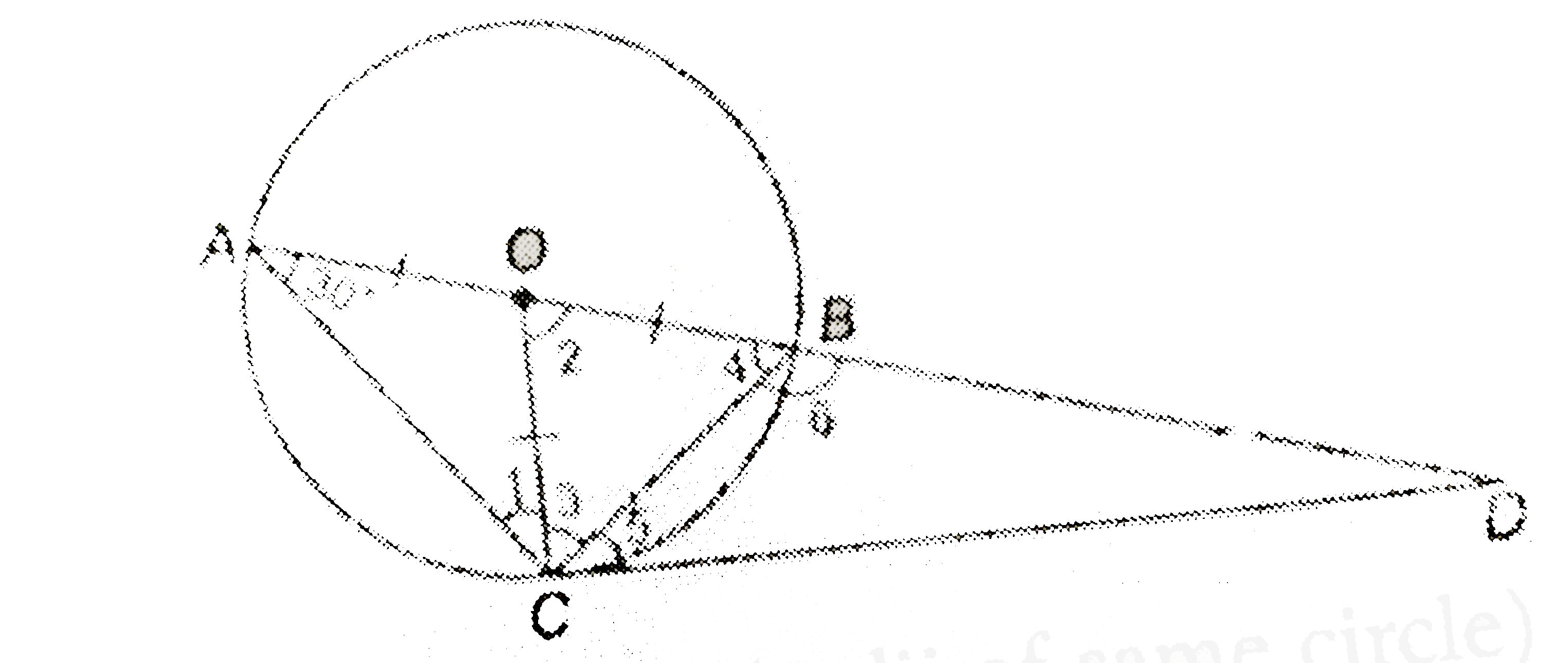
True.
CD is a tangent at contact point C. AOB is diameter which meets tangent produced at D.
Chord AC makes `angleA=30^(@)` with diameter AB.
To Prove : `BD-BC`
Proof : In `triangleOAC,`
`OA=OC=r" "`(radii of same dircle)
`angle1=angleA" "`(angles opposite to equal sides are equal)
`implies" "angle1=30^(@)" " (because angleA=30^(@))`
Exterior `angleBOC=angle2=angle1+angleA=(30^(@)+30^(@))=60^(@)`
Now, in `triangleOCB,`
`OB=OC" "`(radii of same circle)
`:." "angle3=angle4" "`(angles opposite to equal sides are equal)
`angle3+angle4+angleCOB=180^(@)`
`implies" "angle3+angle3+60^(@)=180^(@)" "`(angle sum property of triangle)
`implies" " 2angle3=180^(@)-60^(@)=120^(@)`
`implies" "angle3=60^(@)=angle4`
`implies" "angle6+angle4=180^(@)" "`(linear pair axiom)
`implies" "angle6=180^(@)-angle4=180^(@)-60^(@)`
`implies" "angle6=120^(@)`
`:.` Tangent CD and radius CO are at contact point C.
`:." "angleOCD=90^(@)`
(radius through point of contact is perpendicular to the tangent )
`implies" "angle3+angle5=90^(@)" "implies" "60^(@)+angle5=90^(@)`
`implies" "angle5=30^(@)`
Now, in `triangleBCD,`
`:." "angle5+angle6+angleD=180^(@)" "`(angle sum property)
`implies" "120^(@)+30^(@)+angleD=180^(@)" "implies" "angleD=30^(@)`
Since, `angleC=angleD=30^(@).`
Hence, `BC=BD" "`(sides opposite to equal angles)
Hence Proved.
Promotional Banner

Topper's Solved these Questions

  • CIRCLES

    NAGEEN PRAKASHAN|Exercise Exercise|25 Videos
  • CIRCLES

    NAGEEN PRAKASHAN|Exercise Revision Exercise Very Short Answer Question|7 Videos
  • CIRCLES

    NAGEEN PRAKASHAN|Exercise Revision Exercise Long Answer Questions|3 Videos
  • ARITHMETIC PROGRESSION

    NAGEEN PRAKASHAN|Exercise Revision Exercise Long Answer Question|5 Videos
  • CO-ORDINATE GEOMETRY

    NAGEEN PRAKASHAN|Exercise Revision Exercise Short Answer Questions|9 Videos

Similar Questions

Explore conceptually related problems

AB is a diameter of a circle and AC is its chord such that angleBAC=30^(@) . If the tengent at C intersects AB extended at D, then BC=BD.

In figure, AB is a chord of the circle and AOC is its diameter such that angleACB=50^(@) . If AT is the tangent to the circle at the point A, then angleBAT is equal to

In figure, AB is a chord of the circle and AOC is the diameter such that angleACB=50^(@) . If AT is the tangent to the circle at the point A, then angleBAT is equal to : (a) 45^(@) , (b) 60^(@) , (c) 50^(@) , (d) 55^(@)

AB is a diameter of a circle. CD is a chord parallel to AB and 2CD = AB. The tangent at B meets the line AC produced at E then AE is equal to -

AB is a diameter of a circle. CD is a chord parallel to AB and 2CD = AB. The tangent at B meets the line AC produced at E then AE is equal to

If AOB is a diameter of a circle and C is a point on the circle, then AC^(2)+BC^(2)=AB^(2) .

Seg AB is a diameter of a circle with centre P. Seg AC is a chord. A secant through P and parallel to seg AC intersects the tangent drawn at C in D. Prove that line DB is a tangent to the circle.

AB is diameter of a circle with centre 'O'. CD is a chord which is equal to the radius of the circle. AC and BD are extended so that they intersect each other at point P. Then find the value of angleAPB .

AB is the diameter of a circle whose centre is O. DC is a chord of that circle. If DC||AB and angleBAC=20^(@) then angleADC =?

