Home
Class 12
CHEMISTRY
(A)(C(4)H(8)O)overset(H(3)O^(o+))rarr(B)...

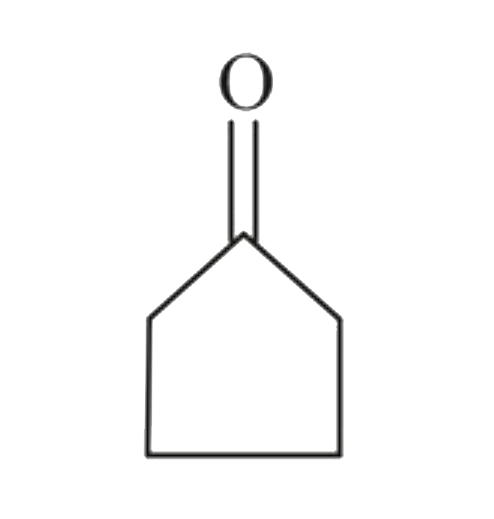
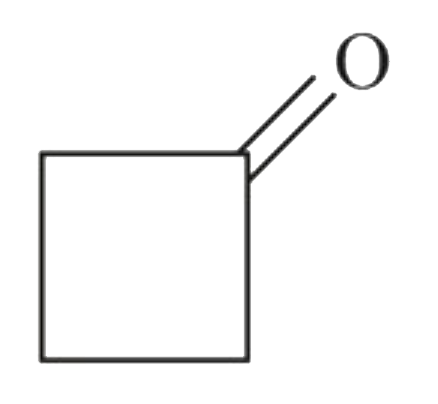
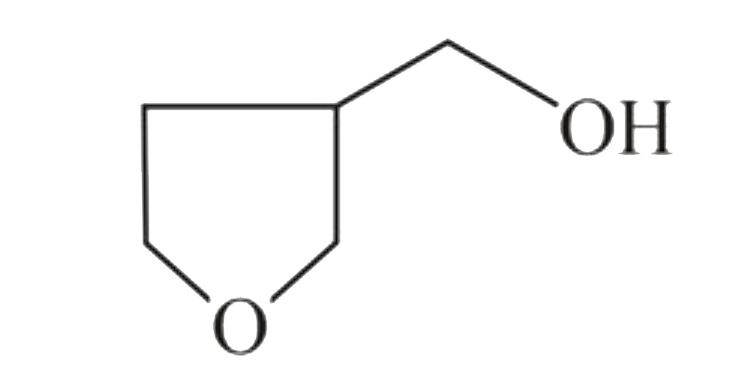
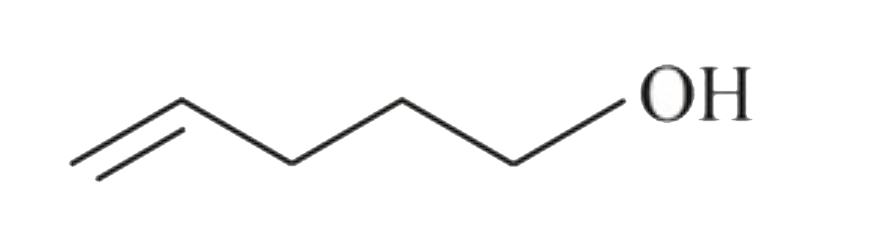
`(A)(C_(4)H_(8)O)overset(H_(3)O^(o+))rarr(B)overset(CrO_(3))underset("acetic acid")rarr(C )overset(CH_(2)N_(2))underset(Delta)rarr(D)`
The compound 'D' is

A

B

C

D

Text Solution

AI Generated Solution

The correct Answer is:

To solve the question step by step, we will analyze the transformations of compound A (C₄H₈O) through the given reactions to determine the final product D. ### Step 1: Identify Compound A Given that A is C₄H₈O, we can start by calculating its degree of unsaturation (DOU) to understand its structure. **Degree of Unsaturation Calculation:** - Formula: DOU = (C + 1 - H + X - N) / 2 - For A (C₄H₈O): - C = 4 - H = 8 - X = 0 (no halogens) - N = 0 (no nitrogens) Plugging in the values: \[ DOU = (4 + 1 - 8 + 0 - 0) / 2 = (5 - 8) / 2 = -3 / 2 \] This indicates that there is one degree of unsaturation, suggesting that A is an unsaturated alcohol. ### Step 2: React A with H₃O⁺ When A reacts with H₃O⁺ (which provides H⁺ and water), it undergoes hydration to form an alcohol (B). The reaction mechanism involves protonation of the double bond, leading to the formation of a carbocation, which is then attacked by water. 1. Protonation of the double bond leads to the formation of a carbocation. 2. Water attacks the carbocation, resulting in the formation of an alcohol. Thus, compound B is an unsaturated alcohol derived from A. ### Step 3: React B with CrO₃ in Acetic Acid Next, B is reacted with CrO₃ in the presence of acetic acid, which acts as an oxidizing agent. Since B is an alcohol, it will be oxidized to a ketone. - The oxidation of the alcohol results in the formation of a carbonyl compound (C), specifically a cyclobutanone. ### Step 4: React C with CH₂N₂ (Diazomethane) Finally, compound C (cyclobutanone) is reacted with CH₂N₂ (diazomethane) under heating conditions. This reaction involves carbene insertion, where the carbene (generated from CH₂N₂) inserts into the carbonyl compound. 1. The carbene (CH₂) inserts into the C=O bond of cyclobutanone. 2. This results in the formation of cyclopentanone (D). ### Conclusion The final product D after all the reactions is cyclopentanone. ### Final Answer The compound 'D' is **cyclopentanone**. ---
Promotional Banner

Topper's Solved these Questions

  • NTA JEE MOCK TEST 83

    NTA MOCK TESTS|Exercise CHEMISTRY|25 Videos
  • NTA JEE MOCK TEST 85

    NTA MOCK TESTS|Exercise CHEMISTRY|25 Videos

Similar Questions

Explore conceptually related problems

H_(3)C-CH_(2)-overset(CH_(3))overset(|)(CH)-underset(O)underset(||)(C)-NH_(2) overset(Br_(2)+KOH)underset(Delta)rarr A overset(1.CH_(3)I("excess"))underset(2.AgOH,Delta)rarr B The major product (B) is:

CH_(3)- overset(CH_(3))overset(|)underset(O)underset(||)(C)overset ((i) CH_(3)MgBr)underset(H_(2)O)(rarr) A Identify the compound A

(CH_(3))_(2)+HCNrarr[A]overset(H_(3)O^(+))rarr[B]underset("Heat")overset(H_(2)SO_(4))rarr[C]

Consider the following sequence of reactions underset((C_(4)H_(8)O_(3)))(A overset(CrO_(3))rarr B) overset("Warm")rarr CH_(3)overset(O) overset(||)C CH_(3)+CO_(2) The compound (A) is :

Identify the compound 'D' in the following series of reaction. CH_(3)-overset(CH_(3))overset("| ")"CH"-CH_(2)-CH_(2)-Broverset("Alc. KOH")underset(Delta)rarr'A' overset("(i) Conc. "H_(2)SO_(4))underset("(ii) "H_(2)O, Delta)rarr underset("product")underset("Major")('B')+underset("product")underset("Minor")('C') " "'B'overset(Hl,Delta)underset(-H_(2)O)rarr underset("product)")underset("(Major")('D')+underset("product)")underset("(Minor")('E')

CH_(3)C C l_(2)CH_(3)underset("Hydrolysis")overset(NaOH)(rarr)P overset(-H_(2)O)(rarr)Q underset([O])overset("Oxidation")(rarr) R The compound R is

Mg_(3)N_(2)overset(H_(2)O)rarr A("gas") overset(CuO)underset(Delta)rarr B+C(g) +H_(2)O, C(g) can be obtained by heating:

2Ph-overset(O)overset(||)(C)-CH_(3)overset(Mg-Hg)underset(H_(2)O)rarroverset(Conc.H_(2)SO_(4))underset(Delta)rarr overset(KMnO_(4)H^(o+))rarr The final product is

NTA MOCK TESTS-NTA JEE MOCK TEST 84-CHEMISTRY
  1. Alcohol (X)overset("aq. NaOH"+I(2))rarrCHI(3)+(Y)overset(H(3)O^(+))rar...

    Text Solution

    |

  2. An element crystallizes both in fcc and bcc lattice. If the density of...

    Text Solution

    |

  3. The CFSE for octahedral [CoCl(6)]^(4-) is 18,000 cm^(-1). The CFSE for...

    Text Solution

    |

  4. CH(3)COCl+H(2)underset("Quinoline")overset(Pd//BaSO(4))rarr

    Text Solution

    |

  5. The vapour pressure of water at T(K) is 20 mm Hg. The following soluti...

    Text Solution

    |

  6. XCl(2)("excess")+Ycl(2) to XCl(4)+Y darr , YO underset(gt400^(@))ove...

    Text Solution

    |

  7. Match list I with list II and select the correct answer using the code...

    Text Solution

    |

  8. Which among the following reactions is can be a example of pseudo firs...

    Text Solution

    |

  9. A chemical A is used for the preparation of washing soda to recover am...

    Text Solution

    |

  10. Pick out the correct statement.

    Text Solution

    |

  11. Which is not true about borax?

    Text Solution

    |

  12. (A)(C(4)H(8)O)overset(H(3)O^(o+))rarr(B)overset(CrO(3))underset("aceti...

    Text Solution

    |

  13. Which In K vs 1/T plot is correct for an equilibrium that shits toward...

    Text Solution

    |

  14. What is Z in the following sequence of reactions ? 2-methyl -2-bromo p...

    Text Solution

    |

  15. Which of the following salt on heating with solid K(2)Cr(2)O(7) and Co...

    Text Solution

    |

  16. In the reaction 8Al+3Fe(3)O(4)rarr 4Al(2)O(3)+9Fe the number of el...

    Text Solution

    |

  17. Total number of enol possible for the compound formed during given rea...

    Text Solution

    |

  18. Calculate pH at which an acid indicator Hin with concentration 0.1M ch...

    Text Solution

    |

  19. CH(3)-underset(Br)underset(|)overset(Br)overset(|)C-undersset(Br)under...

    Text Solution

    |

  20. Total number of covalent bonds in C(3)O(2) is x and y is the number of...

    Text Solution

    |
