

Home
Class 12
CHEMISTRY
Mg(s)|Mg^(2+)(aq)||Zn^(2+)(aq)|Zn(s),E^(...

`Mg(s)|Mg^(2+)(aq)||Zn^(2+)(aq)|Zn(s),E^(@)=+3.13V`
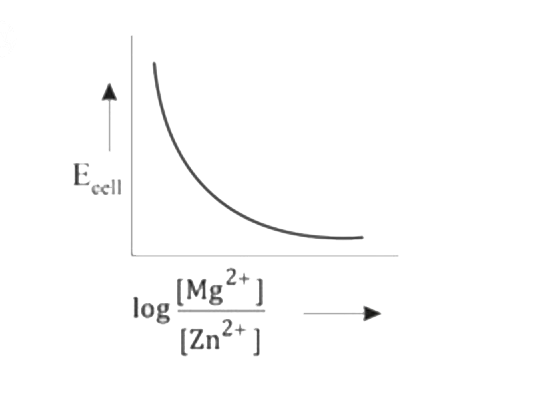
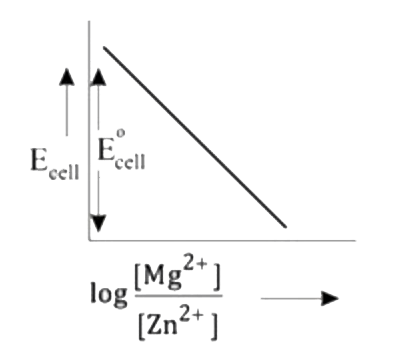
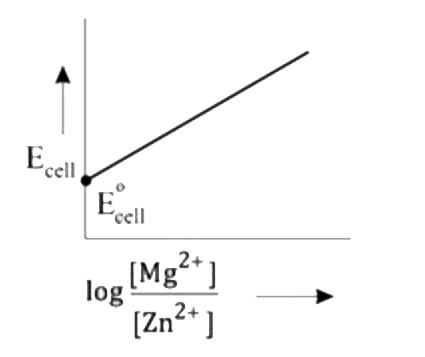
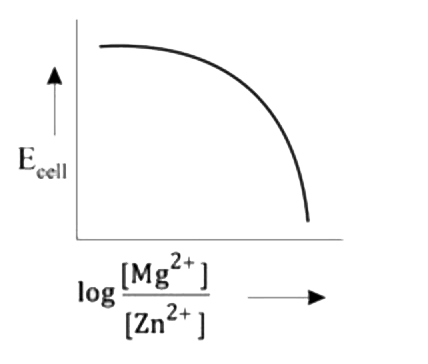
The correct plot of `E_("cell")` versus `log.([Mg^(2+)])/([Zn^(2+)])` will be represented as

A

B

C

D

Text Solution

AI Generated Solution

The correct Answer is:
To solve the problem, we need to analyze the electrochemical cell given and apply the Nernst equation to plot the relationship between the cell potential (E_cell) and the logarithm of the concentration ratio of the ions involved. ### Step-by-Step Solution: 1. **Identify the Half-Reactions**: - At the anode (oxidation): \[ \text{Mg(s)} \rightarrow \text{Mg}^{2+}(aq) + 2e^- \] - At the cathode (reduction): \[ \text{Zn}^{2+}(aq) + 2e^- \rightarrow \text{Zn(s)} \] 2. **Write the Overall Cell Reaction**: The overall cell reaction can be combined from the half-reactions: \[ \text{Mg(s)} + \text{Zn}^{2+}(aq) \rightarrow \text{Mg}^{2+}(aq) + \text{Zn(s)} \] 3. **Apply the Nernst Equation**: The Nernst equation relates the standard cell potential (E°) to the cell potential (E) under non-standard conditions: \[ E = E° - \frac{RT}{nF} \log \left( \frac{[\text{Mg}^{2+}]}{[\text{Zn}^{2+}]} \right) \] Where: - \( E° = +3.13 \, \text{V} \) - \( R \) is the universal gas constant (8.314 J/(mol·K)) - \( T \) is the temperature in Kelvin (assume standard temperature, 298 K) - \( n = 2 \) (number of moles of electrons transferred) - \( F \) is Faraday's constant (96485 C/mol) 4. **Rearranging the Nernst Equation**: We can rearrange the equation in the form of \( y = mx + c \): \[ E = E° - \frac{RT}{nF} \log \left( \frac{[\text{Mg}^{2+}]}{[\text{Zn}^{2+}]} \right) \] Here, \( y = E \), \( x = \log \left( \frac{[\text{Mg}^{2+}]}{[\text{Zn}^{2+}]} \right) \), \( m = -\frac{RT}{nF} \), and \( c = E° \). 5. **Determine the Slope and Intercept**: - The slope \( m \) is negative because \( -\frac{RT}{nF} < 0 \). - The intercept \( c = E° \) is positive since \( E° = +3.13 \, \text{V} \). 6. **Plotting the Graph**: - Since the slope is negative, the graph of \( E_{cell} \) versus \( \log \left( \frac{[\text{Mg}^{2+}]}{[\text{Zn}^{2+}]} \right) \) will be a straight line that slopes downwards from left to right. - The y-intercept will be at \( +3.13 \, \text{V} \). ### Conclusion: The correct plot of \( E_{cell} \) versus \( \log \left( \frac{[\text{Mg}^{2+}]}{[\text{Zn}^{2+}]} \right) \) will be a straight line with a negative slope and a positive intercept.
Promotional Banner

Topper's Solved these Questions

  • NTA JEE MOCK TEST 92

    NTA MOCK TESTS|Exercise CHEMISTRY|25 Videos
  • NTA JEE MOCK TEST 94

    NTA MOCK TESTS|Exercise CHEMISTRY|25 Videos

Similar Questions

Explore conceptually related problems

The cell reaction Zn(s)+2Ag^(+)(aq)rarrZn^(2+)(aq)+Ag(s) is best represented by

For the redox process Zn (s) + Cu^(2+) hArr Zn^(2+) + Cu(s) E_("cell")^(@) = + 1.10V which graph correctly represents E_("cell") (Y-axis) as a function of log ([Zn^(2+)])/([Cu^(2+)]) (X-axis) ?

For the galvanic cell Mg(s)|Mg^(2+)(aq)||Zn^(2+)(aq)|Zn(s) ,the standard free energy change is ( Given:E_((mg^(2+))/(mg))^@= -2.36 V,E_((Zn^(2+))/(Zn))^@= -0.76 V)

For the cell reaction, Mg(s)+2Ag^(+) (aq.) hArr Mg^(2+) (aq.)+2Ag(s) E_(cell)^(@) is +3.17 V at 298 K. The value of E_(cell), Delta G^(@) and Q at Ag and Mg^(2+) concentration of 0.001 M and 0.02 M respectively are :

For the galvanic cell Zn(s)abs(Zn^(2+) ) abs(Cd^(2+)) Cd(s),E_(cell ) = 0.30 V and E_(cell)^(o) = 0.36 V, then value of [Cd^(2+)]//[Zn^(2+)] will be:

For the redox reaction : Zn(s)+Cu^(2+)(aq) hArr Zn^(2+)(aq)+Cu(s) Reaction quotient (Q) =([Zn^(2+)(aq)])/([Cu^(2+)(aq)])=0.01 . What will be the value of E_(cell) ? Given that OA=1.10 V.

Zn+Cu^(2+)(aq)toCu+Zn^(2+)(aq) . Reaction quotient is Q=([Zn^(2+)])/([Cu^(2+)])*E_(cell)^(@)=1.10V ltb rgt E_(cell) will be 1.1591 V when :

Ag^(aq) + e^(-) rightarrow Ag(s) E69@) = 0.80 V Mg^(2+)(aq) + 2e^(-) rightarrow Mg(s) E^(@) = -2.73 V Use the equations above to calcualte the value or DeltaG^(@0 (in kJ/mol) for the reaction: Mg(s) + 2Ag^(+)(aq) rightarrow Mg^(2+)(aq) + 2Ag(s)

NTA MOCK TESTS-NTA JEE MOCK TEST 93-CHEMISTRY
  1. Consider the given compounds : (a) CH(3)-CH(2)-NH(2) (b) CH(3)-C...

    Text Solution

    |

  2. Which of the following ionic/molecular species does not disproportiona...

    Text Solution

    |

  3. In correct statement regarding following reaction is

    Text Solution

    |

  4. In the given reaction [X] will be

    Text Solution

    |

  5. An ideal gas is taken around the cycle ABCA as

    Text Solution

    |

  6. CuSO(4)(aq)overset(H(2)Suarr)rarrMdarroverset("Excess of KCN")rarrN+O ...

    Text Solution

    |

  7. In the reaction sequence will be

    Text Solution

    |

  8. Equilibrium constant K(C) for the following reaction at 800 K is, 4 NH...

    Text Solution

    |

  9. Arrange the following cyano complexes in decreasing order of their mag...

    Text Solution

    |

  10. A reactant (A) forms two products A overset (k(1))rarr B, Activation...

    Text Solution

    |

  11. Pyroxenes are class of silicate minerals, which exhibit a polymeric ch...

    Text Solution

    |

  12. In the given reaction [X] will be

    Text Solution

    |

  13. Mg(s)|Mg^(2+)(aq)||Zn^(2+)(aq)|Zn(s),E^(@)=+3.13V The correct plot o...

    Text Solution

    |

  14. In the reaction sequence C(6)H(5)CHO overset(NH(2)OH//H^(o+))underse...

    Text Solution

    |

  15. Choose the correct sequence for the geometry of the given molecules ...

    Text Solution

    |

  16. Graph between log((x)/(m)) and log P is straight line at angle of 45^(...

    Text Solution

    |

  17. Find the sum of bond order between same bonded atoms in Q and R compou...

    Text Solution

    |

  18. How many mL of 22.4 volume H(2)O(2) is required to oxidise 0.1 mol of ...

    Text Solution

    |

  19. K(a) for HCN is 5xx10^(-10) at 25^(@)C. For maintaining a constant pH ...

    Text Solution

    |

  20. How many -OH groups are present in one molecules of sucrose?

    Text Solution

    |