Home
Class 12
PHYSICS
A block of mass m moving with a velocity...

A block of mass m moving with a velocity `v_(0)` on a smooth horizontal floor collides with a light spring of stiffness k that is rigidly fixed horizontally with a vertical wall. If the maximum force imparted by the spring on the block is F, then:
(A) `F prop sqrt(m) " " (B) F prop sqrt(k)`
(C) `F prop v_(0) " " ` (D) None of these

Text Solution

Verified by Experts
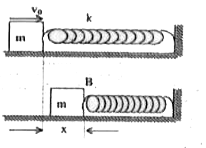
Energy conservation between the position A and B
`DeltaPE+DeltaKE=0`
`rArr 1/2 kx^(2)-1/2 mv_(0)^(2)=0 rArr x= sqrt(m/k)v_(0)`
`:.F_("max")=kx=sqrt(km)v_(0)`
`rArr F_("max") prop sqrt()k`
`prop sqrt()m`
`prop v_(0)`.
Promotional Banner

Topper's Solved these Questions

  • WORK, ENERGY AND POWER

    FIITJEE|Exercise SOLVED PROBLEMS (SUBJECTIVE )|8 Videos
  • WORK, ENERGY AND POWER

    FIITJEE|Exercise SOLVED PROBLEMS ( OBJECTIVE)|18 Videos
  • TEST PAPERS

    FIITJEE|Exercise PHYSICS|747 Videos

Similar Questions

Explore conceptually related problems

A block of mass m moving with velocity v_(0) on a smooth horizontal surface hits the spring of constant k as shown. Two maximum compression in spring is

A block of mass m moving with a velocity v_(0) collides with a stationary block of mass M to which a spring of stiffness k is attached, as shown in Fig. Choose the correct alternative(s)

A block of mass m is moving with an initial velocity v_0 towards a stationary spring of stiffness k attached to the wall as shown in figure a. Find the maximum compression in the spring. b. Is the work done by the spring negative or positive?

A sphere of mass m and radius R rolls without sliding on a horizontal surface. It collides with a light spring of stiffness K with a kinetic energy E . If the surface ( AB ) under the spring is smooth, find the maximum compression of the spring.

A block of mass m is connected rigidly with a smooth wedge (plank) by a light spring of stiffness k. If the wedge is moved with constant velocity v_0 , find the work done by the external agent till the maximum compression of the spring.

A spring of force constant K rests on a smooth floor, with one end fixed to a wall. A block of mass m hits the free end of the spring with velocity v. The maximum force exerted by the spring on the wall is

Two blocks of masses m_(1) and m_(2) being connected with a light spring of stiffness k are driven with forces F_(1) and F_(2) on a smooth horizontal plane.

Two blocks m_(1) and m_(2) are pulled on a smooth horizontal surface, and are joined together with a spring of stiffness k as shown in Fig. Suddenly, block m_(2) receives a horizontal velocity v_(0) , then the maximum extension x_(m) in the spring is

A block of mass m is moving with a speed v on a horizontal rought surface and collides with a horizontal monted spring of spring constant k as shown in the figure .The coefficient of friction between the block and the floor is mu The maximum cobnpression of the spring is

A block of mass m moving with a velocity v_(0) on a smooth horizontal surface strikes and compresses a spring ofstiffuess k till mass coines to rest as shown in the figure. This phenomenon is observed by two observers : (a) Standing on the horizontal surface (b) standing on the block According to observer B, the potential energy of the spring increases :

