Home
Class 12
PHYSICS
An ideal tape of length L is tightly wou...

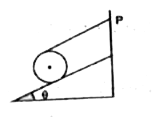
An ideal tape of length L is tightly wound on a cylinder. The tape is allowed to unwind as the cylinder slips down a frictionless inclined plane. The upper end of the tape is fixed to a point P as shown in the figure. Find the time taken by the tape to unwind completely. Assume that plane is very long

Text Solution

Verified by Experts

The correct Answer is:

`sqrt((3L)/(g sin theta))`
Promotional Banner

Topper's Solved these Questions

  • ROTATIONAL MECHANICS

    FIITJEE|Exercise ASSIGNMENT PROBLEMS (OBJECTIVE ) LEVEL - I|41 Videos
  • ROTATIONAL MECHANICS

    FIITJEE|Exercise ASSIGNMENT PROBLEMS (OBJECTIVE ) LEVEL - II|16 Videos
  • ROTATIONAL MECHANICS

    FIITJEE|Exercise ASSIGNMENT PROBLEMS (SUBJECTIVE ) LEVEL - I|15 Videos
  • PHYSICS PART2

    FIITJEE|Exercise Numerical Based Question Decimal Type|6 Videos
  • SEMICONDUCTOR AND DEVICE

    FIITJEE|Exercise SOLVED PROBLEMS Objective: Level-I|20 Videos

Similar Questions

Explore conceptually related problems

A particle slides down a smooth in clined plane of elevation theta fixed in an elevastor going up with an acceleration a_0 . The base of the incline has a length L.Find the time taken by the particle to reach the bottom.

A spring of unstretched length 40 cm and spring constant k is attached to a block of mass 1 kg to one of its end. The other end of the spring is fixed on the top of a frictionless inclined plane of inclination theta = 45^(@) as shown in the figure, so that the spring extends by 3 cm. When the mass is displaced slightly and released the time period of the resulting oscillation is T. Determine the value of 5T close to nearest integer.

A solid cylinder of weight 20 kg and radius 7.5 cm is placed on a inclined plane with inclination 30^(@) to the horizontal. A light thin tape is wound around the cylinder and is taken tangentially over the upper surface parallel to the plane and finally attached to a 5-kg body after passing over a light smooth pulley. Find the tension in the tape and linear acceleration of the cylinder up the plance, assuming no slip.

A frictionless inclined plane of length l having inclination theta is placed inside a lift which is accelerating downward with on acceleration a (ltg) . If a block is allowed to move down the inclined plane, from rest, then the time taken by the block to slide from top of the inclined plane to the bottom of the inclined plane is

A particle slides down a smooth inclined plane of elevation , fixed in an elevator going up with an acceleration a0 (figure). The base of the incline has a length L. Find the time taken by the particle to reach to the bottom -

A block slides down from top of a smooth inclined plane of elevation ● fixed in an elevator going up with an acceleration a_(0) The base of incline hs length L Find the time taken by the block to reach the bottom .

A smooth cylinder is fixed with its axis horizontal. Radius of the cylinder is R. A uniform rope (ACB) of linear mass density lambda (kg/m) is exactly of length pi R and is held in semicircular shape in vertical plane around the cylinder as shown in figure. Two massless strings are connected at the two ends of the rope and are pulled up vertically with force T_(0) to keep the rope in contact with the cylinder. (a) Find minimum value of T_(0) so that the rope does not lose contact with the cylinder at any point. (b) If T_(0) is decreased slightly below the minimum value calculated in (a), where will the rope lose contact with the cylinder.

A straight horizontal conductor PQ of length l, and mass_ m slides down on two smooth conducting fixed parallel rails, set inclined at an angle 9 to the horizontal as shown in figure-5.30. The top end of the bar are connected with a capacitor of capacitance C. The system is placed in a uniform magnetic field, in the direction perpendicular to the inclined plane formed by the rails as shown in figure. If the resistance of the bars and the sliding conductor are negligible calculate the acceleration of sliding conductor as a function of time ifit is released from rest at t= 0

Passage XIV) A uniform cylindrical block of mass 2M and cross-sectional area A remains partially submerged in a non viscous liquid of density rho , density of the material of the cylinder is 3rho . The cylinder is connected to lower end of the tank by means of a light spring of spring constant K. The other end of the cylinder is connected to anotehr block of mass M by means of a light inextensible sting as shown in the figure. The pulleys shown are massless and frictionless and assume that the cross-section of the cylinder is very small in comparison to that of the tank. Under equilibrium conditions, half of the cylinder is submerged. [given that cylinder always remains partially immersed) If the cylinder is pushed down from equilibrium by a distance which is half the distance as calculated in the above question, determine time period of subsequent motion.

A horizontal plane supports a stationary vertical cylinder of radius R and a disc A attached to the cylinder by a horizontal thread AB of length l_0 (figure, to view). An initial velocity v_0 is imparted to the disc as shown in the figure. How long will it move along the plane until it strikes against the cylinder? The friction is assumed to be absent.
