Home
Class 12
CHEMISTRY
The following diagram shown as electroch...

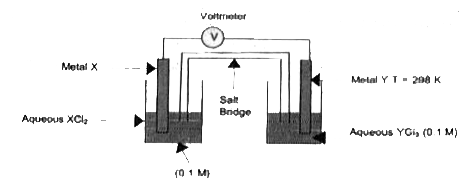
The following diagram shown as electrochemical cell in which the respective half-cells contains aqueous 1.0M solutions of the salts `XCl_(2) and YCl_(3)`. Given that
`3X(s)+2Y^(3+) (aq) to 3X^(2)(aq)+2Y(s) epsi_("cell") gt 0`

`E_("cell")` of the above designed cell is if standard emf od cell is -0.20 V.

A

`(0.20+(0.0591)/(2))V`

B

`(0.20-(0.0591)/(3))V`

C

`(-0.20+(0.0591)/(6))V`

D

`+2.0V`

Text Solution

Verified by Experts

The correct Answer is:

C
Promotional Banner

Topper's Solved these Questions

  • ELECTROCHEMISTRY

    FIITJEE|Exercise Matrix Match Type Questions|8 Videos
  • ELECTROCHEMISTRY

    FIITJEE|Exercise Matcing Type Single Correct Questions|3 Videos
  • ELECTROCHEMISTRY

    FIITJEE|Exercise (Comprehension -IV)|4 Videos
  • CONCEPT OF ACIDS AND BASES

    FIITJEE|Exercise SINGLE INTEGER ANSWER TYPE QUESTIONS|4 Videos
  • ELECTROPHILIC AROMATIC SUBSTITUTION

    FIITJEE|Exercise NUMERICAL BASED QUESTIONS INDICATED BY DIGITAL INTERGER|1 Videos

Similar Questions

Explore conceptually related problems

The following diagram shown as electrochemical cell in which the respective half-cells contains aqueous 1.0M solutions of the salts XCl_(2) and YCl_(3) . Given that 3X(s)+2Y^(3+) (aq) to 3X^(2)(aq)+2Y(s) epsi_("cell") gt 0 Cell reaction is spontaneous:

The following diagram shown as electrochemical cell in which the respective half-cells contains aqueous 1.0M solutions of the salts XCl_(2) and YCl_(3) . Given that 3X(s)+2Y^(3+) (aq) to 3X^(2)(aq)+2Y(s) epsi_("cell") gt 0 if salt-bridge is removed:

The following diagram shown as electrochemical cell in which the respective half-cells contains aqueous 1.0M solutions of the salts XCl_(2) and YCl_(3) . Given that 3X(s)+2Y^(3+) (aq) to 3X^(2)(aq)+2Y(s) epsi_("cell") gt 0 Which of the following statements is correct? I. The electrode made from metal X has positive polarity II. Electrode Y Is the anode II. Tho flow of electrons is from Y to X IV. The reaction at electrode X is an oxidation V. The salt bridge would most likely contain silver nitrate

The following diagram shown as electrochemical cell in which the respective half-cells contains aqueous 1.0M solutions of the salts XCl_(2) and YCl_(3) . Given that 3X(s)+2Y^(3+) (aq) to 3X^(2)(aq)+2Y(s) epsi_("cell") gt 0 E_(X//X^(2+))^@=0.20v, E_(Y//Y^(3+))^(@)=0.40 V " the "E_("cell")^(@) of the above designed cell is

The following diagram shows the setup of an electrochemical cell in which the respective half cells contain aqueous 1.0 M solutions of the salts XCl_(2) and YCl_(3) . Given that 3X(s)+2Y^(3+)(aq)to3X^(2+)(aq)+2Y(s)E_(cell)Llt0 Which of the following statements is correct?

Consider the following cell reaction Cu(s)+2Ag^(+)(aq) rarr Cu^(2+) (aq) +2Ag(s) E_("cell")^(@)=0.46 V By boubling the concentration of Cu^(2+) , E_("cell") is

Consider a voltaic cell in which the reaction below occurs in two half-cells connected by a salt bridge and an external circuit. 2Cr(s) + 3Sn^(2+)(aq) rightarrow 3Sn(s) + 2Cr^(3+)(aq) E^(@) = 0.603V . Which change will cause the voltage to increase?
