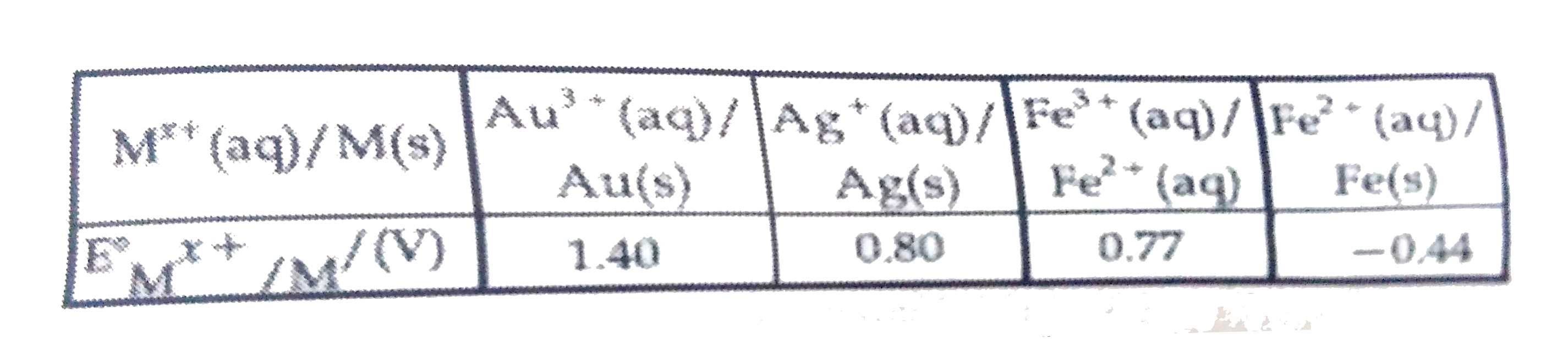
For the cell `Zn(s)|Zn^(2+)(aq)||M^(x+)(aq)|M(s)` different half cells and their standard electrode potentials are given below : If `E^(@)Zn^(2+) |Zn = -0.76 V` which cathode will given a maximum value of `E^@` cell per electron transferred ?
For the galvanic cell Mg(s)|Mg^(2+)(aq)||Zn^(2+)(aq)|Zn(s) ,the standard free energy change is ( Given:E_((mg^(2+))/(mg))^@= -2.36 V,E_((Zn^(2+))/(Zn))^@= -0.76 V)
For a standard cell Zn(s)|Zn^(2+)(1 M)||Cu^(2+)(1 M)|Cu(s) Write the electrode reaction and cell reaction. Also find the e.m.f. of cell if ? E_(Zn^(2+)|Zn)^(@)=-0.76" V", E_(Cu^(2+)|Cu)^(@)=+0.34" V" .
Consider the cell : Zn|Zn^(2+)(aq)(1.0M)||Cu^(2+)(aq)(1.0M)||Cu Thee standard reduction potentials are 0.350V for Cu^(2+)(aq)+2e^(-)rarrCu and -0.763V for Zn^(2+)(aq)+2e^(-) rarr Zn a. Write the cell reaction. b. Calculate the EMF of the cell. c. Is the reaction spontaneous or not ?
For the cell Zn(s) + 2H^(+)(aq) rightarow Zn^(2+)(aq) + H_(2)(g) , E^(@) = 0.76 V Which change will increase the voltage of the cell?
The statdard electrode potential of the half cells is given below: Zn^(2+) +2e^- rarr Nn, E=- 7. 62 V , Zn^(2+) +2e^- rarr Nn, E=- 7. 81 V , The emf of the cell Fe^(2+) + Zn rarr Zn^(2+) + De is ,