Home
Class 12
PHYSICS
A particle of mass 2 kg is moving on a s...

A particle of mass `2 kg` is moving on a straight line under the action of force `F = (8 - 2x)N`. It released at rest from `x = 6 m`.
(a) Is the particle moving simple harmonically.
(b) Find the equilibrium position of the particle.
(c) Write the equation of motionof the particle.
(d) Find the time period of `SHM`.

Text Solution

Verified by Experts
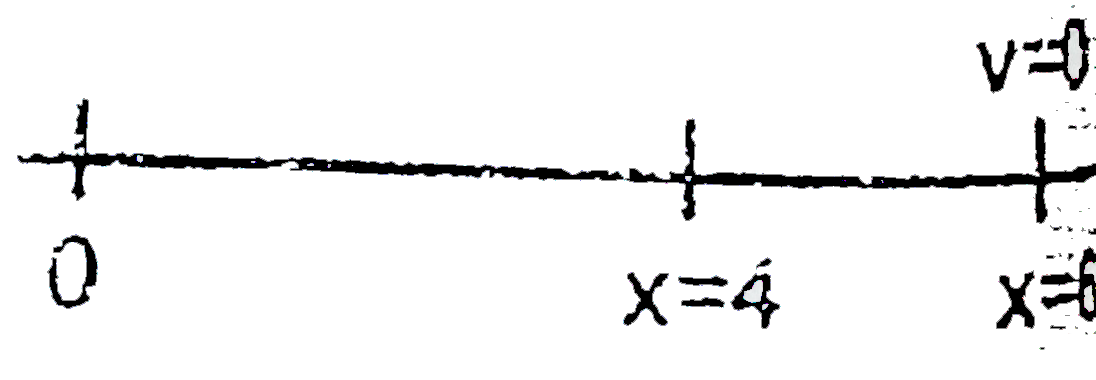
`F = 8 - 2x `
or `F = -2(x - 4)`
at equilibrium position `F = 0`
Hence the motion of particle is `SHM` with force constant `2` and equilibrium position `x = 4`
(a) Yes, motion is `SHM`.
(b) Equilibrium position is `x = 4`
(c) At `x = 6 m`, particle is at rest i.e., it is one of the extreme position Hence amlitude is `A = 2 m` and initially particle is at the extreme position.

`:.` Equation of `SHM` can be written as
`x - 4 = 2 omegat`, where `omega = sqrt((k)/(m)) = sqrt((2)/(2)) = 1`
i.e., `x = 4 + 2 cos t`
(d) Time period, `T = (2pi)/(omega) = 2pisec`.
Promotional Banner

Topper's Solved these Questions

  • SIMPLE HARMONIC MOTION

    RESONANCE|Exercise Solved Miscellaneous Problems|9 Videos
  • SIMPLE HARMONIC MOTION

    RESONANCE|Exercise Board Level Exercise|24 Videos
  • SEMICONDUCTORS

    RESONANCE|Exercise Exercise 3|88 Videos
  • TEST PAPERS

    RESONANCE|Exercise FST-3|30 Videos

Similar Questions

Explore conceptually related problems

A partical of mass 2 kg is moving of a straigh line under the actin force F = (8 - 2s)N . It is released at rest from x = 6m . a. Is the partical moving simple hormonically. b.Find the equilibrium position of the partical. c. Write the equiation of motion of the partical. d. Find the time period of SHM.

A particle of mass 2kg is moving on a straight line under the action of force F = (8-2x) N . The particle is released at rest from x = 6 m . For the subsequnent motion(All the value in the right column are in their S.I. units)

The potential energy U(x) of a particle moving along x - axis is given by U(x)=ax-bx^(2) . Find the equilibrium position of particle.

For a particle performing SHM , equation of motion is given as (d^(2))/(dt^(2)) + 4x = 0 . Find the time period

The position of a particle moving on a stringht line under rthe action of a force is given as x=50t-5t^(2) Here, x is in metre and t is in second. If mass of the particle is 2 kg, the work done by the force acting on the particle in first 5 s is.

A particle of mass 2 kg moves in simple harmonic motion and its potential energy U varies with position x as shown. The period of oscillation of the particle is

Force acting on a particle of mass m moving in straight line varies with the velocity of the particle as F=K//V K is constant then speed of the particle in time t

A particle having mass 2 kg is moving along straight line 3 x + 4 y = 5 with speed 8m//s . Find angular momentum of the particle about origin, x and y are in meters.

A particle of mass m moves from rest under the action of a constant force F which acts for two seconds. The maximum power attained is

A particle of mass 2kg starts to move at position x=0 and time t=0 under the action of force F=(10+4x)N along the x- axis on a frictionless horizontal track . Find the power delivered by the force in watts at the instant the particle has moved by distance 5m .

