Home
Class 12
PHYSICS
Two non - viscous, incompressible and im...

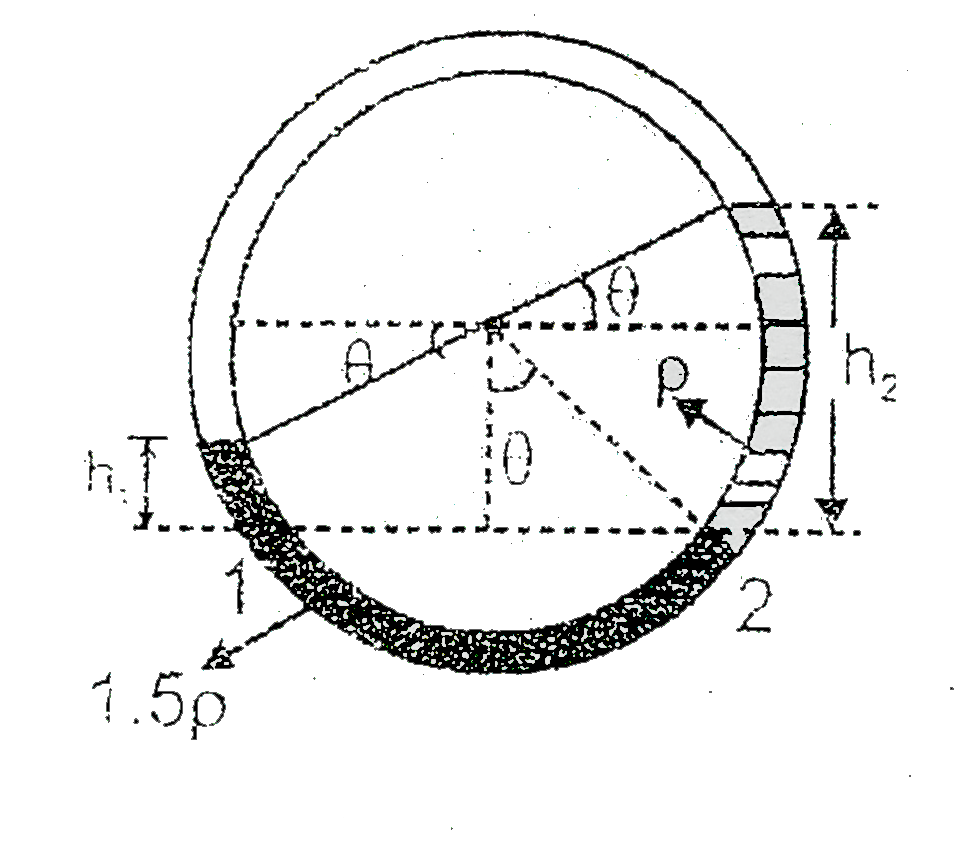
Two non - viscous, incompressible and immiscible liquids of densities (rho) and (1.5 rho) are poured into the two limbs of a circular tube of radius ( R) and small cross section kept fixed in a vertical plane as shown in fig. Each liquid occupies one fourth the cirumference of the tube.
(##JMA_CHMO_C10_027_Q01##).
(a) Find the angle (theta) that the radius to the interface makes with the verticles in equilibrium position.
(b) If the whole is given a small displacement from its equilibrium position, show that the resulting oscillations are simple harmonic. Find the period of these oscillations.

Text Solution

Verified by Experts

The correct Answer is:
(a) `tan^(-1)sqrt((1)/(5))` (b) `2pisqrt((R)/(6.11))`

(a) In equilibrium, pressure of same liquid at same level will be same.
Therefore `P_(1) = P_(2)`
or `P + (1.5 p g h_(1)) = P + (rho g h_(2))`
(`p =` pressure of gas in empty part of the tube)
`:. 1.5 h_(1) = h_(2)`
`1.5 [ R costheta - R sintheta] = rho (R costheta + R sintheta)`
or `3 costheta - 3 sintheta = 2 costheta + 2 sintheta`
or `5 tantheta = 1`
`theta = tan^(-1)((1)/(5))`

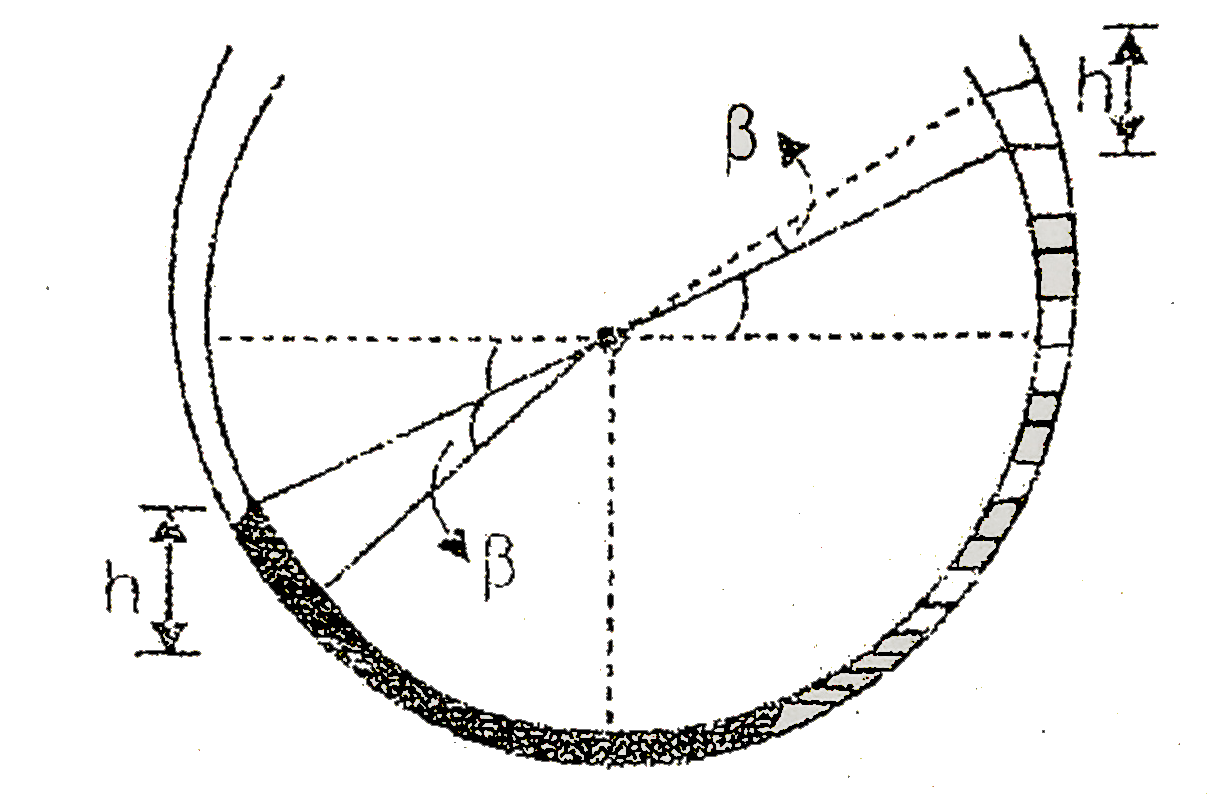
(b) When liquid are slightly disturbed by an angle `beta`. Net restoring pressure `DeltaP = 1.5 rhogh + rhogh` this pressure will be equal at all sections of the liquid. Therefore, net restoring torque on the whole liquid.

`h = R sin (theta + beta) - Rsintheta`
or, `tau = -(DeltaP) (A) (R)`
`tau = -2.5rhogh AR`
`= - 2.5rhog AR [R sin (theta + beta) - R sintheta]`
`= -2.5 rhog AR^(2) [ sintheta cosbeta + sinbeta costheta - sintheta]`
Assuming `cos beta = 1` and `sinbeta = beta` (given, `beta` is small)
`:. tau = -(2.5 rhoA gR^(2) costheta)beta`
or `Ialpha = -(2.5 rhoAgR^(2) costheta)beta ....(1)`
Here, `I = (m_(1) + m_(2))R^(2)`

`= [((piR)/(2).A)rho + ((piR)/(2)).A (1.5 rhop) ]R^(2)`
`= (1.25 piR^(3)rho)A`
and `costheta = (5)/(sqrt(26)) = 0.98`
Substituting in equation `(1)`, we have
`alpha = -((6.11)beta)/(R) rArr` angular acceleration `prop-`angular displacement
As angular acceleration is propotional to `-beta`, motion is simple harmonic in nature.
`T = 2pisqrt(|(beta)/(alpha)|) = 2pisqrt((R)/(6.11))`
Promotional Banner

Topper's Solved these Questions

  • SIMPLE HARMONIC MOTION

    RESONANCE|Exercise Exercise- 3, PART - II|17 Videos
  • SEMICONDUCTORS

    RESONANCE|Exercise Exercise 3|88 Videos
  • TEST PAPERS

    RESONANCE|Exercise FST-3|30 Videos

Similar Questions

Explore conceptually related problems

A cylinder stands vertical in two immiscible liquids of densities rho and 2rho as shown. Find the difference in pressure at point A and B:

A V-shaped glass tube of uniform cross section is kept in a vertical plane as shown. A liquid is poured in the tube. In equilibrum the level of liquid in both limds of tube. Find the angular frequency of small oscillation of liquid.

Two immiscible liquids of densities rho and 2rho and thickness (heights) h and 2h , respectively, push a vertical plate. Find the total side thrust given by the liquids on the vertical plate.

A thin triangular glass tube containing immiscible liquids A, B, C of densities rho, 2rho, 3rho is at rest in vertical plane. Find x.

A uniform long tube is bent into a circle of radius R and it lies in vertical plane. Two liquids of same volume but densities rho " and " delta fill half the tube. The angle theta is

A small uniform tube is bent into a circle of radius r whose plane is vertical. Equal volumes of two fluids whose densities are rho and sigma(rhogtsigma) fill half the circle. Find the angle that the radius passing through the interface makes with the vertical.

A circular tube of uniform cross section is filled with two liquids densities rho_(1) and rho_(2) such that half of each liquid occupies a quarter to volume of the tube. If the line joining the free surfaces of the liquid makes an angle theta with horizontal find the value of theta.

A thin uniform tube is bent into a circle of radius r in the vertical plane. Equal volumes of two immiscible liquids, whose densities are rho_(1) and rho_(2) (rho_(1) gt rho_(2)) fill half the circle. The angle theta between the radius vector passing though the common interface and the vertical is :