Home
Class 12
PHYSICS
In above question what is the depth of ...

In above question what is the depth of object corresponding to incidne rays striking on surface `CD` in medium `mu_(2)`

Text Solution

Verified by Experts
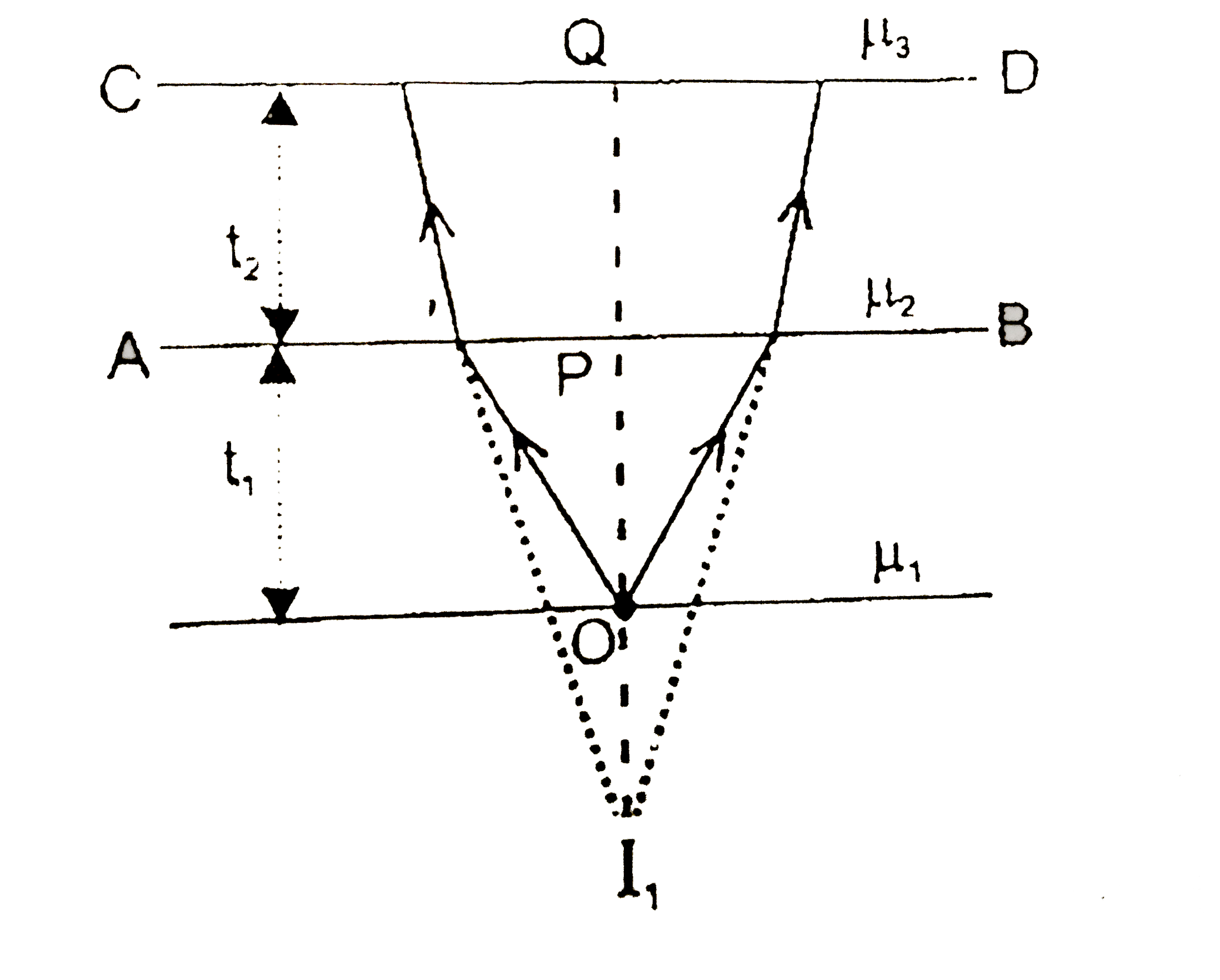
Depth of the object corresponding to incident ray striking `CD` in medium `mu_)(2) = i_(2) + Pl_(1)`

`= t_(2) + (t_(1))/(mu_(1)//mu_(2))`
Promotional Banner

Topper's Solved these Questions

  • GEOMATRICAL OPTICS

    RESONANCE|Exercise Exercise-1|142 Videos
  • GEOMATRICAL OPTICS

    RESONANCE|Exercise Exercise-2|63 Videos
  • GEOMATRICAL OPTICS

    RESONANCE|Exercise Advance level Problems|35 Videos
  • EXPERIMENTAL PHYSICS

    RESONANCE|Exercise PART -II|10 Videos
  • GRAVITATION

    RESONANCE|Exercise HIGH LEVEL PROBLEMS|16 Videos

Similar Questions

Explore conceptually related problems

In above question if observer is in medium mu_(3) what is the apparenet depth of object seen below surface 1CD .

In the above question, what will be the antenna current if depth of modulation is increased to 0.9?

Find the apparent depth of object O below surface AB , seen by an observer in mediumn of refractive index mu_(2)

In the above question, the ralation remains the same whether (A) image is real or virtual (B) refracting surface is convex or cancave (C )light is going from rarer to denser medium or from denser to rarer medium (D) object is close to far off from the refracting surface Choose the wrong statement

If epsilon_(0) and mu_(0) are, respectively, the electric permittivity and magnetic permeability of free space, epsilon and mu the corresponding quantities in a medium, the index of refraction of the medium in terms of the above parameters is "________________" .

If epsilon_0 and mu_o are, respectively, the electric permittivity and magnetic permeability of free space, epsilon and mu the corresponding quantities in a medium, the index of refraction of the medium in terms of the above parameters is….

A luminous object O is located at the bottom of a big pool of liquid of refractive index mu and depth h. The object O emits rays upwards in all directions, so that a circle of light is formed at the surface of the liquid by the rays which are refracted into the air. what happens to the rays beyond the circle ? Determine the radius and the area of the circle .

Determine the value of the angle of incidence for a ray of light travelling from a medium of refractive index mu_1 = sqrt(2) into the medium of refractive index mu_2 = 1 , so that it just grazes along the surface of separation.

RESONANCE-GEOMATRICAL OPTICS -Problem
  1. A concave mirror is placed inside water its shining surface upwards an...

    Text Solution

    |

  2. Prove that the shift in position of object due to parallel slab is g...

    Text Solution

    |

  3. Find the apparent depth of object O below surface AB, seen by an obs...

    Text Solution

    |

  4. In above question what is the depth of object corresponding to inci...

    Text Solution

    |

  5. In above question if observer is in medium mu(3) what is the apparen...

    Text Solution

    |

  6. Find the radius of circle of illuminance, if a luminous object is pla...

    Text Solution

    |

  7. A ship is salling in river. An observe is situated at a depth h i...

    Text Solution

    |

  8. Find r, r', e delta for the case shown in figure

    Text Solution

    |

  9. For the case shown in figure shown in figure prove the relations r' ...

    Text Solution

    |

  10. From the graph fo angle of deviation delta versus angle of incidwenc...

    Text Solution

    |

  11. If two prisms are combined , as shown in figure, find the total angu...

    Text Solution

    |

  12. The dispersive powers of crown and flint glasses are 0.03 and 0.05 res...

    Text Solution

    |

  13. See the situatiion shown on figure (1) Find the positiion of imag...

    Text Solution

    |

  14. Find the focal length of a double-convex lens with R(1) = 15cm and R(...

    Text Solution

    |

  15. Find the focal length of a plance-convex lens with R(1) = 15cm and R...

    Text Solution

    |

  16. Find the focal length of a convavo-convex lens (Positive me menisus ) ...

    Text Solution

    |

  17. Figure shows a point object and a divegoing lens Find the final ...

    Text Solution

    |

  18. An extended real object is placed perpendicular to the principle axis...

    Text Solution

    |

  19. Find the equivalent focal length of the system for paraxal rays paral...

    Text Solution

    |

  20. See the figure Find the equivalent focal length of the combination ...

    Text Solution

    |

