Home
Class 12
PHYSICS
If two prisms are combined , as shown i...

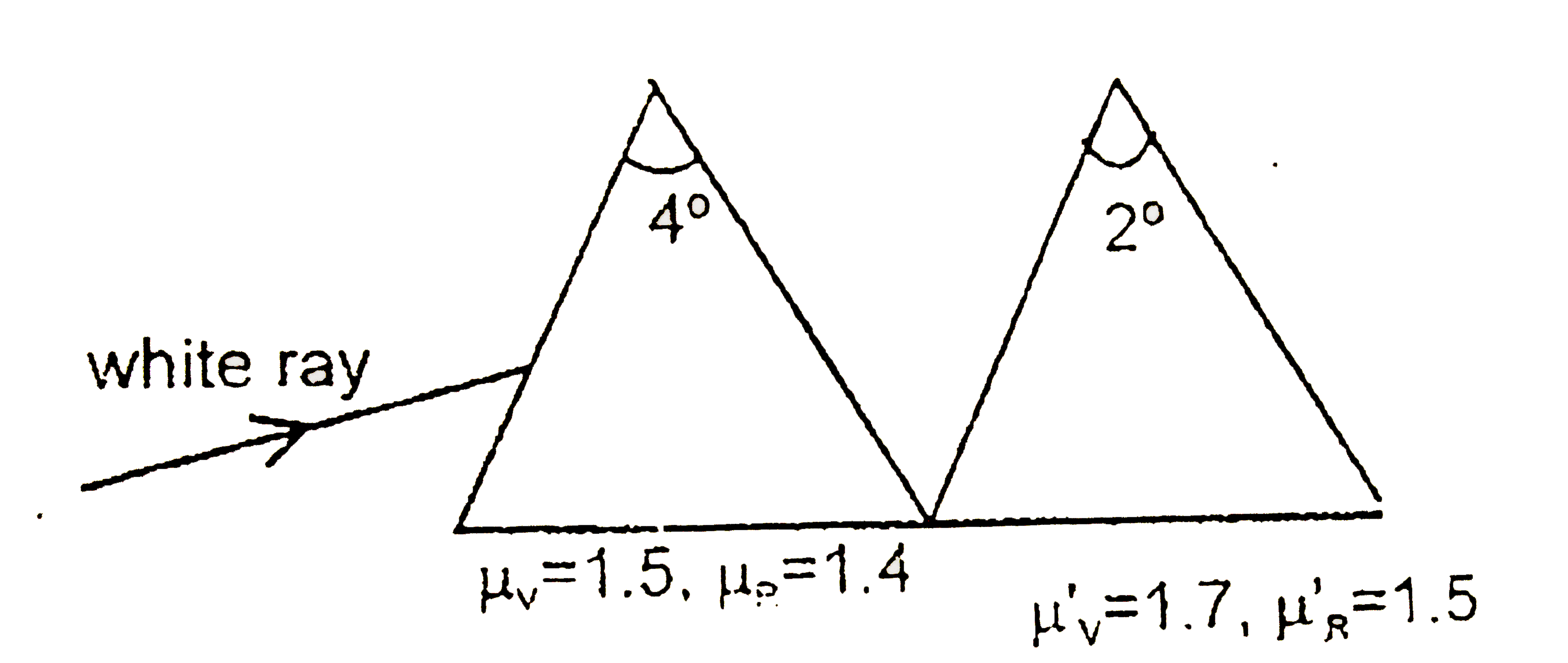
If two prisms are combined , as shown in figure, find the total angular dispersion and angle of deviation suffered by a white ray of light incident on the combination.

Text Solution

Verified by Experts
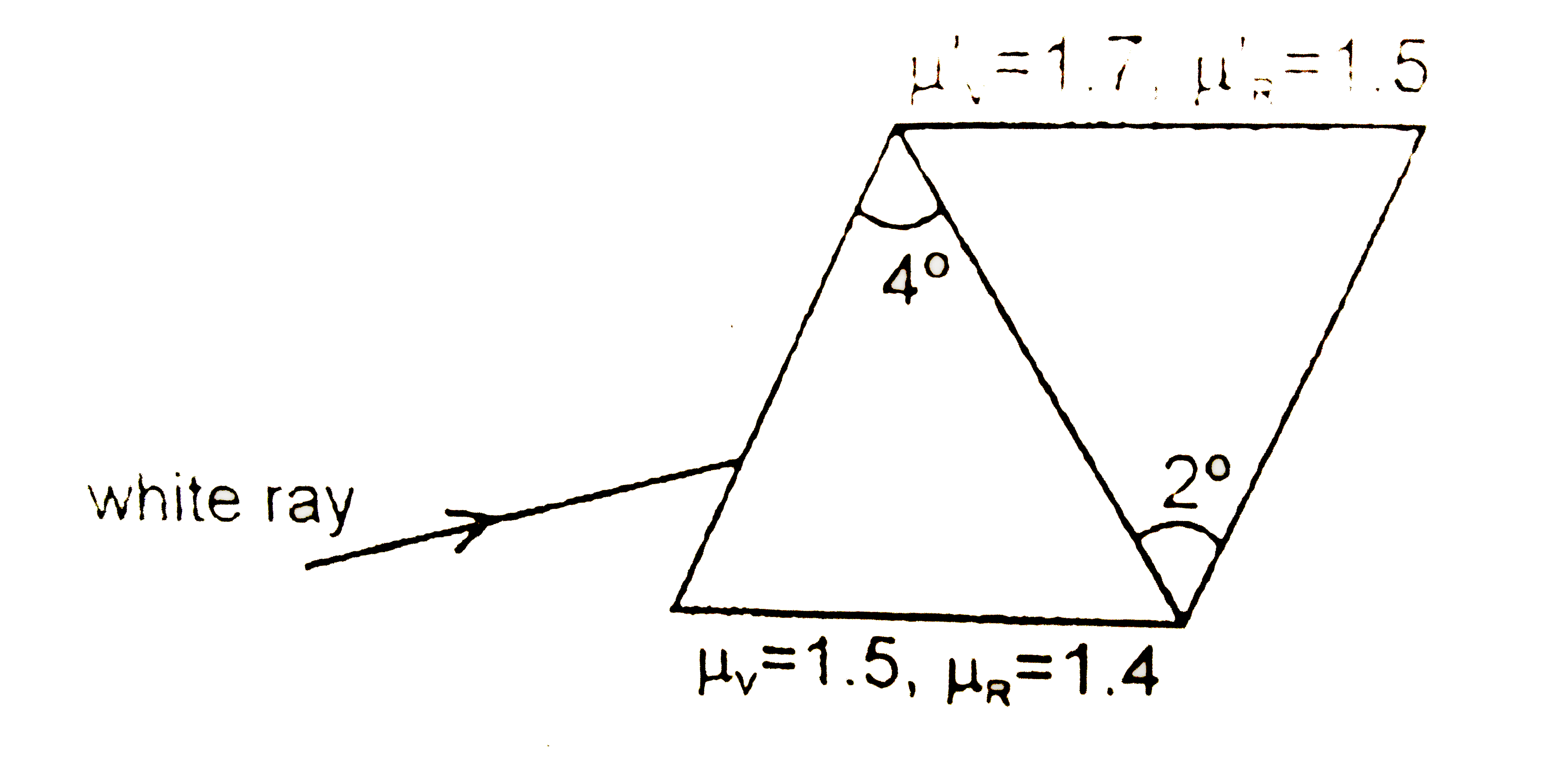
Net angular dispertion
`= (delta_(V) - delta_(t)) - (delta'_(v) - delta'_(t))`
`= (mu_(v) - mu_(f))A - (mu'_(v) - mu'_(r)) A'`
`= (1.5+1.4)xx4^(@) - (1.7-1.5)xx2^(@) = 0`
Angle of deviation `= ((mu_(v) + mu_(r))/(2)-1) A - ((mu'_(V) + mu'_(r))/(2) - 1)` A'
`= ((1.5+1.4)/(2)-1) xx 4^(@) - ((1.7+1.5)/(2)-1) xx2^(@) = 0.6^(@)`
Promotional Banner

Topper's Solved these Questions

  • GEOMATRICAL OPTICS

    RESONANCE|Exercise Exercise-1|142 Videos
  • GEOMATRICAL OPTICS

    RESONANCE|Exercise Exercise-2|63 Videos
  • GEOMATRICAL OPTICS

    RESONANCE|Exercise Advance level Problems|35 Videos
  • EXPERIMENTAL PHYSICS

    RESONANCE|Exercise PART -II|10 Videos
  • GRAVITATION

    RESONANCE|Exercise HIGH LEVEL PROBLEMS|16 Videos

Similar Questions

Explore conceptually related problems

Two thin prisms are combined such that they neither produce any average deviation nor do they cause any dispersion when white light is incident on the combination. Angle of one prism is A = 2° and refractive index of its glass for red, yellow and violet lights are 1.49, 1.50 and 1.51 respectively. Find the dispersive power of the glass of the other prism.

Find the angle of deviation suffered by the light ray shown in figure. The refractive index mu = for the prism material.

The angle of a prism is 60^(@) and its refractive index is sqrt(2) . The angle of minumum deviation sufferred by a ray of light in passing through it is

The angle of a prism is 60^(@) and its refractive index is sqrt2 . The angle of minimum deviation suffered by a ray of light in passing through it is

A ray is incident on the first prism at an angle of incidence 53^(@) as shown in the figure. The angle between side CA and B'A' for the net deviation by both the prisms to be double of the deviation produced by the first prism, will be:

A ray is incident on the first prism at an angle of incidence of 53^(@) as shown in the figure . The angle between side CA and B'A' for the net deviation by both the prisms to be double of the deviation produced by the first prism , will be

A ray is incident on a sphere of refractive index sqrt(2) as shown in figure. Angle of refraction of the ray inside sphere is 30^(@) if total deviation suffered by the ray is 30x^(0) , then find x.

A ray of light is incident on a prism as shown in fig. Find the total deviation suffered by the ray if /_BAC = 1^(@) and /_CAD = 2^(@) .

Draw the path of light ray passing through a prism. Label angle of incidence and angle of deviation in the ray diagram.

RESONANCE-GEOMATRICAL OPTICS -Problem
  1. A concave mirror is placed inside water its shining surface upwards an...

    Text Solution

    |

  2. Prove that the shift in position of object due to parallel slab is g...

    Text Solution

    |

  3. Find the apparent depth of object O below surface AB, seen by an obs...

    Text Solution

    |

  4. In above question what is the depth of object corresponding to inci...

    Text Solution

    |

  5. In above question if observer is in medium mu(3) what is the apparen...

    Text Solution

    |

  6. Find the radius of circle of illuminance, if a luminous object is pla...

    Text Solution

    |

  7. A ship is salling in river. An observe is situated at a depth h i...

    Text Solution

    |

  8. Find r, r', e delta for the case shown in figure

    Text Solution

    |

  9. For the case shown in figure shown in figure prove the relations r' ...

    Text Solution

    |

  10. From the graph fo angle of deviation delta versus angle of incidwenc...

    Text Solution

    |

  11. If two prisms are combined , as shown in figure, find the total angu...

    Text Solution

    |

  12. The dispersive powers of crown and flint glasses are 0.03 and 0.05 res...

    Text Solution

    |

  13. See the situatiion shown on figure (1) Find the positiion of imag...

    Text Solution

    |

  14. Find the focal length of a double-convex lens with R(1) = 15cm and R(...

    Text Solution

    |

  15. Find the focal length of a plance-convex lens with R(1) = 15cm and R...

    Text Solution

    |

  16. Find the focal length of a convavo-convex lens (Positive me menisus ) ...

    Text Solution

    |

  17. Figure shows a point object and a divegoing lens Find the final ...

    Text Solution

    |

  18. An extended real object is placed perpendicular to the principle axis...

    Text Solution

    |

  19. Find the equivalent focal length of the system for paraxal rays paral...

    Text Solution

    |

  20. See the figure Find the equivalent focal length of the combination ...

    Text Solution

    |

