Home
Class 12
PHYSICS
A right-angle crown glass prism with cri...

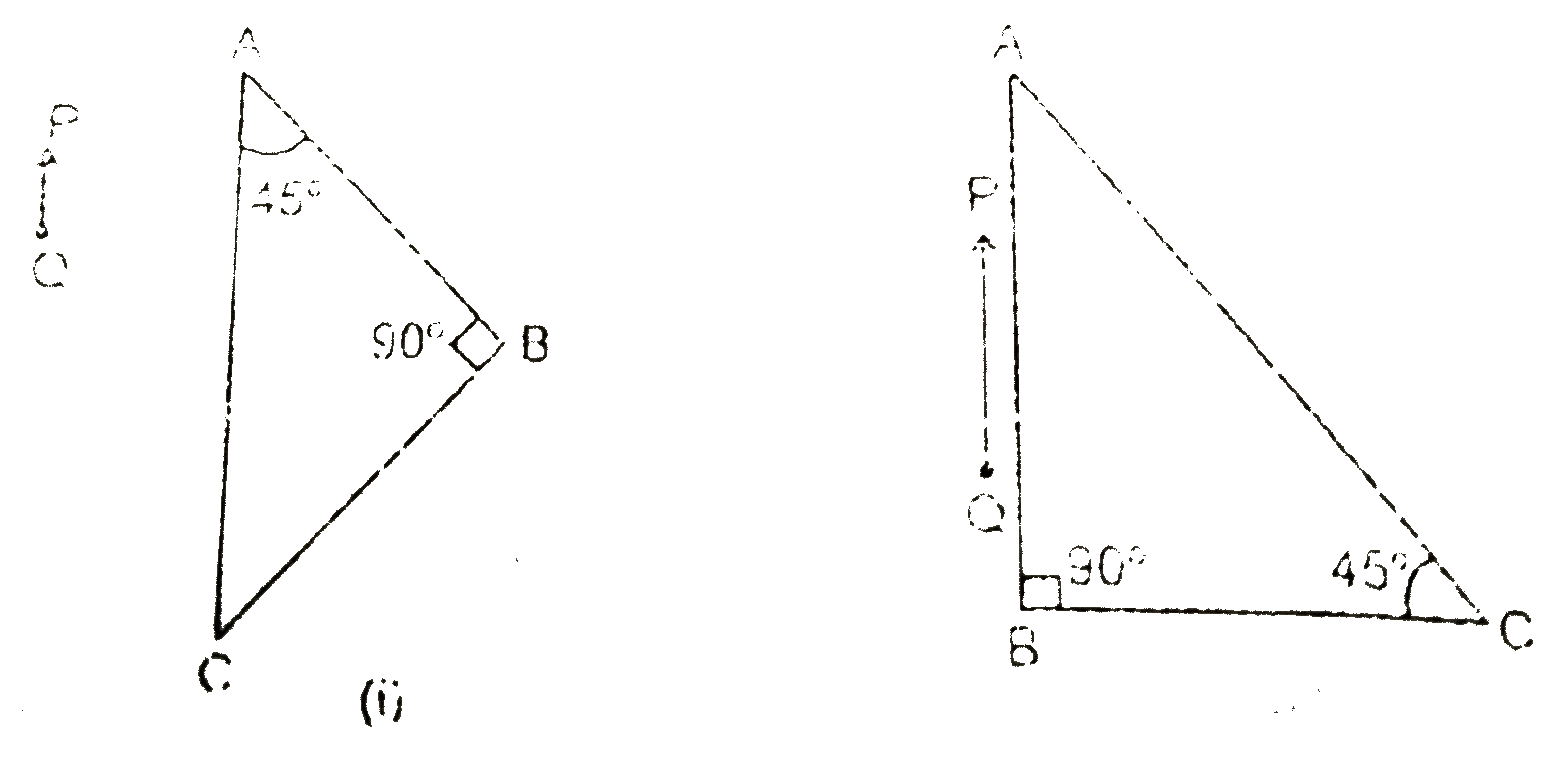
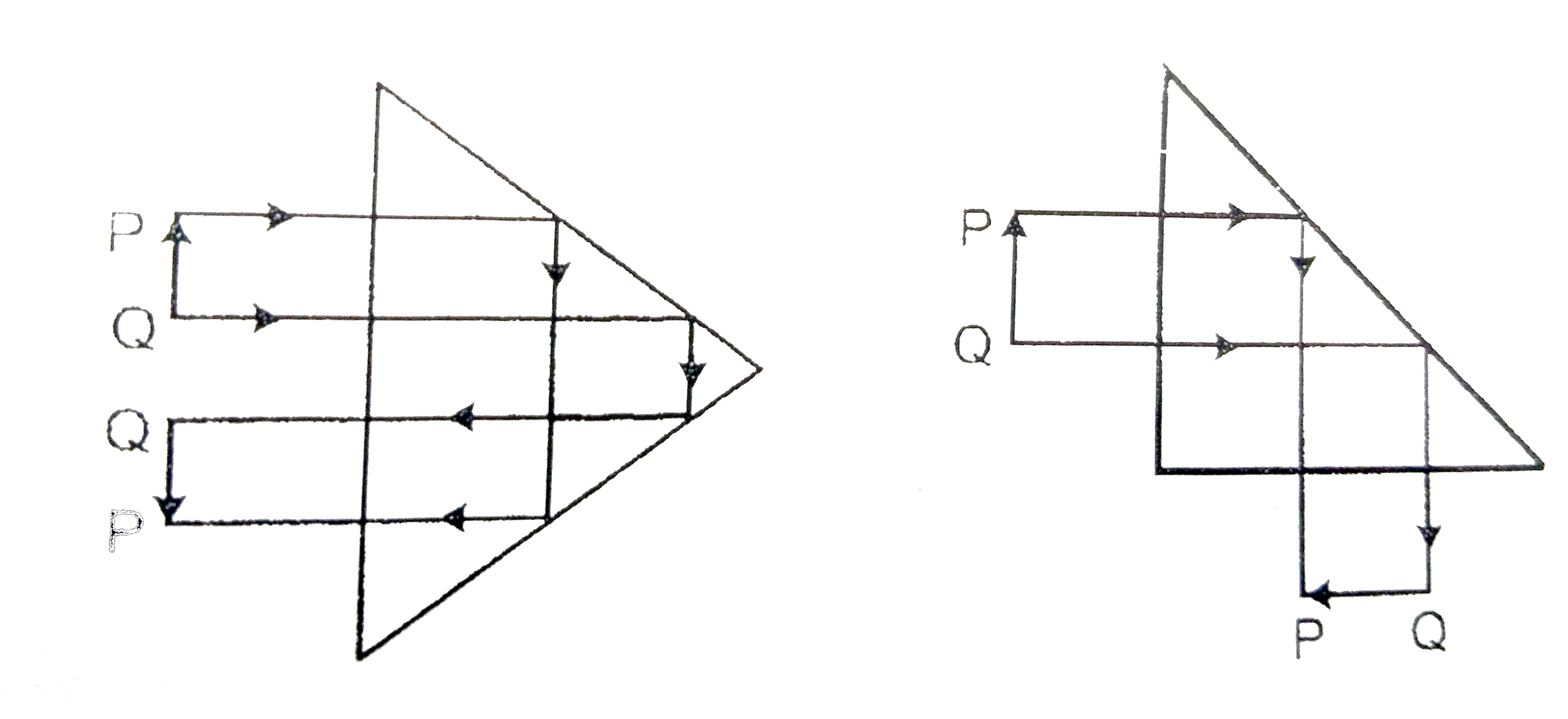
A right-angle crown glass prism with critical angle `41^(@)` is placed berore an object, `PQ`, in two position as shown in the figure `(i)` and `(ii)`. Trace the paths of the rays from `P` and `Q` passing through the prism in the two cases.

Text Solution

Verified by Experts
Promotional Banner

Topper's Solved these Questions

  • GEOMATRICAL OPTICS

    RESONANCE|Exercise Advance level Problems|35 Videos
  • GEOMATRICAL OPTICS

    RESONANCE|Exercise Exercise-2|63 Videos
  • EXPERIMENTAL PHYSICS

    RESONANCE|Exercise PART -II|10 Videos
  • GRAVITATION

    RESONANCE|Exercise HIGH LEVEL PROBLEMS|16 Videos

Similar Questions

Explore conceptually related problems

A ray PQ is incident normally on the face AB of a triangular prism of refracting angle of 60^(@) , made of a transparent material of refractive index 2/sqrt(3) , as shown in the figure. Trace the path of the ray as it passes through the prism. Also calculate the angle of emergence and angle of deviation.

A ray is incident on interface of two media at critical angle as shown in the figure.

Consider a light beam incident from air to a glass slab at Brewster's angle as shown in Figure. A polaroid is placed in the path of the emergent ray at point P and rotated an axis passing through the centre and perpendicular to the plane of the polaroid.

Consider a light beam incident from air to a glass slab at Brewster's angle as shown in figure. A polaroid is placed in the path of the emergent ray at point P and rotated about an axis passing through the centre and pependicular to the plane of the plaroid.

In the position of minimum deviation when a ray of yellow light passes through the prism then its angle of incidence is

Two monochromatic rays of light are incident normally on the face AB of an isosceles right-angled prism ABC . The refractive indices of the glass prism for the two rays '1' and '2' are respectively 1.38 and 1.52 . Trace the path of these rays after entering through the prism.

RESONANCE-GEOMATRICAL OPTICS -Exercise-3
  1. A green light is incident from the water to the air - water interface ...

    Text Solution

    |

  2. Monochromatic light is incident on a glass prism of angle A. If the re...

    Text Solution

    |

  3. A right-angle crown glass prism with critical angle 41^(@) is placed b...

    Text Solution

    |

  4. A ray of light falls on a mirror normally. What are the values of angl...

    Text Solution

    |

  5. What is far-sightedness or hypermatropia? What cause hypermetropia How...

    Text Solution

    |

  6. A double convex lens of glass of refractive index 1.6 has its both sur...

    Text Solution

    |

  7. A convex mirror always produces a virtual image of real object indepen...

    Text Solution

    |

  8. A converging lens of refractive index 1.5 is kept in a liquid medium h...

    Text Solution

    |

  9. What is the main reason for axial charomatic aberration in the formati...

    Text Solution

    |

  10. An equiconvex lens, with redii of curvature of magnitude 10 cm each, i...

    Text Solution

    |

  11. What is the ratio of velocities of two light waves travelling in vacuu...

    Text Solution

    |

  12. (a) For a ray of light travelling from a denser medium of refractive ...

    Text Solution

    |

  13. Derive the lens formula, (1)/(f)=(1)/(v)-(1)/(u) for a concave lens, u...

    Text Solution

    |

  14. A ray of light passing through an equilateral traingular glass prism f...

    Text Solution

    |

  15. (a) Draw a ray diagram showing the passage of light through a glass pr...

    Text Solution

    |

  16. A glass lens of refractive index 1.5 is placed in a trough of liquid....

    Text Solution

    |

  17. Why are convex mirrors used as side view mirrors in cars ?

    Text Solution

    |

  18. Three light rays red (R), green (G) and blue (B) are incident on a rig...

    Text Solution

    |

  19. The for point of a myopic person is 80 cm in front of the eye. What is...

    Text Solution

    |

  20. (a) (i) Draw a labelled ray diagram to show the formation of image in ...

    Text Solution

    |

