Home
Class 12
PHYSICS
(a) Draw the ray diagram showing the geo...

(a) Draw the ray diagram showing the geometry of formation of the image of a point object situated on the principal axis, and on the convex side, of a spherical of radius of curvature `R` . Taking the rays as incident from a medium of refractive index `n_(1)` to anothr of refractive index `n_(2)` show that `(n_(2))/(v)-(n_(1))/(u)=(n_(2)-n_(1))/(R)` where the symbols have their usual meaning.
(b) Use this relation to obtain the (thin) lens maker's formula.

Text Solution

Verified by Experts
Refraction of spherical surface :
(a) Sign conventions : (i) All distances are measured from the pole of the spherical surface.
(ii) Distances measured in the direction of incident light are taken positive.
(iii) Distances measured in the opposite direction of incident light are negative.
Assumptions : (i) The object is a point object placed on the principal axis.
(ii) Aperture of the refracting surface is small.
(iii) Angle of incidence and angle of refraction are small
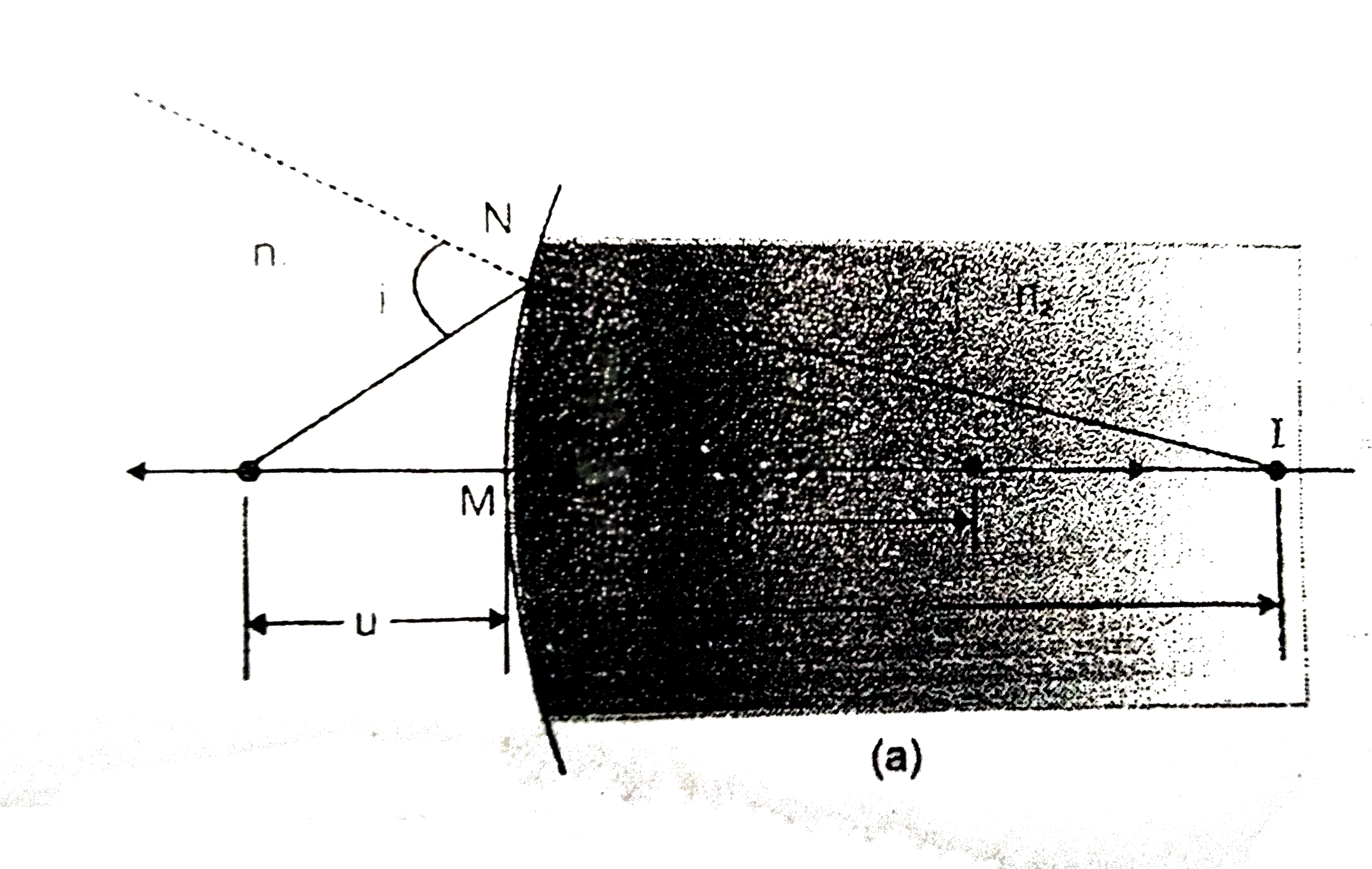
Figure `(a)` shows the geometry of formation of image `I` of an object `O` on the principal axis of a spherical surface with centre of curvature `C`, and radius of curvature `R`. The rays are incident from a medium of refractive index `n_(1)`, to another of refractive index `n_(2)`. As before, we take the aperture (or the lateral size) of the surface to be small compared to other distances involved, so that small angle approximation can be made. In particular, `NM` will be taken to be nearly equal to the length of the perpendicular from the point `N` on the principal axis. We have, for small angles,
`tan/_NOM=(MN)/(OM)`
`tan/_NCM=(MN)/(MC)`
`tan/_NLM=(MN)/(MI)`
Now, for `DeltaNOC`, `I` is the exterior angle.
Therefore, `i=/_NOM+/_NCM`
`i=(MN)/(OM)+(MN)/(MC)`
similarly
`r=/_NCM-/_NLM`
`i.e. r=(MN)/(MC)-(MN)/(MI)`
Now, by Snell's law
`n_(1) sin i=n_(2) sin r`
or for small angles
`n_(1)i=n_(2)r`
Substituting `i` and `r` from Eqs we get
`(n_(1))/(OM)+(n_(2))/(MI)=(m_(2)-n_(1))/(MC)`
Here, `OM,MI` and and `MC` represent magnitudes of distances. Applying the cartesian convention, substuting sign convention,
`OM=-mu, MI=+v, MC=+R`
substituting these in Eq. we get,
`(n_(2))/(v)-(n_(1))/(u)=(n_(2)-n_(1))/(R)`
Equation gives us a relation between object image distance in terms of refractive index of the medium and the radius of cuvature of the curved spherical, It holds for any curved spherical surface.

(b) Lens Maker's Formula :
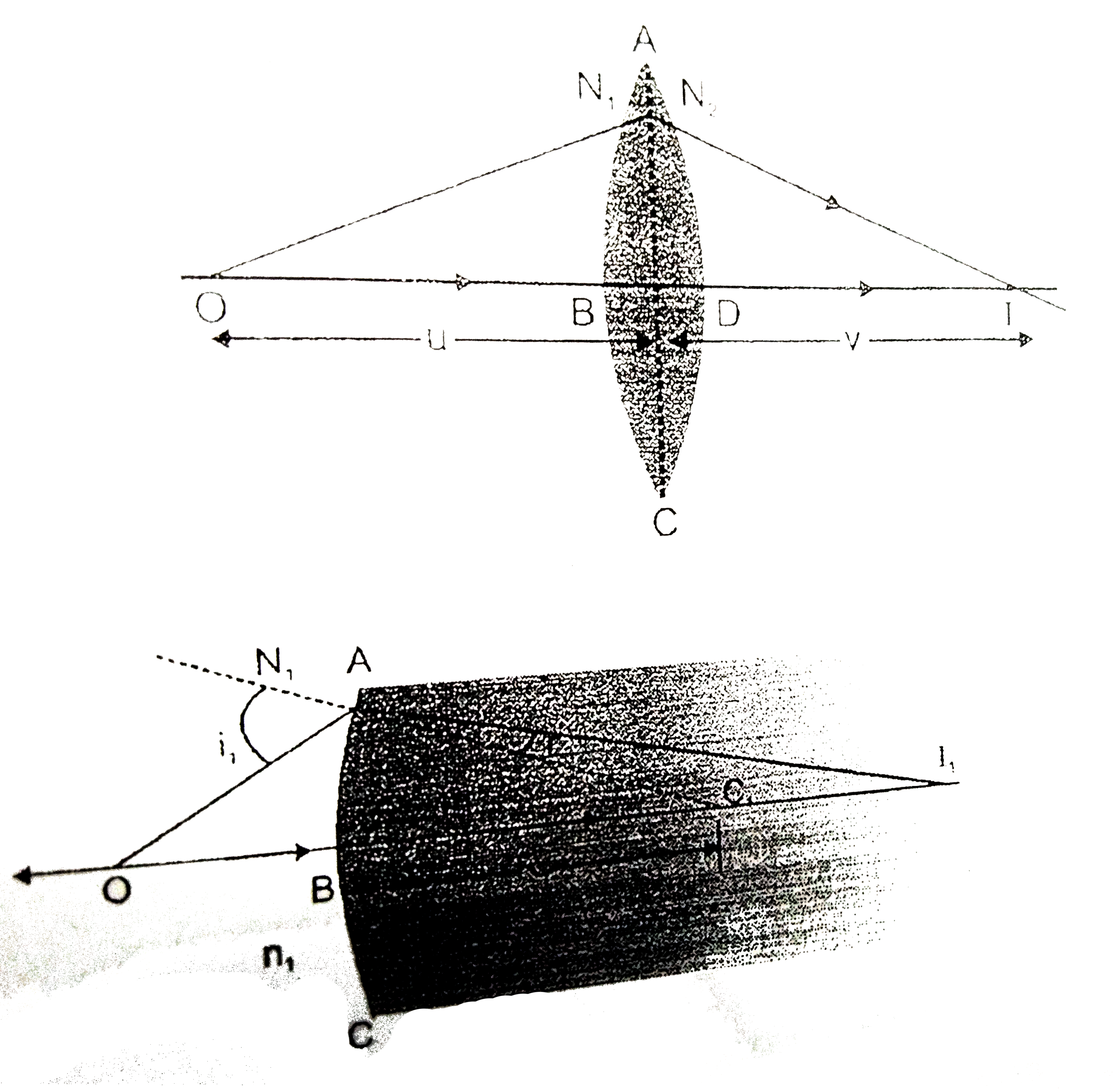
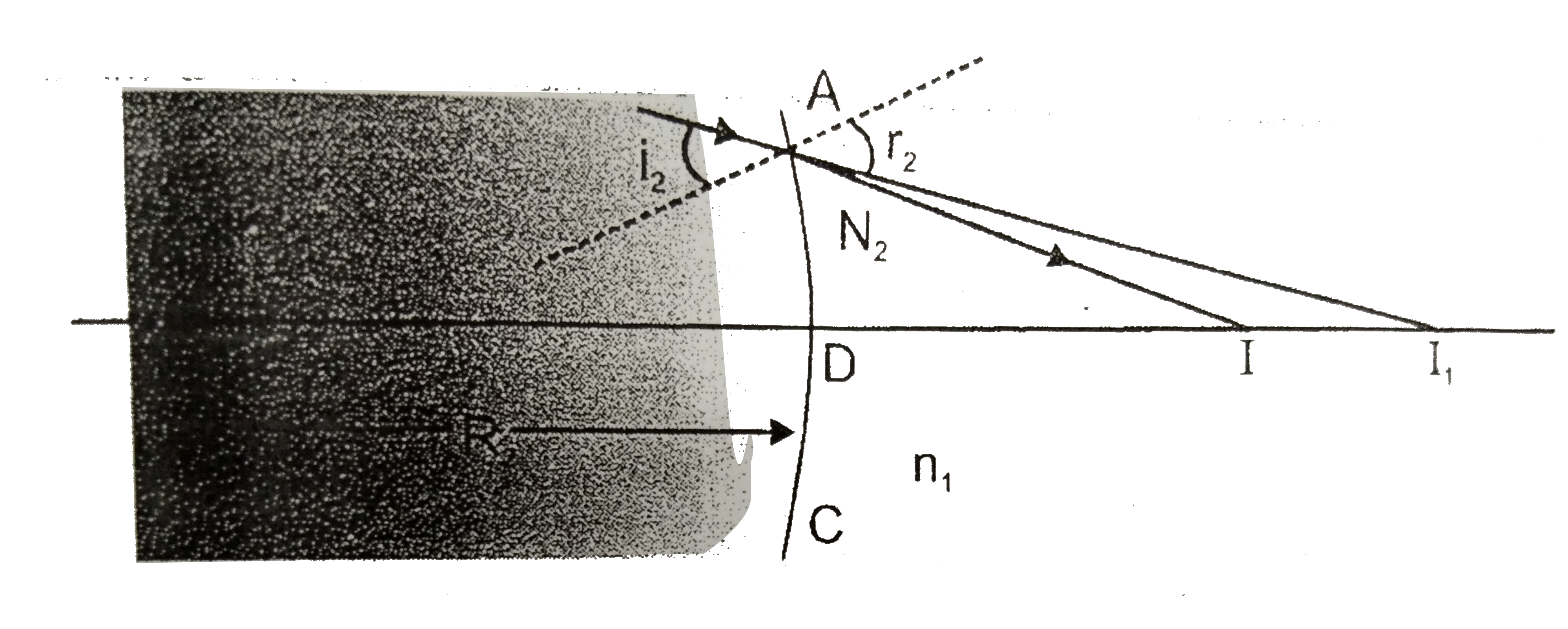
The first refractive surface forms the image `I_(1)` of object `O`. The image `I_(1)` acts as a virtual object for the second surface that forms the image at `I` [Fig.`(b)`]. Applying to the first interface `ABC`, we get
`(n_(1))/(OB)+(n_(1))/(DI)=(n_(2)-n_(1))/(DC_(21)) ......(i)`
A similar procedure applied to the second interface `ADC` gives,
`-(n_(2))/(DI_(1))+(n_(1))/(DI)=(n_(2)-n_(1))/(DC_(2)) .........(ii)`
For a thin lens, `BI_(1)=DI_(1)`.
Adding Eqs. `(i)` and `(ii)`, we get
`(n_(1))/(OB)+(n_(1))/(DI)=(n_(2))((1)/(BC_(1))+(1)/(DC_(2)))`
Suppose the object is at infinity,
`i.e.,OBrarrinfty` and `DI=f`, Eq. `(ii)` gives

`(n_(1))/(f)=(n_(2)-n_(1))((1)/(BC_(1))+(1)/(DC_(2))) .........(iii)`
The point where image of an object placed at infinity is formula is called the focus `F`, of the lens and the distance `f` given its focal length. `A` lens has two foci, `F` and `F'`, on either side of it . By the sign convention, `BC_(1)=+R_(1)`
`DC_(2)=-R_(2)`
So Eq. `(iii)` can be written as
`(1)/(f)=(n_(21)-1)((1)/(R_(1))-(1)/(R_(2))) ............(iv)` `(n_(21)=(n_(2))/(n_(1)))`
Equation `(iv)` is known as the lens maker's formula. It is useful to design lenses of desired focal length using surfaces of sutable radii of curvature. Note that the formula is true for a concave lens also. In that case `R_(1)` is negative, `R_(2)` positive and therefore, `f` is negative.
Promotional Banner

Topper's Solved these Questions

  • GEOMATRICAL OPTICS

    RESONANCE|Exercise Advance level Problems|35 Videos
  • GEOMATRICAL OPTICS

    RESONANCE|Exercise Exercise-2|63 Videos
  • EXPERIMENTAL PHYSICS

    RESONANCE|Exercise PART -II|10 Videos
  • GRAVITATION

    RESONANCE|Exercise HIGH LEVEL PROBLEMS|16 Videos

Similar Questions

Explore conceptually related problems

A ray of light travels from a medium of refractive index n_(1) to a medium of refractive index n_(2) . If angle of incidence is i and angle of refraction is r, than (sin i)/(sin r) is equal to

Monochromatic light of wavelength lambda_1 travelling in medium of refractive index n_1 enters a denser medium of refractive index n_2 . The wavelength in the second medium is

Assertion : Units of Rydberge constant R are m^(-1). Reason : It follows from Bohr's formula [barV = R((1)/(n_1^2) - (1)/(n_2^2))], where the symbole have their usual meaning.

When a lens of refractive index n_(1) , then the lens looks to be dissapeared only, if

RESONANCE-GEOMATRICAL OPTICS -Exercise-3
  1. The for point of a myopic person is 80 cm in front of the eye. What is...

    Text Solution

    |

  2. (a) (i) Draw a labelled ray diagram to show the formation of image in ...

    Text Solution

    |

  3. (a) Draw the ray diagram showing the geometry of formation of the imag...

    Text Solution

    |

  4. The image obtained with a convex lens is erect and its length is 4 tim...

    Text Solution

    |

  5. A converging lens is kept coaxially in contact with a diverging lens -...

    Text Solution

    |

  6. Draw a ray diagram to show the working of a compound microscope. Deduc...

    Text Solution

    |

  7. Two convex lenses of focal length 20 cm and 1 cm constitute a telescop...

    Text Solution

    |

  8. A convex lens made up of glass of refractive index 1.5 is dippedin tur...

    Text Solution

    |

  9. Use the mirror equation to show that (a) an object placed btween f and...

    Text Solution

    |

  10. A gaint refrecting telescope at an observatory has an objective lens o...

    Text Solution

    |

  11. A beam of light converges to a point P.A lens is placed in the path of...

    Text Solution

    |

  12. For the same angle of incidence in media P,Q and R, the angles of refr...

    Text Solution

    |

  13. Define magnifying power of a telescope. Write its expression. A smal...

    Text Solution

    |

  14. An object AB is kept in front of a concave mirror as shown in Fig. ...

    Text Solution

    |

  15. You are given three lenses L(1),L(2) and L(3) each of focal length 20 ...

    Text Solution

    |

  16. Describe a reflecting type telescope. What are its advantage over the ...

    Text Solution

    |

  17. Which type of lens is used to correct astigmatisum ?

    Text Solution

    |

  18. A biconcave lens made of transparent material of refractive index 1.25...

    Text Solution

    |

  19. Two monochromatic rays of light are incident normally on the face AB o...

    Text Solution

    |

  20. A convex lens of focal length 20cm is placed coaxilly with a convex mi...

    Text Solution

    |