Home
Class 12
PHYSICS
If the lower spring is cut, find acceler...

If the lower spring is cut, find acceleration of the blokcs, immediately after cutting the spring.

Text Solution

Verified by Experts
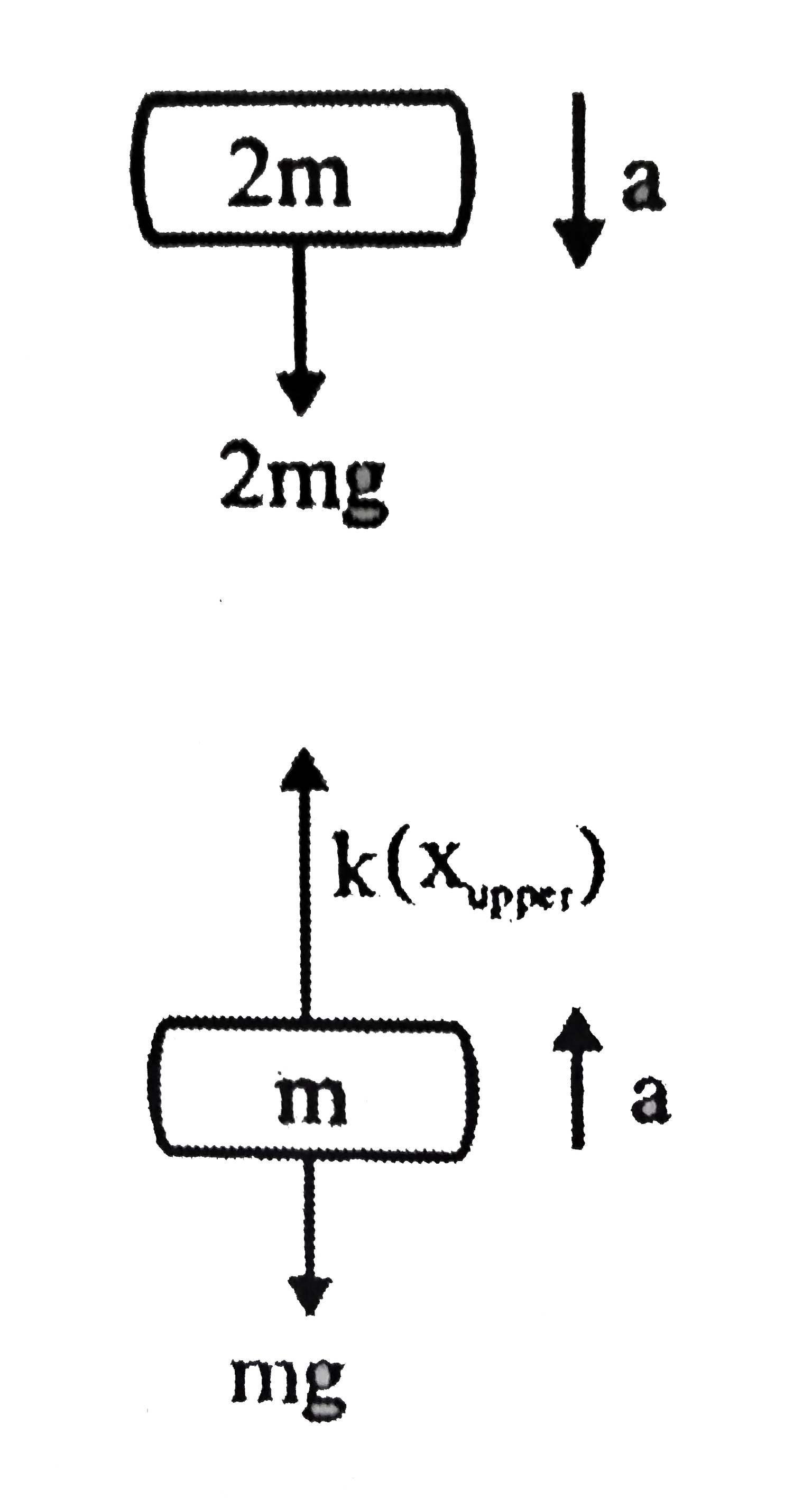
Intial stretches
`x_("upper")=(3mg)/(k)&x_("lower")=(mg)/(k)`
On cutting the lower spring by virture of non-impulsive nature of speing the stretch in upper spring remains same. Thus,
Promotional Banner

Topper's Solved these Questions

  • NEWTON'S LAWS OF MOTION & FRICTION

    ALLEN|Exercise EXERCISE (S-1)|26 Videos
  • NEWTON'S LAWS OF MOTION & FRICTION

    ALLEN|Exercise EXERCISE (S-2)|9 Videos
  • MOTION IN A PALNE

    ALLEN|Exercise SOLVED EXAMPLE|28 Videos
  • NEWTONS LAWS OF MOTION

    ALLEN|Exercise EXERCISE-III|28 Videos

Similar Questions

Explore conceptually related problems

The system shown in the figure is in equilibrium and all the blocks are at rest. Assume that the masses of the strings, the pulley and the spring and negligible with respect to the masses of the blocks and friction is absent. Find the acceleration of block C, just after cutting the spring 1. [g=10ms^(-2)]

A block tied between identical springs is in equilirium. If upper spring is cut, then the acceleration of the nlock just after cut is 5 ms^(1) Now if instead of upper string lower spring is cut, then the acceleration of the block just after the cut will be (Take g=10 m//s^(2) ).

A block of mass m is connected two springs of spring constant 2k annd k , respectively , as shown in the vertical plane. At equilibrium , both springs are compressed by same length. If suddenly lower spring is cut, then acceleration of block, just after spring cut , is

The string between blocks of mass m and 2m is massless and inextensible. The system is suspended by a massless spring as shown. If the string is cut find the magnitudes of accelerations of mass 2m and m (immediately after cutting)

Block of mass m=10kg is suspended by two springs vertically as shown in the diagram. The block is at rest initially. Find the acceleration of block just after cutting the right spring.

A block tied between two identical springs is in equilibrium. If upper spring is cut then the acceleration of the block just after cut is 6m//s^(2) downwards. Now, if instead of upper spring, lower spring is being cut then the acceleration of the block just after the cut will be.

For the system at rest shown in Fig., determine the accelerations of all the loads immediately after the lower thread keeping the system in equilibrium has been cut. Assume that the threads are weightless and inextensible, the springs are weightless, the mass of the pulley is negligibly small, and there is no friction at the point of suspension.

Examples on cutting OF spring

Two blocks A and B of masses 2m and m, respectively, are connected by a massless and inextensible string. The whole system is suspended by a massless spring as shown in the fig The magnitudes of acceleration of A and B immediately after the string is cut, are respectively:

