Home
Class 12
PHYSICS
A passenger on a large ship sailing in a...

A passenger on a large ship sailing in a quiet sea hangs a ball from the ceiling of her cabin by means of a long thread. Whenever the ship accelerates , she notes that the pendulum ball lags behind the point of suspension and so the pendulum no longer hangs vertically. How large is the ship's acceleration when teh pendulum stands at an angle of `5^(@)` to teh vertical?

Text Solution

Verified by Experts
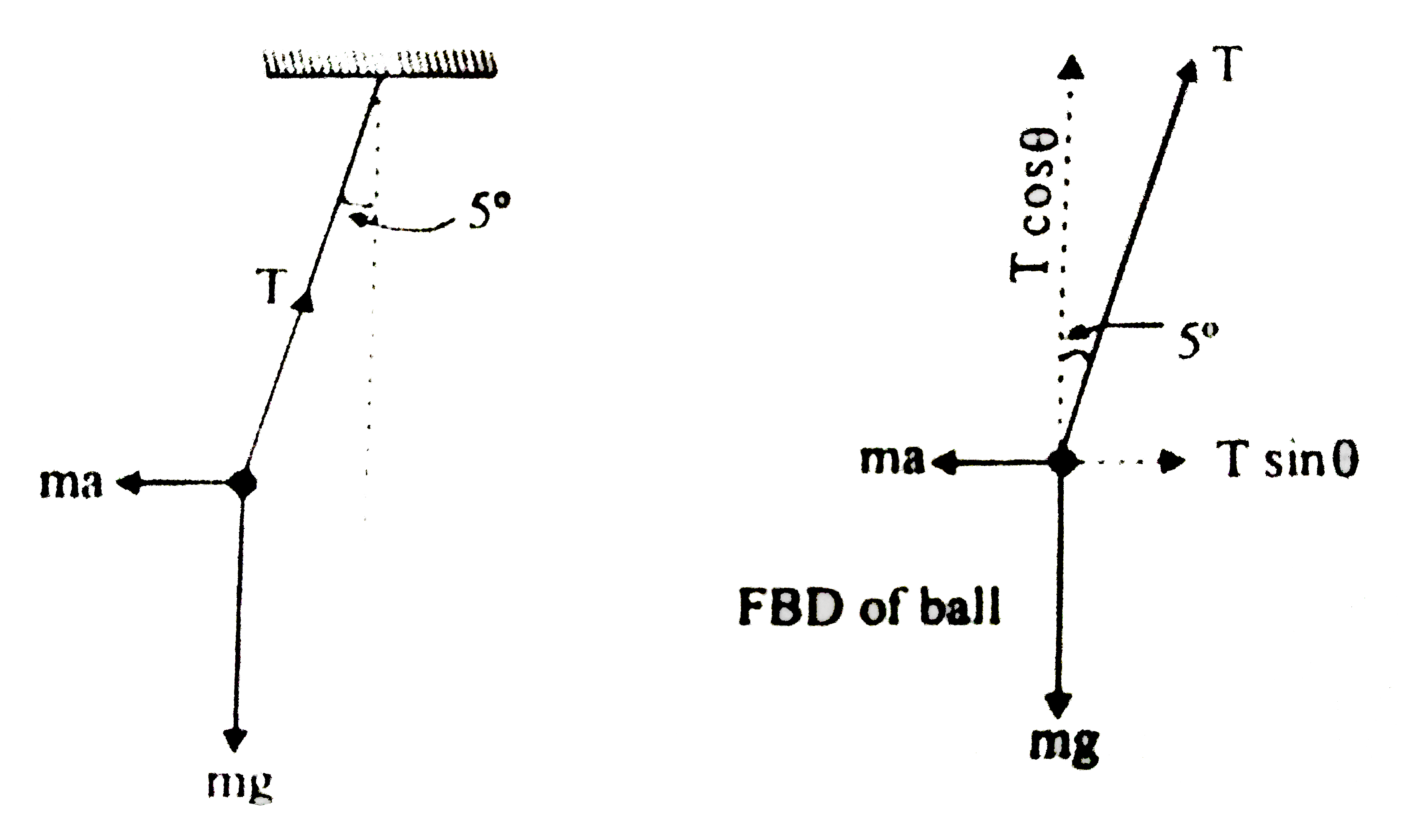
The ball is accelerated by the force T sin `5^(@).` Therefore T `sin5^(@)` = ma.
Vertical component `sumF=0,soT co5^(@)=mg.` By solving a = g `tan 5^(@)` = 0.0875 g = 0.86 `ms^(-2).`
Promotional Banner

Topper's Solved these Questions

  • NEWTON'S LAWS OF MOTION & FRICTION

    ALLEN|Exercise EXERCISE (S-1)|26 Videos
  • NEWTON'S LAWS OF MOTION & FRICTION

    ALLEN|Exercise EXERCISE (S-2)|9 Videos
  • MOTION IN A PALNE

    ALLEN|Exercise SOLVED EXAMPLE|28 Videos
  • NEWTONS LAWS OF MOTION

    ALLEN|Exercise EXERCISE-III|28 Videos

Similar Questions

Explore conceptually related problems

A passenger on a large ship sailing in a quiet sea hangs a ball from the celling of her cabin by means of a long thread. Whenever the ship acceleration when the pendulum stands at an angle of 5^(@) to the vertical ?

A pendulum is hanging from the ceiling of a car having an acceleration a_0 with respect to the road. Findthe angle made by the string with the vertical.

A pendulum is hanging from the ceiling of a railway carriage making an angle of 30^(@) with the vertical direction . The acceleration of the carriage is :

A small positively charged ball of mass m is suspended by an insulating thread of length L. This ball remains in equilibrium with string horizontal when another small charged ball is placed exactly at a distance L below the point of suspension of the first ball. The second ball is slowly moved away from the first ball to a far away point. (The second ball is moved horizontally so that the first ball does not accelerate). As a result the first ball lowers down to the original position of the second ball and the string become vertical. Find the work done by the external agent in removing the second ball.

A pendulum consists of an inextensible thread connected to a solid spherical ball of radius r. The distance between the point of suspension and the centre of the ball is L (gt gt r) . Calculate the percentage difference in the time period of this pendulum to the time period of a simple pendulum of length L. How large is this difference for r = 5 cm and L = 100 cm.

A pendulum has a period T for small osillations. An obstacle is placed directly beneath the pivot, so that only the lowest one - quarter of the string can follow the pendulum bob when it swings to the left of its resting position. The pendulum is released from rest at a certain point. How long will it take to return to that point again ? In answering this question, you may assume that the angle between the moving string and the vertical stays small throughout the motion.

