Home
Class 12
PHYSICS
In the adjacent figure, mass of A, B and...

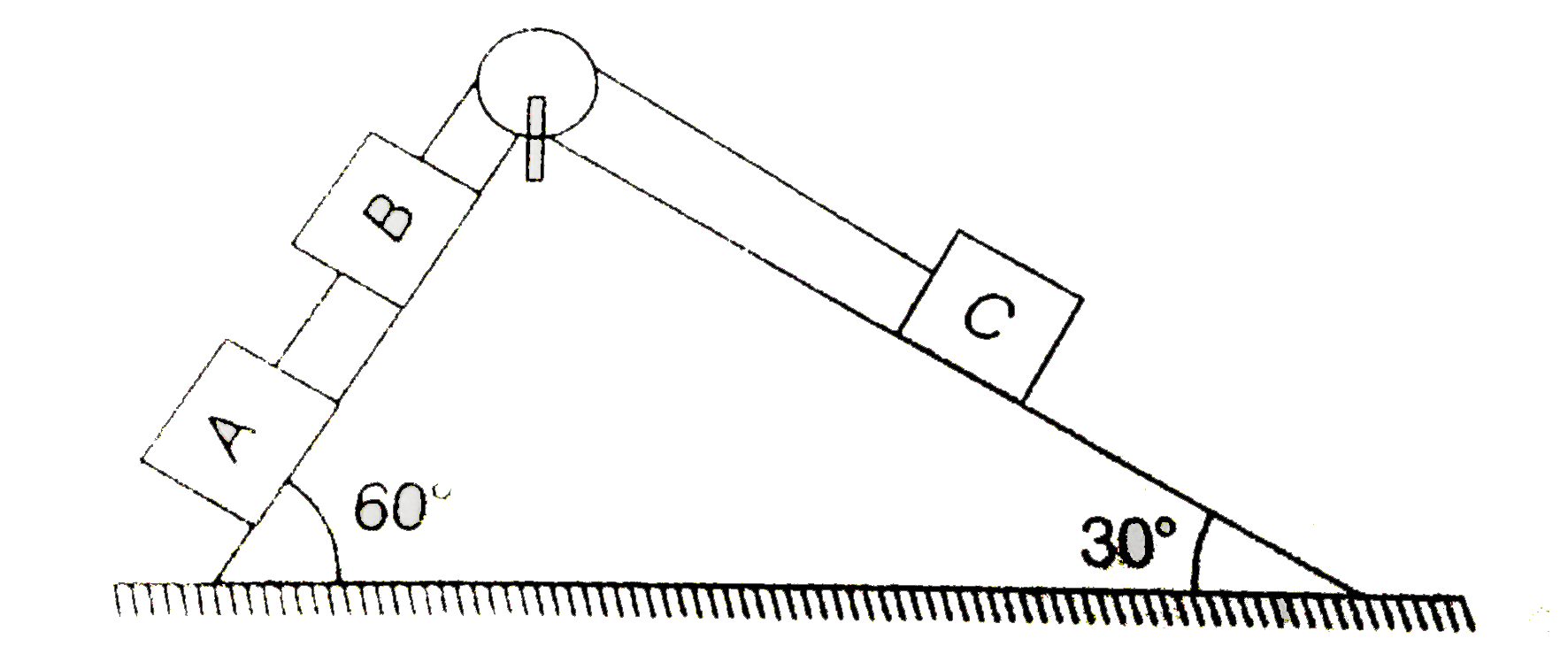
In the adjacent figure, mass of A, B and C are 1 kg , 3 kg and 2 kg, respectively. Find

(a) the acceleration of the system, and
(b) tensions in the string .
Neglect friction. (g`=10ms^(-2)`)

Text Solution

Verified by Experts
(a) IN this case net pulling force
= `m_(A)g sin 60^(@)+m_(B)g sin60^(@)-m_(C)g sin 30^(@)`
`=(M_(A)+m_(B))g sin 60^(@)-m_(C)g sin30^(@)`
`=(1+3)xx10xx(sqrt3)/(2)-2xx10xx1/2`
`=20sqrt3-10=20xx1.732-10=24.64N`
Total mass being pulled = 1+ 3+2= 6 kg

`therefore` Acceleration of the system a `=(24.64)/(6)=4.1m//s^(2)`
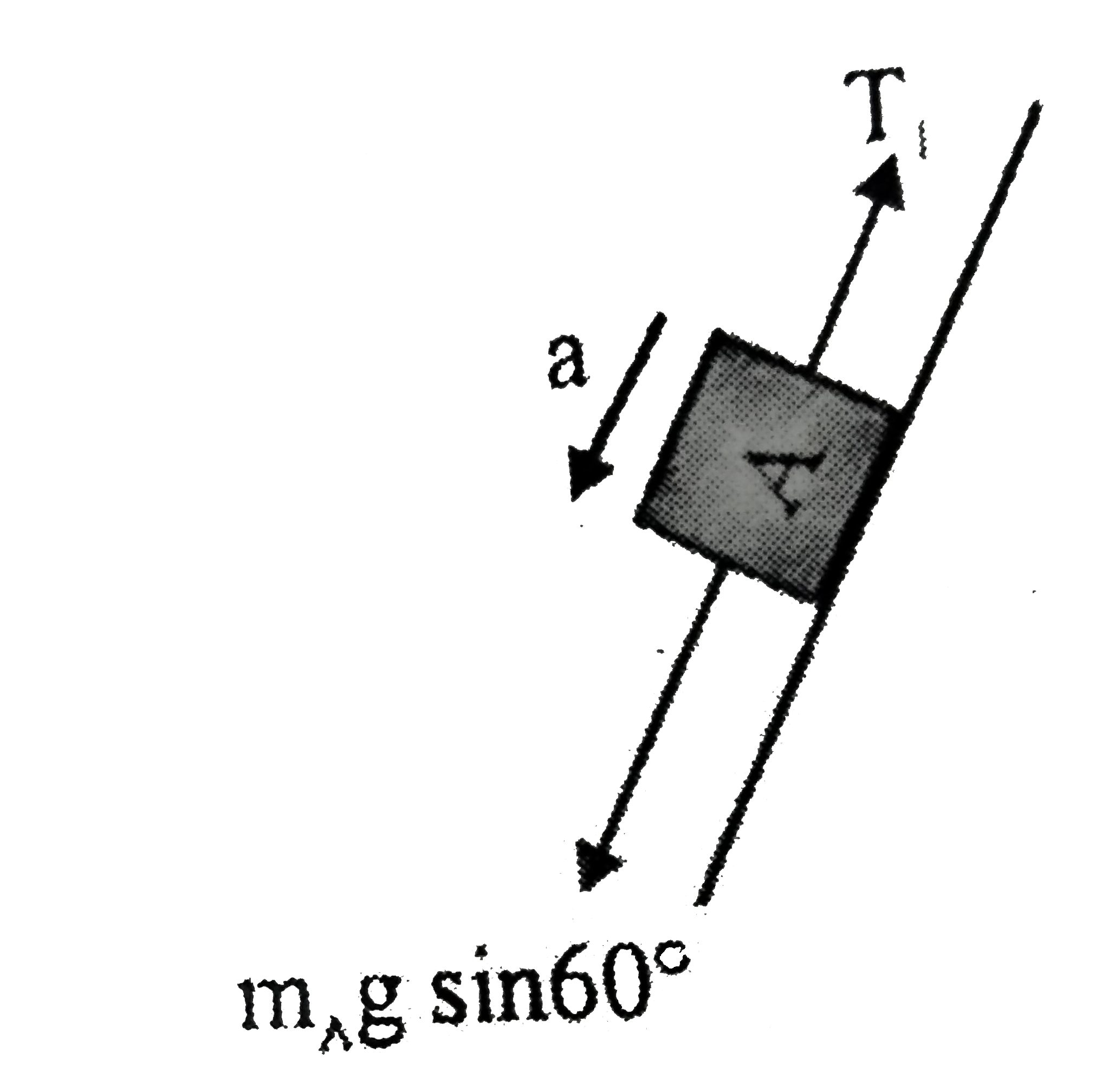
(b) For the tension `T_(1)` in the string between A and B, `m_(A)g sin 60^(@)-T_(1)=(m_(A))(a) therefore T_(1)=m_(A)g sin60^(@)-m_(A)a=m_(A)(g sin60^(@)-a)`
`impliesT_(1)=(1)(10xx(sqrt3)/(2)-4.1)=4.56N`
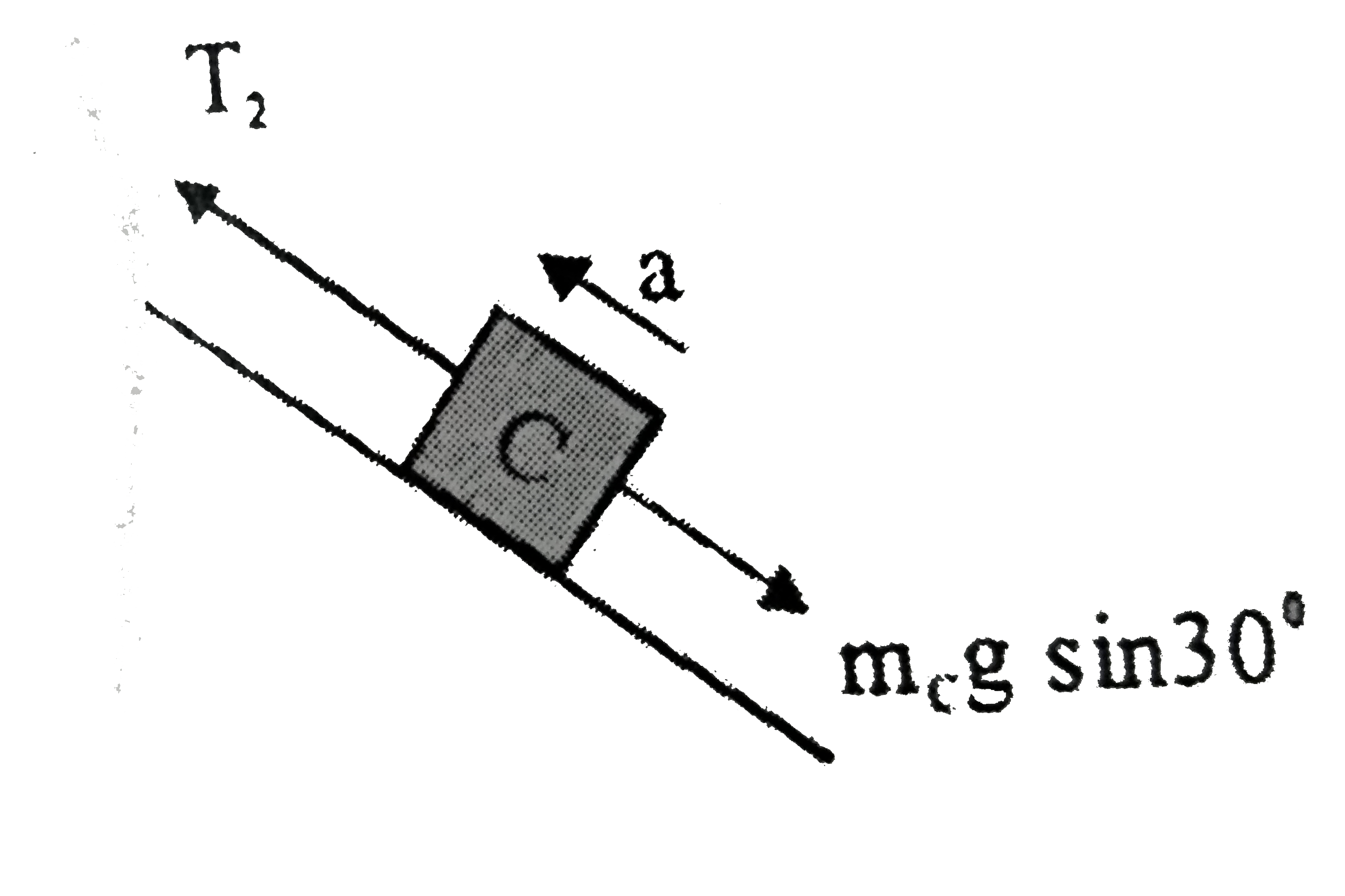
For the tension `T_(2)` in the string between B and C.
`T_(2)-m_(C)g sin30^(@)=m_(C)a`
`impliesT_(2)=m_(C)(a+g sin30^(@))=2[4.1+10((1)/(2))]=18.2N`
Promotional Banner

Topper's Solved these Questions

  • NEWTON'S LAWS OF MOTION & FRICTION

    ALLEN|Exercise EXERCISE (S-1)|26 Videos
  • NEWTON'S LAWS OF MOTION & FRICTION

    ALLEN|Exercise EXERCISE (S-2)|9 Videos
  • MOTION IN A PALNE

    ALLEN|Exercise SOLVED EXAMPLE|28 Videos
  • NEWTONS LAWS OF MOTION

    ALLEN|Exercise EXERCISE-III|28 Videos

Similar Questions

Explore conceptually related problems

In the abjecent figure, masses of A,B and C are 1kg ,3kg and 2kg respectivelly.Find (a) the acceleration of the system and (b) tension in the strings. Neglect friction. (g=10m//s^(2))

As shown in figure A, B and C are 1 kg, 3 kg and 2 kg respectively. The acceleration of the system is -

If coeffiecient of friction between the block of mass 2kg and table is 0.4 then out acceleration of the system and tension in the string. (g=10m//s^(2))

In the above example, if two blocks have masses 1kg and 2kg respectively then find their acceleration and tension in different string.

If masses of the blocks A and B shown in figure-2.204 (a) and 2.204(b) are 10kg and 5kg respectively, find the acceleration of the two masses. Assume all pulleys and strings are ideal. (Take g=9.8m/s^(2) )

In the arrangement shown in Figure, m_A=2kg and m_B=1kg . String is light and inextensible. Find the acceleration of centre of mass of both the blocks. Neglect friction everywhere.

Two block of mass 4 kg and 2 kg are attached by an inextensible light string as shown in figure. Both the blocks are pulled vertically upwards by a force F=120N Find (a) the acceleration of the blocks, (b) tension in the string. (Take g= 10 ms^(-2) )

Two blocks of mass 2 kg and 5 kg are connected by an ideal string passing over a pulley. The block of mass 2 kg is free to slide on a surface inclined at an angle of 30^(@) with the horizontal whereas 5 kg block hangs freely. Find the acceleration of the system and the tension in the string. Given mu=0.30 .

In the figure-2.205 shown in blocks A, B and C has masses m_(A)= 5 kg, m_(B) = 5 kg and m_(C )= 10kg respectively, find the acceleration of the three blocks. Assume all pulleys and strings are ideal. (Take g = 10m//s^(2) )