Home
Class 12
PHYSICS
A 1kg block B rests as shown on a bracke...

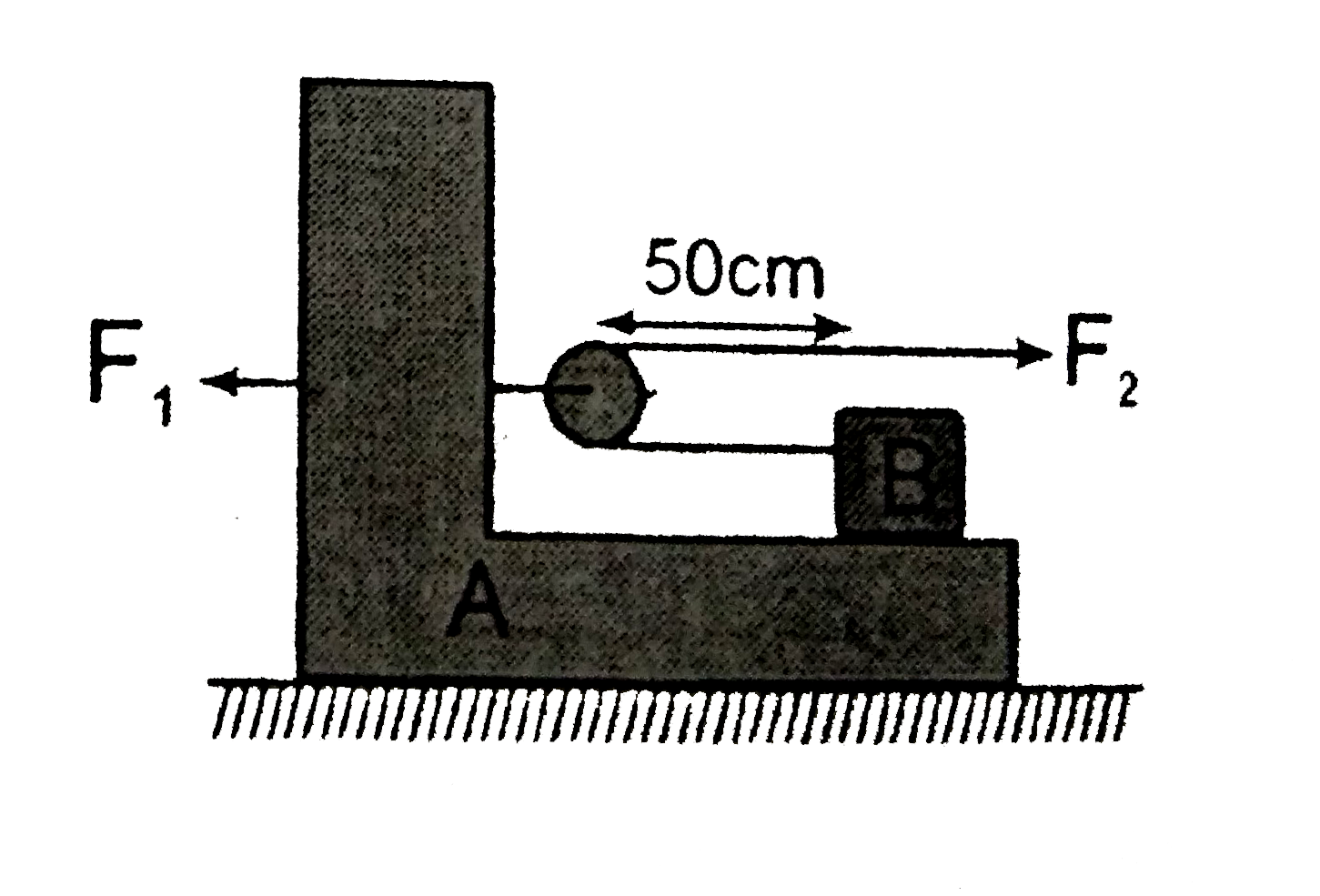
A `1kg` block `B` rests as shown on a bracket `A` of same mass. Constant forces `F_(1)=20N` and `F_(2)=8N` start to act at time `t=0` when the distance of block `B` from pulley is `50cm`. Time when block `B` reaches the pulley is `……………………` .`(` Assume that friction is absent every where. Pulley and string are light.

Text Solution

Verified by Experts

The correct Answer is:

`0.5s`
Promotional Banner

Topper's Solved these Questions

  • NEWTON'S LAWS OF MOTION & FRICTION

    ALLEN|Exercise EXERCISE (S-2)|9 Videos
  • NEWTON'S LAWS OF MOTION & FRICTION

    ALLEN|Exercise EXERCISE (O-1)|51 Videos
  • NEWTON'S LAWS OF MOTION & FRICTION

    ALLEN|Exercise EXERCISE (JA)|4 Videos
  • MOTION IN A PALNE

    ALLEN|Exercise SOLVED EXAMPLE|28 Videos
  • NEWTONS LAWS OF MOTION

    ALLEN|Exercise EXERCISE-III|28 Videos

Similar Questions

Explore conceptually related problems

In the system shown in figure m_(B)=4kg , and m_(A)=2kg . The pulleys are massless and friction is absent everywhere. The acceleration of block A is.

The velocities of A and B shown in fig. Find the speed (in ms^(-1) ) of block C. (Assume that the pulleys and string are ideal).

In the figure shown, all surfaces are smooth and the pulley is massless. A constant force of magnitude F = (mg)/(2) is acting on the block of mass M. The acceleration of the block M is :

A block B is placed over a cart which in turn lies over a smooth horizontal floor. Block A and Block C are connected to block B with light inextensible strings passing over light frictionless pulleys fixed to the cart as shown. Initially the blocks and the cart are at rest. All the three blocks have mass m and the cart has mass M(M=3m) . Now a constant horizontal force of magnitude F is applied to block A towards right. Q. Let the coefficient of friction between block B and cart is mu(mugt0) and friction is absent everywhere else. Then the maximum value of force F applied to block A such that there is no relative acceleration between block B and cart is

Blocks m_(1) and m_(2) starts from rest and move to right with accelerations as shown. If t is in second then the time when block m_(3) again come to rest from t =0 is (pulley and strings are ideal) : .

For the given figure the acceleration of 1 kg block if string is massless and mass of pulley is 2 kg and diameter of pulley is 0.2 m :-

Two blocks of masses 2 kg and 4kg are connected through a massless inextensible string. The co-efficient of fricition between 2kg block and ground is 0.4 and the coefficient of friction between 4kg block and ground is 0.6. The forces F_(1)=10N and F_(2)=20N are applied on the blocks as shown in the figure. Calculate the frictional force between 4 kg block and ground (Assume initially the tension in the string was just before forces F_(1) and F_(2) wer applied).

Two blocks of mass 10 kg and 2 kg are connected by an ideal spring of spring constant K = 800 N//m and the system is placed on a horizontal surface as shown. The coefficient of friction between 10 kg block and surface is 0.5 but friction is absent between 2 kg and the surface. Initially blocks are at rest and spring is relaxed. The 2 kg block is displaced to elongate the spring by 1 cm and is then released. (a) Will 10 kg block move subsequently? (b) Draw a graph representing variation of magnitude of frictional force on 10 kg block with time. Time t is measured from that instant when 2 kg block is released to move.

There blocks a,b and c of massses 10 kg ,10 kg and 20 kg respectivaly are arrenged as shown in figure all the surface are frictionless and string is inextensible A constant force F= 20N MN is applied on block a as shown .pulley and string are light . part of block a as shown . pulley and string are light . part of the string connecting both pulleys is vertical and part of hte stings connecting pulleys with masses a and b are horizontal .

ALLEN-NEWTON'S LAWS OF MOTION & FRICTION-EXERCISE (S-1)
  1. Force F is applied on upper pulley. If F = 30 t where t is time in sec...

    Text Solution

    |

  2. A 40 kg boy climbs a rope that passes over an ideal pulley. The other ...

    Text Solution

    |

  3. A 1kg block B rests as shown on a bracket A of same mass. Constant for...

    Text Solution

    |

  4. In the figure shown, all surfaces are smooth and block. A and wedge B ...

    Text Solution

    |

  5. Find the reading of the massless spring balance in the given condition

    Text Solution

    |

  6. The system shown adjacent is in equilibrium. Find the acceleration of ...

    Text Solution

    |

  7. A block of mass m lies on wedge of mass. Mas shown in figure. Wit...

    Text Solution

    |

  8. The block A is moving downward with constant velocity v(0.) Find the v...

    Text Solution

    |

  9. Find force in newton which mass A exert on mass B if B is moving to wa...

    Text Solution

    |

  10. Rod A can slide in vertical direction pushing the triangular wedge B t...

    Text Solution

    |

  11. Calculate the relative acceleration of A w.r.t. B if B is moving with ...

    Text Solution

    |

  12. A block is placed on a rough horizontal plane. Three horizontalforces ...

    Text Solution

    |

  13. A force of 100 N is applied on a block of mass 3kg as shown below. The...

    Text Solution

    |

  14. Two trolleys A and B are moving with accelerations a and 2a, respectiv...

    Text Solution

    |

  15. A thin rod of length 1 m is fixed in a vertical position inside a trai...

    Text Solution

    |

  16. A block of mass m(1) = 1 kg is horizontally thrown with a velocity of ...

    Text Solution

    |

  17. A block of mass m lies on wedge of mass Mas shown in figure. Find the ...

    Text Solution

    |

  18. A block of mass 15 kg is resting on a rough inclined plane as shown in...

    Text Solution

    |

  19. In the figure, what should be mass m so that block A slides up with a ...

    Text Solution

    |

  20. Find the acceleration of the block and magnitude and direction of fric...

    Text Solution

    |
