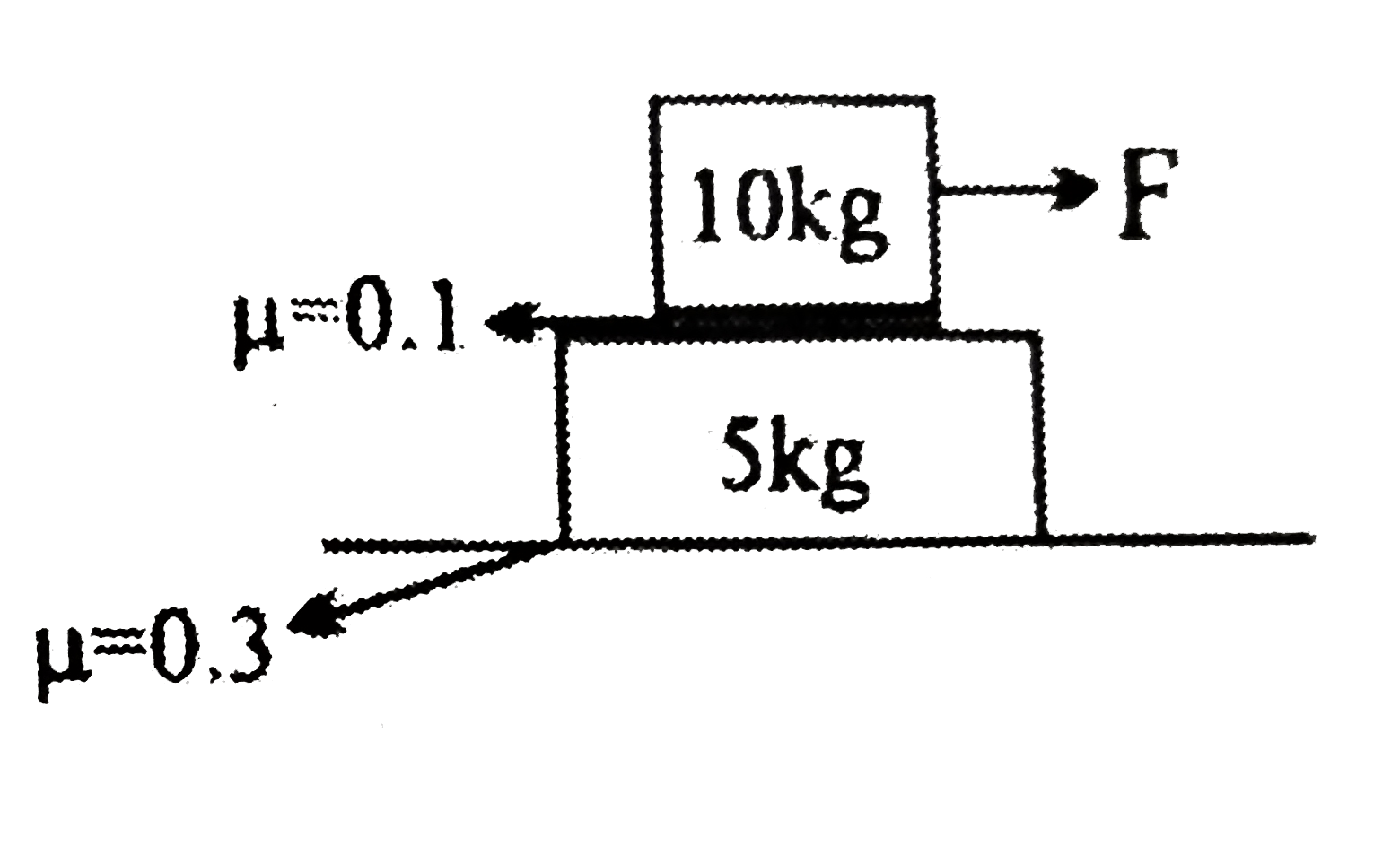
A
B
C
D
Text Solution
Verified by Experts
The correct Answer is:



Topper's Solved these Questions
NEWTON'S LAWS OF MOTION & FRICTION
ALLEN|Exercise EXERCISE (JM)|6 VideosNEWTON'S LAWS OF MOTION & FRICTION
ALLEN|Exercise EXERCISE (JA)|4 VideosNEWTON'S LAWS OF MOTION & FRICTION
ALLEN|Exercise EXERCISE (O-1)|51 VideosMOTION IN A PALNE
ALLEN|Exercise SOLVED EXAMPLE|28 VideosNEWTONS LAWS OF MOTION
ALLEN|Exercise EXERCISE-III|28 Videos
Similar Questions
Explore conceptually related problems
ALLEN-NEWTON'S LAWS OF MOTION & FRICTION-EXERCISE (O-2)
- Consider a block suspended from a light string as shown in the digure....
Text Solution
|
- A block of weight 9.8N is placed on a table. The table surface exerts...
Text Solution
|
- A block of mass m is suspended from a fixed support with the help of a...
Text Solution
|
- A block A and wedge B connected through a string as shown. The wadge B...
Text Solution
|
- Two blocks A and B of mass 2 kg and 4 kg respectively are placed on a ...
Text Solution
|
- A block is kept on a rough surface and applied with a horizontal force...
Text Solution
|
- A block placed on a rough horizontal surface is pushed with a force F ...
Text Solution
|
- A block is placed over a plank. The coefficient of friction between th...
Text Solution
|
- A block is released from rest from point on a rough inclined place of ...
Text Solution
|
- In the given figure both the bocks have equal mass. When the thread is...
Text Solution
|
- A block of mass m is placed on a smooth horizontal floor is attached t...
Text Solution
|
- A block of mass m is placed on a smooth horizontal floor is attached t...
Text Solution
|
- A block of mass m is placed on a smooth horizontal floor is attached t...
Text Solution
|
- When F = 2N, the frictional force between 5 kg block and ground is
Text Solution
|
- When F = 2n, the frictional force between 10 kg block 5 kg block is
Text Solution
|
- The maximum F which will not cause motion of any of the blocks is
Text Solution
|
- The maximum acceleration of 5 of kg block is :-
Text Solution
|
- The acceleration of 10 kg block when F = 30 N is
Text Solution
|
- In the figure shown ,acceraltion of is x (upwards ) Acceleration o fpu...
Text Solution
|
- Velocity of there particless A.B and C varies with time t as , v(A) =(...
Text Solution
|