Home
Class 11
PHYSICS
The surface shown in the diagram are smo...

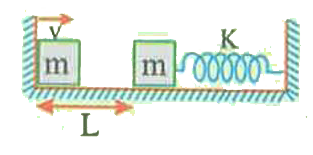
The surface shown in the diagram are smooth and all collisions are elastic. Find the time period of the periodic motion.

Text Solution

Verified by Experts

Before Ist collision, time speed `= (L)/(v)` after Ist collision, entire velocity is transferred to the second mass. This spring mass system covers half its oscillation before 2nd collision.
`therefore t = pi sqrt((m)/(K))` again velocity is transferred to the previous mass. It take `(L)/(v)` time again to reach its initial position
`therefore" "T = (2L)/(V) + pi sqrt((m)/(K))`
Promotional Banner

Topper's Solved these Questions

  • OSCILLATIONS

    NARAYNA|Exercise EVALUATE YOURSELF - 1|7 Videos
  • OSCILLATIONS

    NARAYNA|Exercise EVALUATE YOURSELF - 2|4 Videos
  • OSCILLATIONS

    NARAYNA|Exercise DAMPED OSCILLATIONS|1 Videos
  • NEWTONS LAWS OF MOTION

    NARAYNA|Exercise PASSAGE TYPE QUESTION|6 Videos
  • PHYSICAL WORLD

    NARAYNA|Exercise C.U.Q|10 Videos

Similar Questions

Explore conceptually related problems

The right block in figure moces at a speed V towards the left block placed in equilibrium. All the surfaces are smooth and all the collisions are elastic. Find the time period motion. Neglect the width of the blocks.

The right block in figure moces at a speed V towards the left block placed in equilibrium. All the surfaces are smooth and all the collisions are elastic. Find the time period motion. Neglect the width of the blocks.

(a) The right block collides with left block and sticks to it. Find amplitude of the resulting SHM. (b) The block starts from left wall and moves with constant speed v. All collisions are elastic. Find time period of periodic motion.

The left block in figure moves at a speed v towards the right block placed in equilibrium. All collilsions to take place are elastic and the surfaces are frictionless. Show that motion of the two blocks are periodic. Find the timepoerid of these periodic motions. Neglect the widths of the blocks.

The time period of system shown below is :-

Consider the situation as shown in the diagram , the ball strikes the wall normally and the collision is elastic , the change in the kinetic energy of the ball is

A block is attached to a spring and is placed on a horizontal smooth surface as shown in which spring is unstretched. Now the spring is given an initial compression 2x_(0) an block is released from rest. Collision with the wall PQ are elastic. Find the time period of motion of the block:

An assembly of identicl spring mass system is placed on a smooth horizontal surface as shown. Initially the springs are relaxed. The left mass is displaced to the left while the right mass is displaced to the right and released. The resulting collision is elastic. The time period of the oscillatins of the system is.

NARAYNA-OSCILLATIONS-ILLUSTRATION
  1. The system of simple pendulum is immersed in liquid of a density rho(l...

    Text Solution

    |

  2. Find the time period in each of the following cases, if the mass is pu...

    Text Solution

    |

  3. The system is pulled to an elongation A and Then released. Find the mi...

    Text Solution

    |

  4. A 50 gm mass at the end of a spring vibrates in SHM. The amplitude of ...

    Text Solution

    |

  5. The left block in figure collides inelastically with the right block a...

    Text Solution

    |

  6. One end of a spring of force constant k is fixed to a vertical wall an...

    Text Solution

    |

  7. A horizontal platform vibrate up and down with a simple harmonic motio...

    Text Solution

    |

  8. Find time period of oscillation of the system.

    Text Solution

    |

  9. The surface shown in the diagram are smooth and all collisions are ela...

    Text Solution

    |

  10. Total mechanical energy of an oscillator is 160 J. Its force constant ...

    Text Solution

    |

  11. A point particle of mass 0.1kg is executing SHM of amplitude 0.1m. Whe...

    Text Solution

    |

  12. The average energy in one time period in simple harmonic motion is

    Text Solution

    |

  13. A particle moves on the X-axis according to the equation x = x(0) sin^...

    Text Solution

    |

  14. A particle of mass m is dropped in a tunnel dug along the diameter of ...

    Text Solution

    |

  15. A disc of mass 'm' is suspended at a point R/2 above its centre. Find ...

    Text Solution

    |

  16. A simple pendulum oscillates simple harmonically. The tension in the s...

    Text Solution

    |

  17. The end of the rod which is connected to the spring is pushed down and...

    Text Solution

    |

  18. In a damped oscillation amplitude at (t = 0) is A(0) and at (t = T) it...

    Text Solution

    |

  19. The equation of a damped oscillator of mass 1kg is (d^(2)y)/(dt^(2)) =...

    Text Solution

    |

  20. D is disturbed, and ultimately all the pendulums start oscillating. Ma...

    Text Solution

    |
