Home
Class 11
PHYSICS
A particle of mass m oscillates with sim...

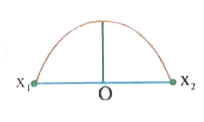
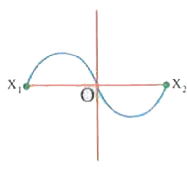
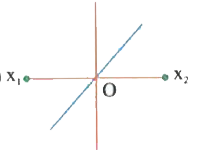
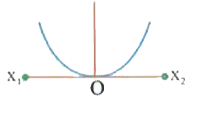
A particle of mass m oscillates with simple harmonic motion between points `x_(1)` and `x_(2)`, the equilibrium position being O. Its potential energy is plotted. It will be as given below in the graph

A

B

C

D

Text Solution

Verified by Experts

The correct Answer is:

D

Potential energy of particle performing SHM is given by `PE = (1)/(2) m omega^(2) y^(2)` i.e., it varies parabolically such that at mean position it becomes zero and maximum at extreme positions.
Promotional Banner

Topper's Solved these Questions

  • OSCILLATIONS

    NARAYNA|Exercise EXERCISE - II (H.W)|19 Videos
  • OSCILLATIONS

    NARAYNA|Exercise EXERCISE - III|29 Videos
  • OSCILLATIONS

    NARAYNA|Exercise EXERCISE - I (H.W)|66 Videos
  • NEWTONS LAWS OF MOTION

    NARAYNA|Exercise PASSAGE TYPE QUESTION|6 Videos
  • PHYSICAL WORLD

    NARAYNA|Exercise C.U.Q|10 Videos

Similar Questions

Explore conceptually related problems

A particle of mass m oscillates with simple harmonic motion between points x_(1) and x_(2) the equilibrium position being O its potential energy in plotted it will be as given bellow in the graph

The potential energy of a particle, executing a simple harmonic motion, at a dis"tan"ce x from the equilibrium position is proportional to

A particle executes simple harmonic motion of ampliltude A. At what distance from the mean position is its kinetic energy equal to its potential energy?

A particle oscillates simple harmonic motion with a period of 16 s . Two second after crossing the equilibrium position its velocity becomes 1 m//s . The amplitude is

A particle is executing simple harmonic motion between exterme positions given by (-1,-2,-3)cm and (1,2,1)cm . Its amplitude of oscillation is

A particle is vibrating in a simple harmonic motion with an amplitude of 4 cm . At what displacement from the equilibrium position, is its energy half potential and half kinetic

A particle starts oscillating simple harmonically from its equilibrium position then, the ration of kinetic energy and potential energy of the particle at the time T//12 is: (T="time period")

When the displacement of a particle executing simple harmonic motion is half its amplitude, the ratio of its kinetic energy to potential energy is

NARAYNA-OSCILLATIONS-EXERCISE - II (C.W)
  1. The displacement - time graph of a particle executing SHM is as shown ...

    Text Solution

    |

  2. The acceleration of the particle at t = 3 s in the above figure is

    Text Solution

    |

  3. The minimum time the particle takes to travel from y = + "1 m to y" = ...

    Text Solution

    |

  4. Match the following {:("List - I","List - II"),("(a) acceleration","...

    Text Solution

    |

  5. For a particle executing SHM along a straight line (displacement is me...

    Text Solution

    |

  6. {:("List - I","List - II"),("(A) x-t graph of simple harmonic oscillat...

    Text Solution

    |

  7. The mass and diameter of a planet are twice those of earth. What will ...

    Text Solution

    |

  8. The length of a second's pendulum on the surface of the moon, where g ...

    Text Solution

    |

  9. The matallic bob of a simple pendulum has the relative density rho. Th...

    Text Solution

    |

  10. A pendulum clock is taken 1km inside the earth from mean sea level. Th...

    Text Solution

    |

  11. A seconds pendulum is suspended from rof of a vehicle that is moving a...

    Text Solution

    |

  12. For a simple pendulum, the graph between T^(2) and L (where T is the t...

    Text Solution

    |

  13. In case of a simple pendulum, time period versus length is depicted by

    Text Solution

    |

  14. Assuming the earth as an spherical body, for seconds pendulum {:("Co...

    Text Solution

    |

  15. {:("List - I","List - II"),("(A) Frequency of seconds pendulum","(E)"A...

    Text Solution

    |

  16. For a simple pendulum, a graph is plotted between itskinetic energy (K...

    Text Solution

    |

  17. As a body performs SHM its potential energy U. varies with time as ind...

    Text Solution

    |

  18. A particle of mass m oscillates with simple harmonic motion between po...

    Text Solution

    |

  19. A simple harmonic oscillator (A) Always has maximum KE at the equili...

    Text Solution

    |

  20. Which of the following figure represents damped harmonic motion

    Text Solution

    |
