Home
Class 12
CHEMISTRY
a) Compound (A) C(8)H(12) on oxidation g...

a) Compound (A) `C_(8)H_(12)` on oxidation gives an acid (B) `C_(4)H_(6)O_(2)`. One molecule of compound (A) reacts with 3 mole of `H_(2)` in presence of platinum catalyst to give octane. Identify compound (A).

Text Solution

Verified by Experts
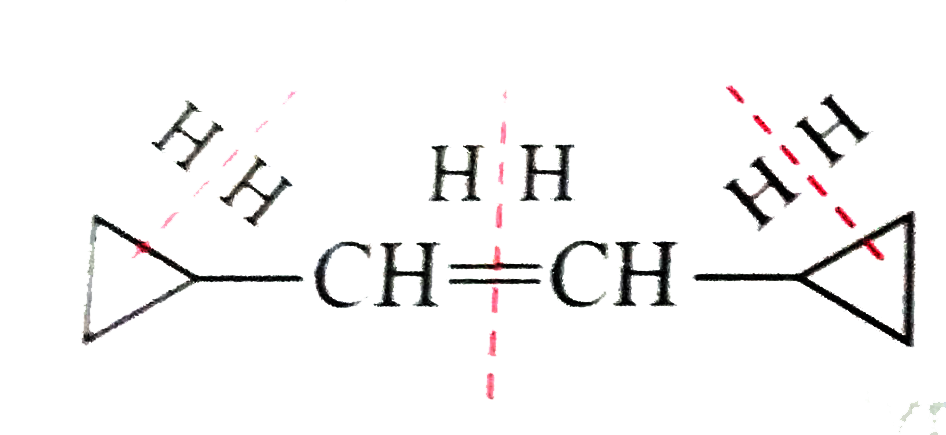
The number of carbon atoms `(C_(8))` in (A) is twice the number of carbon atoms `(C_(4))` in acid (B). So 2 mole of acid `C_(4)H_(6)O_(4)` join with each other to give the compound (A).

Since, the cyclopropane ring is highly strained ring, so on catalyst hydrogenation, 3 moleof `H_(2)` are required i.e., one mol for each of cyclopropane ring and one mol for reducing the `(C=C)` bond.
b)
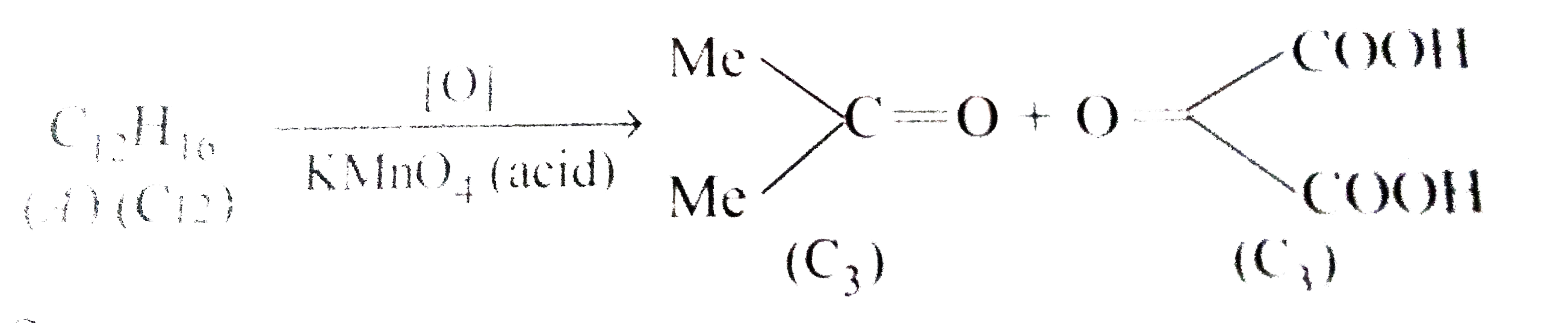
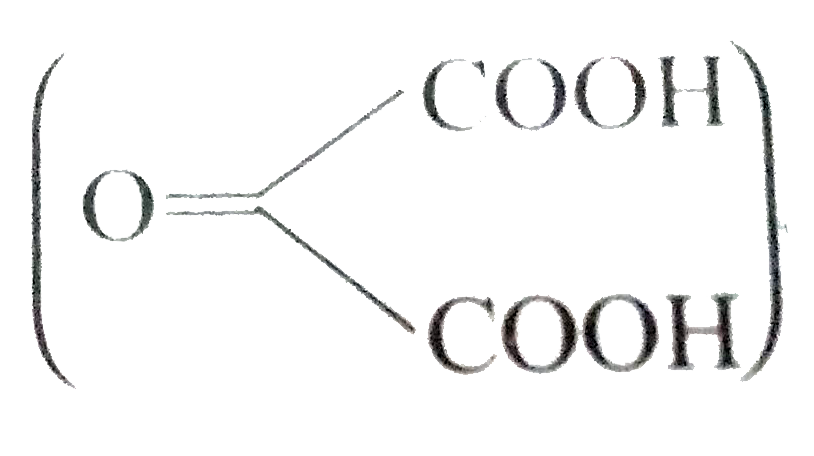
So,2 mole of each of the products `C_(3)` are obtained by oxidation of (A). Two (C=O) groups of two acetone are joned with two (C=O) groups of dicarboxyclic acid and then removing the oxygen atoms and joining the carbon atoms with double bonds gives the structure of compound (A)
Promotional Banner

Topper's Solved these Questions

  • UNSATURATED HYDROCARBONS

    OP TANDON|Exercise Match type|1 Videos
  • UNSATURATED HYDROCARBONS

    OP TANDON|Exercise PROBLEMS BASED ON STRUCTURE AND PROPERTIES|10 Videos
  • UNSATURATED HYDROCARBONS

    OP TANDON|Exercise SOME SOLVED PROBLEMS|31 Videos
  • STOICHIOMETRY (CHEMICAL FORMULAE AND EQUATIONS )

    OP TANDON|Exercise SELF ASSESSMENT|11 Videos

Similar Questions

Explore conceptually related problems

Compound (A)(C_(8)H_(12)) on oxidation gives an acid B(C_(4)H_(6)O_(2)) . One mole of compound (A) reacts with 3 mol of H_(2) in the presence of Pt catalyst to give octane. Identify compound (A) .

Compound (A)(C_(12)H_(16)) on oxidation with acideic KMnO_(4) solution gives acetone and . Identify compound (A) .

The compound F(C_(6)H_(12)O) on oxidative ozonolysis yirlds acetic acid and a compound (G) (C_(4)H_(8)O_(3)) . The new compound (G) on heating gives:

An organic compound A (C_(7)H_(6)Cl_(2)) on treatment with NaOH solution gives another compound B (C_(7)H_(6)O) . B on oxidation gives and acid C (C_(7)H_(6)O_(2)) which on treatment with a mixture of conc. HNO_(3)" and "H_(2)SO_(4) gives a compound D (C_(7)H_(5)NO_(4)) . B on treatment with conc. NaOH gives a compound E (C_(7)H_(8)O)" and "C_(6)H_(5)COONa . Deduce the structures of [A], [B], [C], [D] and [E].

OP TANDON-UNSATURATED HYDROCARBONS-PROBLEMS FOR PRACTICE
  1. Explain the formation of products (B), (C), and (D) in the following r...

    Text Solution

    |

  2. Complete the following equations: a) H(2)C=CH-CH(3)+HCl to (A) b) ...

    Text Solution

    |

  3. Draw all the structural , stereo, and cyclic isomers of C(4) H(6).

    Text Solution

    |

  4. a) Give the structural formulae of the alkene (C(8)H(16)) which on red...

    Text Solution

    |

  5. Answer the following: a) If the bond order (number of bonds) between...

    Text Solution

    |

  6. a) Arrange benzene, n-hexane and ethyne in decreasing order of acidic ...

    Text Solution

    |

  7. Draw the cis and trans structures of hex-2-ene. Which isomer will have...

    Text Solution

    |

  8. Two compounds (X) and (Y) of the same molecular formula. C(4)H(6) gave...

    Text Solution

    |

  9. Identify the products of the following reactions:

    Text Solution

    |

  10. How will you synthesis? ltbrlt a) Vinyl chloride from acetylene b) B...

    Text Solution

    |

  11. How will you obtain the following from propene? a) n-Propyl bromide ...

    Text Solution

    |

  12. How will you differentiate the following? A) Ethylene and ethane b) ...

    Text Solution

    |

  13. a) A gaseous mixutre consists ethane and ehylene. How are the individu...

    Text Solution

    |

  14. Explain the mechanism of the following reactions: a) Addition of bro...

    Text Solution

    |

  15. Deduce the structures of the compounds which yeild the following produ...

    Text Solution

    |

  16. a) Compound (A) C(8)H(12) on oxidation gives an acid (B) C(4)H(6)O(2)....

    Text Solution

    |

  17. Explain the following: a) Why alkenes are more reactive than alkanes...

    Text Solution

    |