Home
Class 12
CHEMISTRY
In the reaction with HCl, an alkene reac...

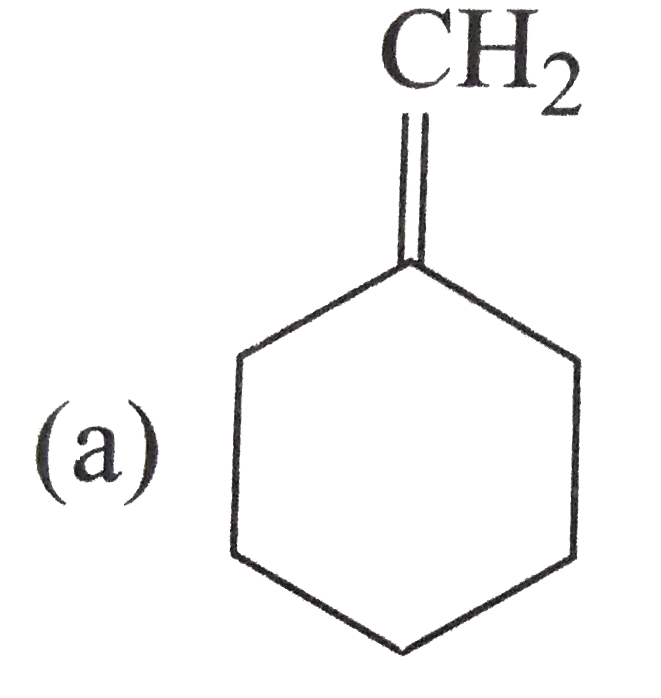
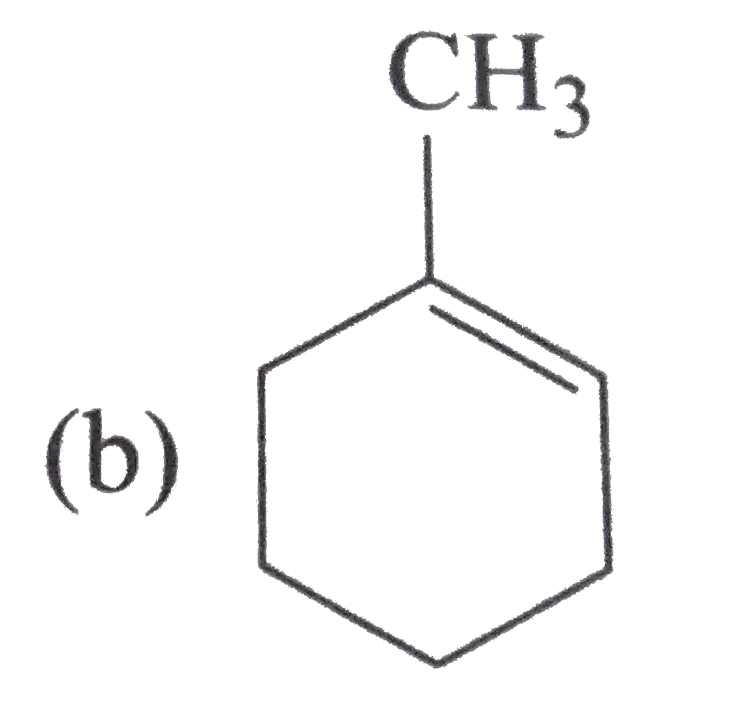
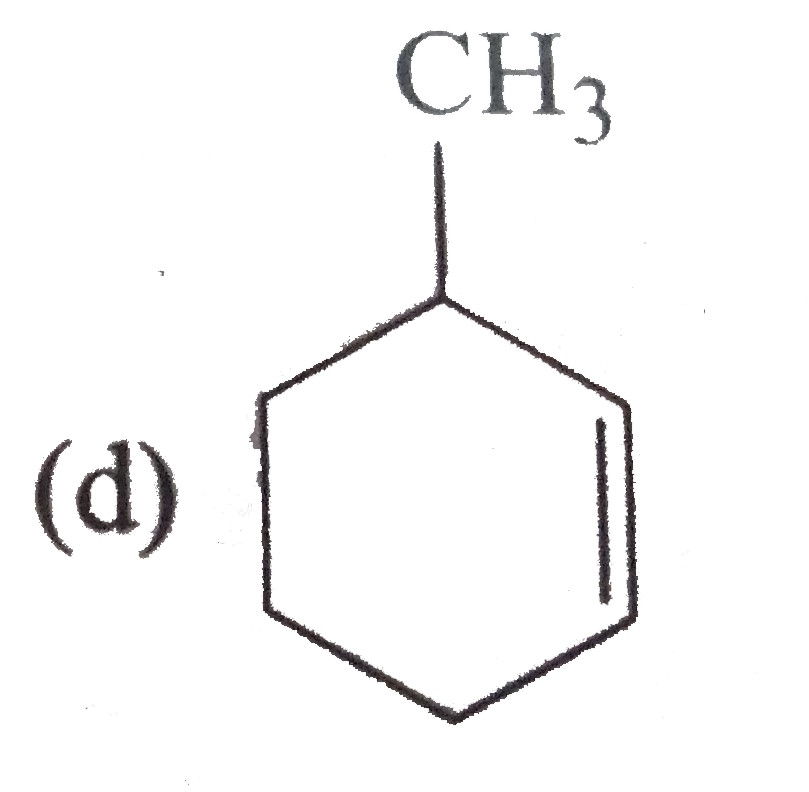
In the reaction with HCl, an alkene reacts in accordance with Markownikoff's rule to give a product 1-chloro-1-methylcyclohexane. The possible alkene is:

A

B

C

both (A) and (B)

D

Text Solution

AI Generated Solution

The correct Answer is:

To determine the possible alkene that reacts with HCl to yield 1-chloro-1-methylcyclohexane according to Markownikoff's rule, we need to analyze the structure of the product and the implications of the rule. ### Step-by-Step Solution: 1. **Identify the Product Structure**: The product is 1-chloro-1-methylcyclohexane. This indicates that we have a cyclohexane ring with a chlorine (Cl) and a methyl (CH₃) group both attached to the same carbon (the first carbon in the ring). 2. **Understand Markownikoff's Rule**: Markownikoff's rule states that in the addition of HX (where X is a halogen) to an alkene, the hydrogen atom (H) will attach to the carbon with the greater number of hydrogen atoms already attached, while the halogen (Cl in this case) will attach to the carbon with fewer hydrogen atoms. 3. **Analyze the Possible Alkenes**: We need to find an alkene that, when reacted with HCl, will lead to the formation of the product. The alkene must have a structure that allows for the addition of HCl to yield the desired product. 4. **Consider the Structure of Cyclohexane**: Cyclohexane has six carbon atoms in a ring. The presence of a methyl group on one of the carbons indicates that this carbon is already bonded to one additional carbon (the methyl group) and will have fewer hydrogen atoms compared to the adjacent carbon. 5. **Determine the Alkene**: - If we consider a possible alkene such as 1-methylcyclohexene, the double bond is between the carbon that has the methyl group and an adjacent carbon. - When HCl is added, according to Markownikoff's rule, Cl will attach to the carbon of the double bond that has fewer hydrogens (the one with the methyl group), and H will attach to the other carbon, leading to the formation of 1-chloro-1-methylcyclohexane. 6. **Verify Other Options**: - Check other potential alkenes (like 3-methylcyclohexene or 2-methylcyclohexene) to see if they can also yield the same product. - For instance, 3-methylcyclohexene would not yield the desired product because the addition of HCl would not follow Markownikoff's rule correctly to give 1-chloro-1-methylcyclohexane. 7. **Conclusion**: The possible alkenes that can react with HCl to yield 1-chloro-1-methylcyclohexane are those that allow for the addition of HCl according to Markownikoff's rule, specifically 1-methylcyclohexene. ### Final Answer: The possible alkene is **1-methylcyclohexene**.
Promotional Banner

Topper's Solved these Questions

  • UNSATURATED HYDROCARBONS

    OP TANDON|Exercise (LEVEL B) OBJECTIVE QUESTIONS|29 Videos
  • UNSATURATED HYDROCARBONS

    OP TANDON|Exercise SET II This set contains the questions with more ..|23 Videos
  • UNSATURATED HYDROCARBONS

    OP TANDON|Exercise BRAIN STORMING PROBLEMS|19 Videos
  • STOICHIOMETRY (CHEMICAL FORMULAE AND EQUATIONS )

    OP TANDON|Exercise SELF ASSESSMENT|11 Videos

Similar Questions

Explore conceptually related problems

In the reaction with HCl , an alkene reacts in accordance with the Markovnikov's rule. The possible alkene is

In additon reactions of alkenes, the Markownikoff's rule follow:

In which case the product formed is in accordance of anti Markownikoff's rule?

OP TANDON-UNSATURATED HYDROCARBONS-OBJECTIVE QUESTIONS
  1. Which product is formed when trans-2-phenyl-1-bromocyclopentane is tre...

    Text Solution

    |

  2. trans-2-Butene +Br(2) gives:

    Text Solution

    |

  3. In the reaction with HCl, an alkene reacts in accordance with Markowni...

    Text Solution

    |

  4. Which of the following reagents, which heated with ethyl chloride, for...

    Text Solution

    |

  5. Ozonolysis products of an olefin are OHC-CHO and OHC-CH(2)-CH(2)-CHO, ...

    Text Solution

    |

  6. What is formed when calcium carbide reacts with heavy water?

    Text Solution

    |

  7. A molecule (X) has (i) four sigma bonds formed by hte overlap of sp^(2...

    Text Solution

    |

  8. RCH=CH(2) overset(Na//NH(2)(l))underset(C(2)H(5)OH)to RCH(2)CH(3) Th...

    Text Solution

    |

  9. CH(3)CH=CH(2)+NOClrarrP Identify the product.

    Text Solution

    |

  10. Identitfy 'B' in the following reactions: H(2)C=CH(2)+HCl overset("A...

    Text Solution

    |

  11. The product C is CH(3).CH(2).C-=CH+HCl rarrBoverset(HI)rarrC

    Text Solution

    |

  12. CaC(2)+H(2)O to (X) overset(O(3)//H(2)O)toHCOOH, (X) is:

    Text Solution

    |

  13. B overset(Lindlar's)underset(Catalyst)larrR-C=C-Roverset(Na//Nh(3))rar...

    Text Solution

    |

  14. The reagent(s) for the following conversion, is/are:

    Text Solution

    |

  15. Arrange the following according to the increasing order of stability: ...

    Text Solution

    |

  16. Identify the products in the following reaction 3CH(3)CH=CH(2)overse...

    Text Solution

    |

  17. A hydrocarbon of molecular formula, C(6)H(10) reacts with sodamine and...

    Text Solution

    |

  18. 2,3-Dimethyl-2-butene can be prepared by heating which of the followin...

    Text Solution

    |

  19. What will be the increasing order of the stability of the following al...

    Text Solution

    |

  20. The isomerism of 1-butyne to 2-butyne can be achieved by treatment wit...

    Text Solution

    |
