Home
Class 12
CHEMISTRY
In the given reaction , overset(Br) ov...

In the given reaction ,
`overset(Br) overset(|)(CH_2)-(CH_2)_(3)-CH_2-OH underset("Toluene" 140^@C)overset(NaOH)(rarr)(X)`
X will be

A

`overset(OH)overset(|)(CH_2)-(CH_2)_(4)-CH_2OH`

B

`CH_2=CH-(CH_2)_(3)-CH_2OH`

C

`CH_3-overset(OH)overset(|)(CH)-(CH_3)_(3)-CH_2OH`

D

Text Solution

AI Generated Solution

The correct Answer is:

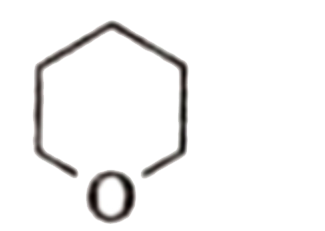
To solve the problem, we need to analyze the given reaction step by step. The reaction involves a brominated alcohol (Br-CH2-CH2-CH2-CH2-OH) reacting in the presence of sodium hydroxide (NaOH) in toluene at 140°C. ### Step 1: Identify the Reactants The reactant is a bromo alcohol, specifically Br-CH2-CH2-CH2-CH2-OH. The hydroxyl group (-OH) is attached to the terminal carbon of a four-carbon chain, making it a primary alcohol. ### Step 2: Understand the Reaction Conditions The reaction is carried out in toluene, a non-polar solvent, at a high temperature (140°C). The presence of NaOH suggests that it will act as a strong base. ### Step 3: Mechanism of Reaction 1. **Deprotonation**: The hydroxide ion (OH-) from NaOH will first abstract the acidic hydrogen from the -OH group of the alcohol, resulting in the formation of an alkoxide ion (O-). \[ \text{Br-CH}_2\text{-CH}_2\text{-CH}_2\text{-CH}_2\text{-OH} + \text{OH}^- \rightarrow \text{Br-CH}_2\text{-CH}_2\text{-CH}_2\text{-CH}_2\text{-O}^- + \text{H}_2\text{O} \] 2. **Nucleophilic Attack**: The alkoxide ion (O-) is a strong nucleophile and will attack the carbon atom bonded to bromine (Br). This leads to the displacement of bromine, forming a new bond. \[ \text{Br-CH}_2\text{-CH}_2\text{-CH}_2\text{-CH}_2\text{-O}^- \rightarrow \text{Cyclized product} \] ### Step 4: Cyclization Due to the structure of the molecule, the nucleophilic attack can lead to cyclization. The alkoxide ion attacks the carbon atom adjacent to the bromine, resulting in the formation of a cyclic ether. ### Step 5: Identify the Product The product formed from this reaction will be a cyclic ether, specifically a tetrahydrofuran (THF) derivative, where the oxygen is part of a five-membered ring. ### Conclusion The final product (X) will be a cyclic ether, specifically a five-membered ring, which is tetrahydrofuran (THF). ### Final Answer X is Tetrahydrofuran (THF). ---
Promotional Banner

Topper's Solved these Questions

  • NTA NEET SET 109

    NTA MOCK TESTS|Exercise CHEMISTRY|45 Videos
  • NTA NEET SET 113

    NTA MOCK TESTS|Exercise CHEMISTRY|45 Videos

Similar Questions

Explore conceptually related problems

In the given reaction overset(Br)overset(|)(CH_2)-(CH_2)_(3)-CH_2OH underset("Toluene" 140^@C)overset(NaOH)(rarr)(X) 'X' will be

In the given reaction overset(Br)overset(|)(CH_2)-CH=CH_2overset(NaNH_2//Delta)rarr(X) X will be

In the given reaction CH_3-overset(Br)overset(|)(C )H-CH_2-COOH overset(NaOH)(rarr)(X) . 'X' will be

In the given reaction CH_3-CH_2-overset(Br)overset(|)(CH)-CH=CH_2overset("Alc.KOH//Delta)rarr(X) X will be

In the given reaction : CH_(3)-overset(OH)overset(|)CH-underset(CH_(3))underset(|)overset(OH)overset(|)O-CH_(3)overset(HIO_(4))rarr(A)+(B) (A) and (B) respectively be:

In the given reaction, CH_(3)-underset(CH_3)underset(|)(CH)-overset(O)overset(||)(C )-CH_2-CH_3 overset(CF_3CO_3H)(rarr)(X) as main product, 'X' will be

The major product (A) formed in the following reaction is CH_(3) - overset( CH_3) overset(|) CH-CH_2 - underset(CH_(3))underset(|) overset(CH_(3)-CH_() -CH_(3) ) overset(|)N-overset( o+)CH_(2) -CH_(3) underset( Delta ) overset( OH^(-)) (A)

The reaction CH_(2)=CH-CH_(3)+HBr rarr CH_(3)-overset(Br)overset(|)(C )HCH_(3) is

NTA MOCK TESTS-NTA NEET SET 110-CHEMISTRY
  1. 8:8 coordination of CsCl is found to change into 6:6 coordination :

    Text Solution

    |

  2. The compounds formed by the reaction of ammonia with chlorine and iodi...

    Text Solution

    |

  3. In the given reaction , overset(Br) overset(|)(CH2)-(CH2)(3)-CH2-OH ...

    Text Solution

    |

  4. Which of the following nitrate gives off different nitrogen oxide then...

    Text Solution

    |

  5. The pair in which phosphorus atoms have a formed oxidation state of +3...

    Text Solution

    |

  6. For the following cell, Zn(s)|ZnSO(4)(aq)||CuSO(4)(aq)||Cu(s) When...

    Text Solution

    |

  7. Which arrangement of the following esters correctly, indicates the dec...

    Text Solution

    |

  8. For an octahedral complex, which of the following d electron configura...

    Text Solution

    |

  9. In the reaction sequence CH -= CH + CH -=CH overset(Cu2Cl2)(rarr)(A)...

    Text Solution

    |

  10. Calcualate Delta(f)G^(@) "for" (NH(4)Cl,s) at 310 K. Given : Delta(...

    Text Solution

    |

  11. Among [Ni(CO)(4)], [NiBr4]^(2-), [Co(NH3)(4)Cl2]Cl, Na3[CoF6], BaO2 an...

    Text Solution

    |

  12. Which of the following can produce a colour change from yellowish brow...

    Text Solution

    |

  13. The number of waves made by a Bohr electron in an orbit of maximum mag...

    Text Solution

    |

  14. Which of the following combination of reagents does not undergo redox ...

    Text Solution

    |

  15. For an ideal binary liquid solution with p(A)^(@) gt p(B)^(@), which i...

    Text Solution

    |

  16. In the given reaction ,

    Text Solution

    |

  17. Identify the reagents A and B respectively in the following reactions ...

    Text Solution

    |

  18. Which of the reactions defined Deltaf H^@?

    Text Solution

    |

  19. H2O2 + Ti^(4+) + 2H2O to orange colour. The orange colour is due to fo...

    Text Solution

    |

  20. Blocks of magnesium metal are often strapped to the steel hulls of oc...

    Text Solution

    |
