Home
Class 12
CHEMISTRY
Which of these carbocation will undergo ...

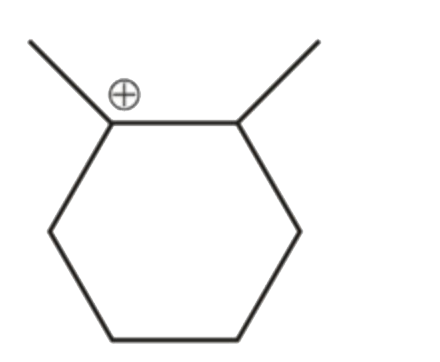
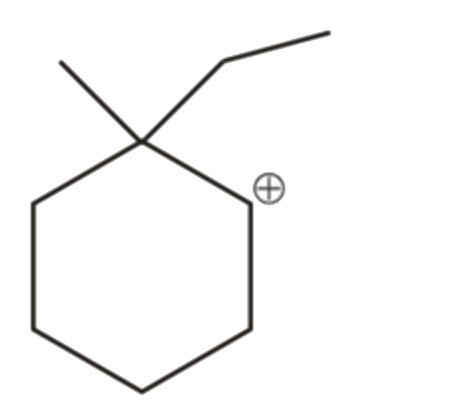
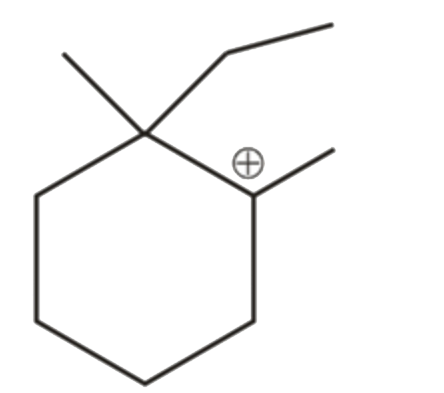
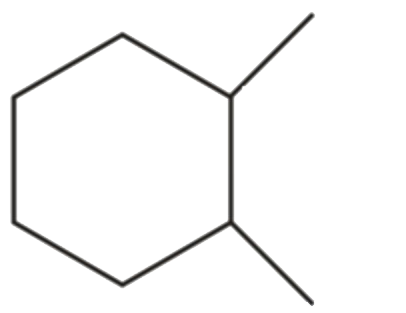
Which of these carbocation will undergo favourable rearrangement?

A

B

C

D

Text Solution

AI Generated Solution

The correct Answer is:

To determine which carbocation will undergo favorable rearrangement, we need to analyze the stability of each carbocation based on the number of alpha hydrogens and the potential for rearrangement. Here’s a step-by-step breakdown of the solution: ### Step 1: Identify the Carbocations We have four different carbocations to analyze. Each carbocation is associated with a specific structure, which we will evaluate for stability and potential rearrangement. ### Step 2: Analyze the First Carbocation - **Structure**: A cyclohexane ring with a carbocation. - **Alpha Hydrogens**: Count the alpha hydrogens around the carbocation. - Methyl group contributes 3 hydrogens. - Other groups contribute additional hydrogens. - **Total Alpha Hydrogens**: 6. - **Rearrangement**: If we shift a hydride, the total alpha hydrogens remain the same (6). Thus, no favorable rearrangement occurs. ### Step 3: Analyze the Second Carbocation - **Structure**: A cyclohexane ring with a methyl and ethyl group. - **Alpha Hydrogens**: Count the alpha hydrogens. - Methyl contributes 3 hydrogens. - Ethyl contributes 2 hydrogens. - **Total Alpha Hydrogens**: 5. - **Rearrangement**: - If we shift the methyl group, we get a new carbocation with 6 alpha hydrogens. - If we shift the ethyl group, we also get a carbocation with 6 alpha hydrogens. - **Conclusion**: The rearrangement is favorable since we increase the stability of the carbocation. ### Step 4: Analyze the Third Carbocation - **Structure**: A cyclohexane ring with two methyl groups. - **Alpha Hydrogens**: Count the alpha hydrogens. - Each methyl group contributes 3 hydrogens. - **Total Alpha Hydrogens**: 5. - **Rearrangement**: - Shifting a methyl group results in a carbocation with 4 alpha hydrogens. - Shifting the ethyl group results in a carbocation with 5 alpha hydrogens. - **Conclusion**: No favorable rearrangement occurs as the stability does not increase. ### Step 5: Analyze the Fourth Carbocation - **Structure**: No carbocation present. - **Conclusion**: Since there is no carbocation, no rearrangement can occur. ### Final Conclusion The only carbocation that undergoes a favorable rearrangement is from the **second option**. The other options do not provide a more stable carbocation upon rearrangement. ### Summary of Findings - **Favorable Rearrangement**: Second option. - **Unfavorable Rearrangement**: First, third, and fourth options.
Promotional Banner

Topper's Solved these Questions

  • NTA NEET SET 109

    NTA MOCK TESTS|Exercise CHEMISTRY|45 Videos
  • NTA NEET SET 113

    NTA MOCK TESTS|Exercise CHEMISTRY|45 Videos

Similar Questions

Explore conceptually related problems

Which of the following carbocation will undergo rarrangement ?

Which of the following carbocation can not undergo rearrangement ?

Which is most stable carbocation

Which of the following carbocations would not likely rearrange to more stable carbocation ?

Which is most stable carbocation?

NTA MOCK TESTS-NTA NEET SET 110-CHEMISTRY
  1. Identify the reagents A and B respectively in the following reactions ...

    Text Solution

    |

  2. Which of the reactions defined Deltaf H^@?

    Text Solution

    |

  3. H2O2 + Ti^(4+) + 2H2O to orange colour. The orange colour is due to fo...

    Text Solution

    |

  4. Blocks of magnesium metal are often strapped to the steel hulls of oc...

    Text Solution

    |

  5. According to Bronsted Lowry concept, the correct order of strength of ...

    Text Solution

    |

  6. Cellulose has very high degree of hydrophilicity because of

    Text Solution

    |

  7. D-mannose is epimeric wtih D-glucose at C2. Which of the following str...

    Text Solution

    |

  8. For adsorption of gas on solid surface. The plots of logx//m versus lo...

    Text Solution

    |

  9. The rate of certain hypothetical reaction A+B+C rarr Products, is gi...

    Text Solution

    |

  10. Identify the final product 'H' in the given reaction sequence here

    Text Solution

    |

  11. Free radical chlorination of hexane produces how many of monochloro de...

    Text Solution

    |

  12. Which of the following pairs of complexes are isomeric with each thei...

    Text Solution

    |

  13. The correct order of acidity for the following compounds is

    Text Solution

    |

  14. How many milli gram of iron (Fe^(2+)) are equal to 1 mL of 0.1055NK2Cr...

    Text Solution

    |

  15. Which of the following processes involves smelting?

    Text Solution

    |

  16. Sodium bicarbonate reacts with salicylic acid to form

    Text Solution

    |

  17. The unit cell of aluminium is a cube with an edge length of 405 pm. T...

    Text Solution

    |

  18. Cyanohydrin of which compound on hydrolysis will give lactic acid?

    Text Solution

    |

  19. Which of these carbocation will undergo favourable rearrangement?

    Text Solution

    |

  20. An inorganic compounds gives off O2 on heating. It also makes the colo...

    Text Solution

    |
