Home
Class 12
CHEMISTRY
For the equilibrium AhArrB , the variati...

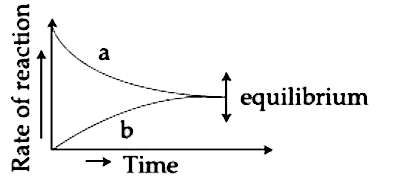
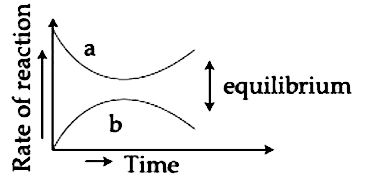
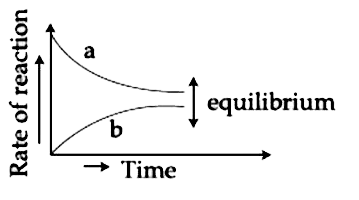
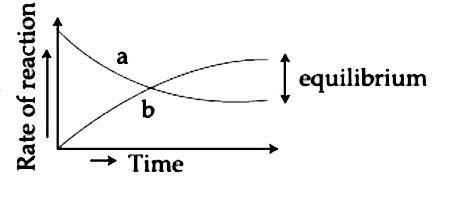
For the equilibrium `AhArrB` , the variation of the rate of the forward (a) and reverse (b) reaction with time is given by :

A

B

C

D

Text Solution

AI Generated Solution

The correct Answer is:

To solve the problem regarding the equilibrium of the reaction \( A \rightleftharpoons B \) and the variation of the rates of the forward and reverse reactions over time, we can follow these steps: ### Step 1: Understand the Concept of Equilibrium At equilibrium, the rate of the forward reaction (formation of \( B \) from \( A \)) is equal to the rate of the reverse reaction (formation of \( A \) from \( B \)). This means that the concentrations of \( A \) and \( B \) remain constant over time. **Hint:** Remember that at equilibrium, the rates of the forward and reverse reactions are equal. ### Step 2: Analyze the Rate Expressions Let’s denote the rate of the forward reaction as \( r_f \) and the rate of the reverse reaction as \( r_b \). At equilibrium, we can express this as: \[ r_f = k_f [A] \] \[ r_b = k_b [B] \] Where \( k_f \) and \( k_b \) are the rate constants for the forward and reverse reactions, respectively. **Hint:** Write down the rate expressions for both the forward and reverse reactions. ### Step 3: Set Up the Equilibrium Condition At equilibrium, we have: \[ k_f [A] = k_b [B] \] This equation indicates that the concentrations of \( A \) and \( B \) are related through their respective rate constants. **Hint:** Use the equality of the rates to set up an equation involving concentrations. ### Step 4: Determine the Changes Over Time Initially, as the reaction proceeds, the concentration of \( A \) will decrease while the concentration of \( B \) will increase. Over time, the rates of the reactions will change until they reach equilibrium. **Hint:** Consider how the concentrations of \( A \) and \( B \) change over time until they stabilize. ### Step 5: Conclusion At equilibrium, since the rates are equal, we can conclude that: \[ \text{At equilibrium, } r_f = r_b \] This means that the system has reached a state where the concentrations of \( A \) and \( B \) do not change, and the forward and reverse reactions continue to occur at the same rate. **Hint:** Remember that equilibrium is a dynamic state where reactions continue to occur, but there is no net change in concentrations. ### Final Answer The correct option regarding the equilibrium of the reaction \( A \rightleftharpoons B \) is that the rate of the forward reaction equals the rate of the reverse reaction at equilibrium. ---
Promotional Banner

Topper's Solved these Questions

  • JEE MAINS 2020

    JEE MAINS PREVIOUS YEAR|Exercise CHEMSITRY|25 Videos
  • JEE MAINS

    JEE MAINS PREVIOUS YEAR|Exercise QUESTION|1 Videos
  • JEE MAINS 2021

    JEE MAINS PREVIOUS YEAR|Exercise Chemistry (Section B )|10 Videos

Similar Questions

Explore conceptually related problems

For the equilibrium, A(g)hArrB(g),DeltaH is -40kJ//mol , if the ratio of the activation energies of the forward (E_(f)) and reverse (E_(b)) reactions is 2/3, then

In a reversible reaction the rate of the backward reaction is

A reaction having equal energies of activation for forward and reverse reactions has

For the reversible reaction, A+BhArrC , the specific reaction rates for forward and reverse reactions are 1.25xx10^(3) "and" 2.75xx10^(4) respectively. The equilibrium constant for the reaction is:

JEE MAINS PREVIOUS YEAR-JEE MAINS 2020-CHEMSITRY
  1. For the equilibrium AhArrB , the variation of the rate of the forward ...

    Text Solution

    |

  2. The correct statement with respect to dinitrogen is :

    Text Solution

    |

  3. Consider the following reactions :

    Text Solution

    |

  4. The major product obtained from the following reaction is :

    Text Solution

    |

  5. A solution of two components containing n1 moles of 1^(st) component a...

    Text Solution

    |

  6. The INCORRECT statement is :

    Text Solution

    |

  7. Consider the Assertion and Reason given below. Assertion (A) : Ethe...

    Text Solution

    |

  8. Arrange the following solutions in the decreasing order of pOH : (A...

    Text Solution

    |

  9. Among the sulphates of alkaline earth metals the solubilities of BeSO4...

    Text Solution

    |

  10. The major products of the following reaction are : CH3 -overset(CH...

    Text Solution

    |

  11. The major product of the following reaction is :

    Text Solution

    |

  12. The presence of soluble fluoride ion upto 1 ppm concentration in drink...

    Text Solution

    |

  13. The increasing order of pKb values of the following compounds is :

    Text Solution

    |

  14. Which of the following compounds shows geometrical isomerism ?

    Text Solution

    |

  15. The set that contains atomic numbers of only transition elements , is ...

    Text Solution

    |

  16. The variation of equilibrium constant with temperature is given below ...

    Text Solution

    |

  17. Kraft temperature is the temperature :

    Text Solution

    |

  18. For the reaction Fe2N(s)+(3)/(2)H2(g)=2Fe(s)+NH3(g)

    Text Solution

    |

  19. The species that has a spin -only magnetic moment of 5.9 BM , is : (...

    Text Solution

    |

  20. The lanthanoid that does NOT show +4 oxidation stat is :

    Text Solution

    |

  21. Consider the following reaction A to P1, B to P2 , C to P3 , D to P4...

    Text Solution

    |
