Home
Class 12
PHYSICS
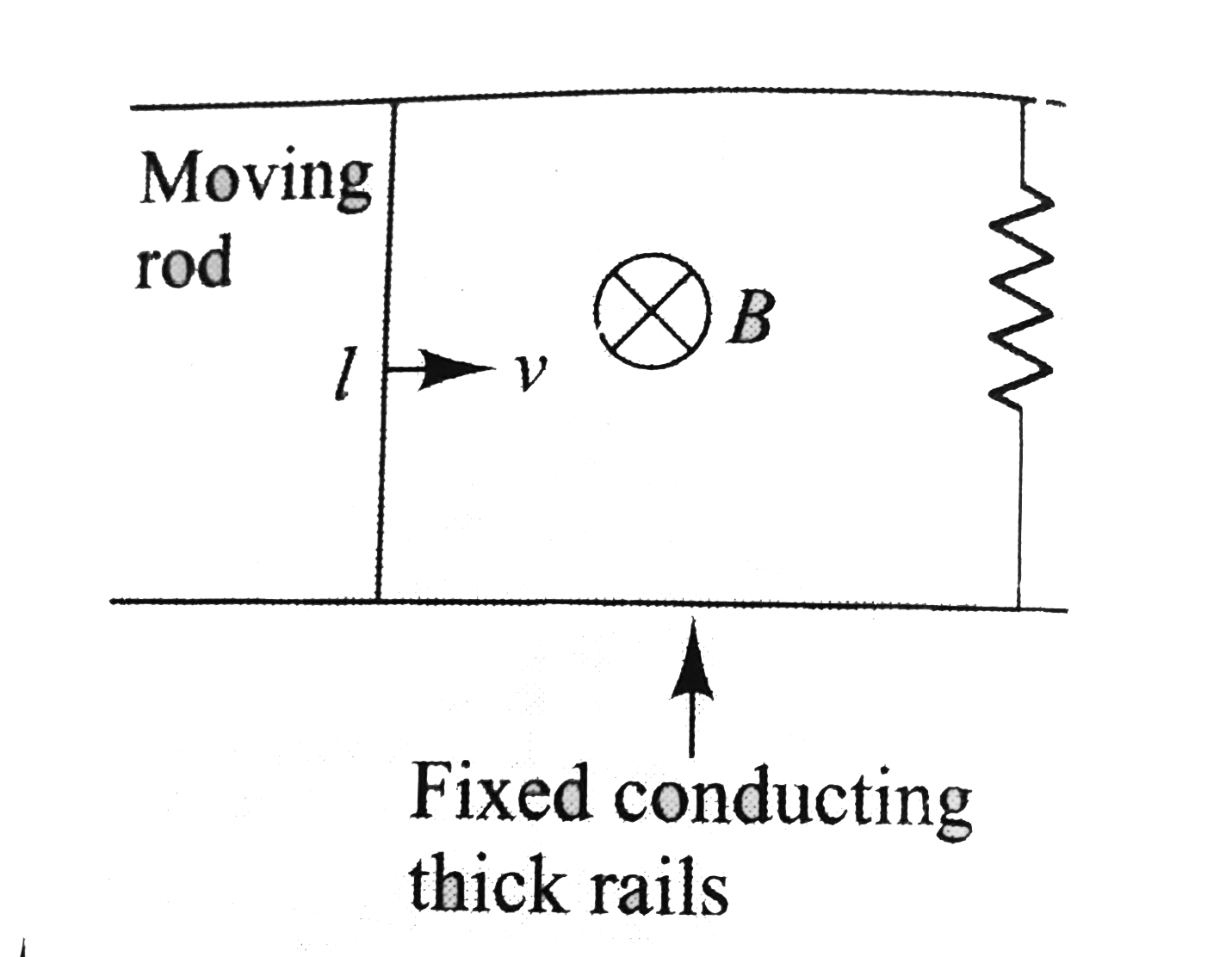
Shows a rod of length l and resistance r...

Shows a rod of length `l` and resistance `r` moving on two rails shorted by a resistance `R`. A uniform magnetic field `B` is present normal to the plane of rod and rails. Show the electrical equivalence of each branch.

Text Solution

Verified by Experts
Promotional Banner

Topper's Solved these Questions

  • ELECTROMAGNETIC INDUCTION

    RESONANCE|Exercise Exercis-1|63 Videos
  • ELECTROMAGNETIC INDUCTION

    RESONANCE|Exercise Exercis-1 PART 2|51 Videos
  • ELECTROMAGNETIC INDUCTION

    RESONANCE|Exercise A.l.P|19 Videos
  • ELECTRODYNAMICS

    RESONANCE|Exercise Advanced level problems|31 Videos
  • ELECTROSTATICS

    RESONANCE|Exercise HLP|39 Videos

Similar Questions

Explore conceptually related problems

a copper rod of mass m slides under gravity on two smooth parallel rails with separation I and set at an angle of theta with the horiziontal at the bottom rails are joined by resistance R. There is a uniform magnetic field B normal to the plane of the rails as shown in the figure The terminal speed of the copper rod is :

A copper rod of mass m slides under gravity on two smooth parallel rails l distance apart set at an angle theta to the horizontal. At the bottom, the rails are joined by a resistance R . There is a uniform magnetic field perpendicular to the plane of the rails. the terminal valocity of the rod is

A conducting rod of mass m and length l is free to move without friction on two parallel long conducting rails, as shown below. There is a resistance R across the rails. In the entire space around, there is a uniform magnetic field B normal to the plane of the rod and rails. The rod is given an impulsive velocity v_(0) - Finally, the initial energy (1)/(2) mv_(0)^(2)

Two parallel vertical metallic bars X X^(1) and Y Y^(1) , of negligible resistance and separated by a length 'l' , are as shown in Fig. The ends of the bars are joined by resistance R_(1) and R_(2) . A uniform magnetic field of induction B exsits in space normal to the plane of the bars. A horizontal metallic rod PQ of mass m starts falling vertically, making contact with the bars. It is oberved that in the steady state the powers dissipated in the resistance R_(1) and R_(2) and the terminal velocity attained by the rod PQ .

A rod of mass m , length l and resistance R is sliding down on a smooth inclined parallel rails with a cinstant velocity v . If a uniform horizontal magnetic field B exists, then find thevalue of B .

Two parallel fixed conducting rails are l distance apart. They are connected by a conducting wire xy. A uniform magnetic field B is applied normal to its plane. Two other rods PQ and RT(RS = ST) are moved with a constant velocity v. Resistance/ length of these two rods are lamda no other wire has resistance. Then :

A conducting rod of length l slides at constant velocity v on two parallel conducting rails, placed in a uniform and constant magnetic field B perpendicular to the plane of the rails as shown in Fig.3.49. A resistance R is connected between the two ends of the rails. (a) Idenify the cause which produces change in magnetic flux. (b) Identify the direction of current in the loop. ( c) Determine the emf induced in the loop. (d) Compute the electric power dissipated in the resistor. (e) Calcualte the mechenical power required to pull the rod at a cinstant velovity.

A metallic rod of length l is rotated at a constant angular speed omega , normal to a uniform magnetic field B. Derive an expression for the current induced in the rod, if the resistance of the rod is R.

A vertical ring of radius r and resistance on R falls vertically. It is in contact with two vertical rails which are joined at the top. The rails are without friction and resistance. There is a horizontal uniform, magnetic field of magnitude B perpendicular to the plane of the ring and the rails. When the speed of the ring is v , the current in the section PQ is

