Home
Class 12
PHYSICS
A particle of mass 2 kg is moving of a s...

A particle of mass `2 kg` is moving of a straight line under the actin force `F = (8 - 2x)N`. It is released at rest from `x = 6m`.
a. Is the particle moving simple hormonically.
b. Find the equilibrium position of the particle.
c. Write the equation of motion of the particle.
d. Find the time period of SHM.

Text Solution

Verified by Experts
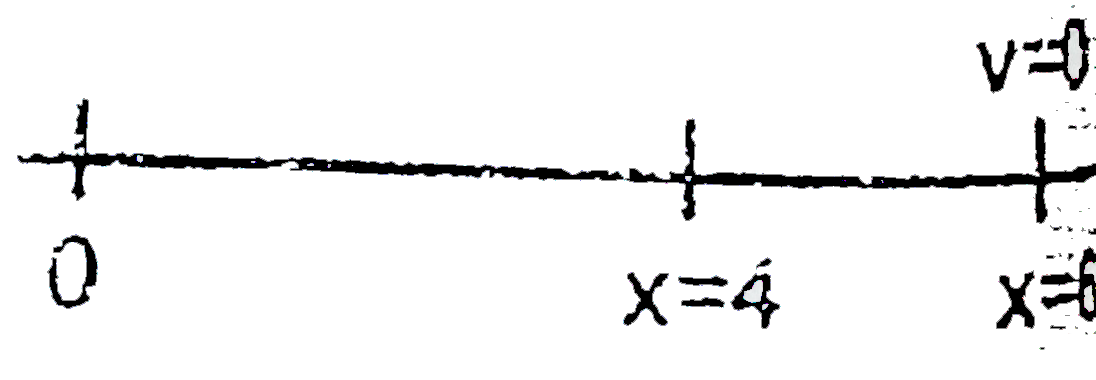
`F = 8 - 2x `
or `F = -2(x - 4)`
at equilibrium position `F = 0`
Hence the motion of particle is `SHM` with force constant `2` and equilibrium position `x = 4`
(a) Yes, motion is `SHM`.
(b) Equilibrium position is `x = 4`
(c) At `x = 6 m`, particle is at rest i.e., it is one of the extreme position Hence amlitude is `A = 2 m` and initially particle is at the extreme position.

`:.` Equation of `SHM` can be written as
`x - 4 = 2 omegat`, where `omega = sqrt((k)/(m)) = sqrt((2)/(2)) = 1`
i.e., `x = 4 + 2 cos t`
(d) Time period, `T = (2pi)/(omega) = 2pisec`.
Promotional Banner

Topper's Solved these Questions

  • SIMPLE HARMONIC MOTION

    RESONANCE|Exercise Solved Miscellaneous Problems|9 Videos
  • SIMPLE HARMONIC MOTION

    RESONANCE|Exercise Board Level Exercise|24 Videos
  • SEMICONDUCTORS

    RESONANCE|Exercise Exercise 3|88 Videos
  • TEST PAPERS

    RESONANCE|Exercise FST-3|30 Videos

Similar Questions

Explore conceptually related problems

A partical of mass 2 kg is moving of a straigh line under the actin force F = (8 - 2s)N . It is released at rest from x = 6m . a. Is the partical moving simple hormonically. b.Find the equilibrium position of the partical. c. Write the equiation of motion of the partical. d. Find the time period of SHM.

A particle of mass 2kg is moving on a straight line under the action of force F = (8-2x) N . The particle is released at rest from x = 6 m . For the subsequnent motion(All the value in the right column are in their S.I. units)

The potential energy U(x) of a particle moving along x - axis is given by U(x)=ax-bx^(2) . Find the equilibrium position of particle.

For a particle performing SHM , equation of motion is given as (d^(2))/(dt^(2)) + 4x = 0 . Find the time period

A particle of mass 2 kg moves in simple harmonic motion and its potential energy U varies with position x as shown. The period of oscillation of the particle is

Force acting on a particle of mass m moving in straight line varies with the velocity of the particle as F=K//V K is constant then speed of the particle in time t

A particle having mass 2 kg is moving along straight line 3 x + 4 y = 5 with speed 8m//s . Find angular momentum of the particle about origin, x and y are in meters.

A particle of mass 0.2 kg moves with simple harmonic motion of amplitude 2 cm. If th~ total energy of the particle is 4 xx10^(-5) J, then the time period of the motion is

A particle of mass = 2kg moves in simple harmonic motion and its potential energy U varies with position x as shown. The period of oscillation of the particle is (npi)/5 second. Find value of n.

A particle of mass 2kg starts to move at position x=0 and time t=0 under the action of force F=(10+4x)N along the x- axis on a frictionless horizontal track . Find the power delivered by the force in watts at the instant the particle has moved by distance 5m .

