Home
Class 12
PHYSICS
The friction coefficient between the two...

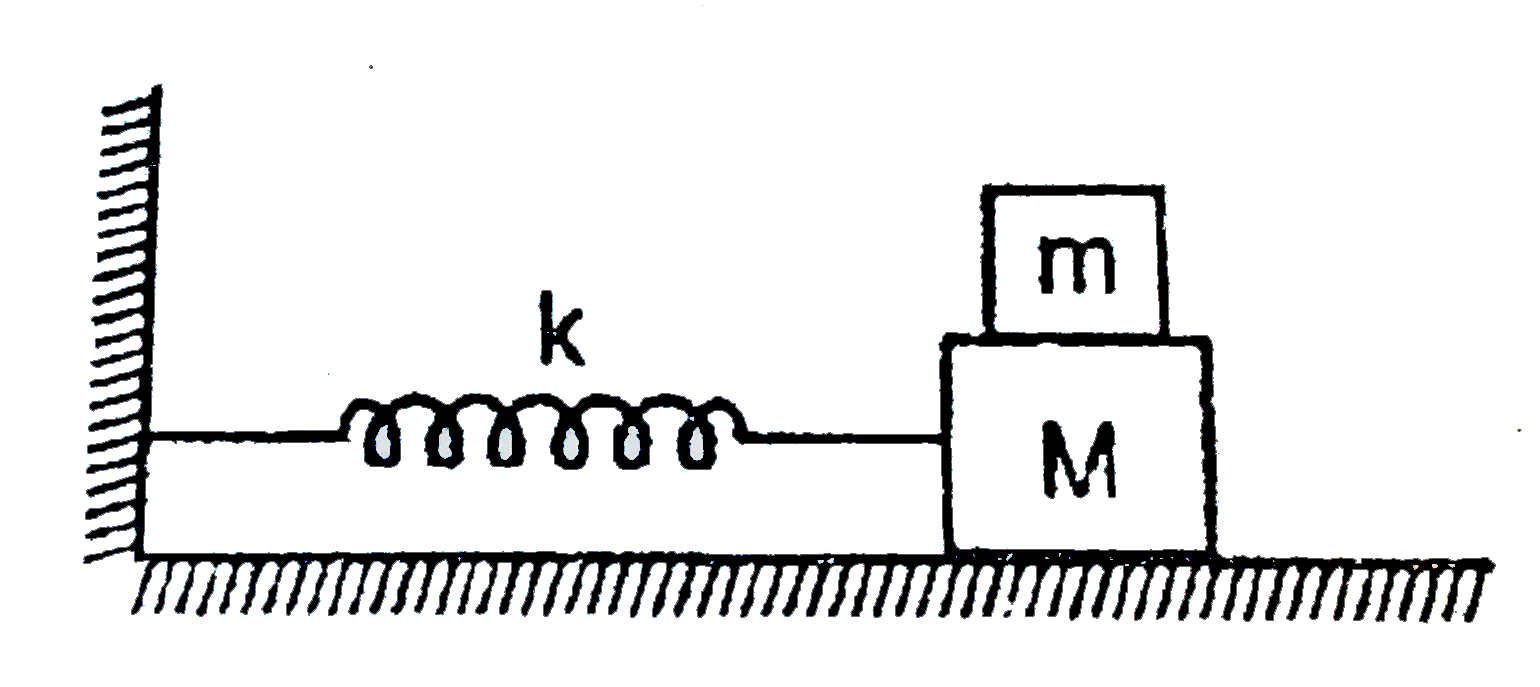
The friction coefficient between the two blocks shown in figure is `mu` and the horizontal plane is smoth. (a) if the systeam is slightly displacement and released, find the time period. (b) Find the magnitude of the fricational force between the blocks when the displacement from the fmean position is `x`. (c) What can be the maximum amplitude if the upper block does not slip relative to the lower block ?

Text Solution

Verified by Experts

(a) For small amplitude, the two blocks oscillate together. The angular requency is `omega = sqrt((k)/(M + m))` and so the time period `T = 2pi sqrt((M + m)/(k))`
(b) The acceleration of the blocks at displacement `x` from the mean position is
`a = -omega^(2)x = ((-kx)/(M + m))`
The resultant force on the upper block is, therefore, `ma = ((-mkx)/(M + m))`
This force is provided by the frication of the lower block. Hence, the magnitude of the frication force is `(mk |x|)/(M + m)`
(c) Maximum force of frication required for simple harmonic motion of the upper block is `(mk_(A))/(M + m)` as the extreme positions. But the maximum frication force can only be `mu mg`. Hence, `(mkA)/(M + m) = mu mg` or `A = (mu(M + m)g)/(k)`
Promotional Banner

Topper's Solved these Questions

  • SIMPLE HARMONIC MOTION

    RESONANCE|Exercise Solved Miscellaneous Problems|9 Videos
  • SIMPLE HARMONIC MOTION

    RESONANCE|Exercise Board Level Exercise|24 Videos
  • SEMICONDUCTORS

    RESONANCE|Exercise Exercise 3|88 Videos
  • TEST PAPERS

    RESONANCE|Exercise FST-3|30 Videos

Similar Questions

Explore conceptually related problems

The friction coeficeint betweenteh tow blocks shown in figure is mu and the horizontal plance is smooth. A. If the system is slightly diplaced and released find the time period. B. find the magnitude of the frictional force between the blocks when the displacement from the mean position is x. c. What can be the maximum amplitude if the upper block does not slip relative to the lower block?

The friction coefficient between the blocks is mu . If force F is applied on the lower block , analyse motion of two blocks.

The coefficient of static friction between the two blocks shown in figure is mu and the table is smooth. What maximum horizontal forced F can be applied to he block of mass M so that the block move together?

A block is stationary on an inclined plane If the coefficient of friction between the block and the plane is mu then .

A block A of mass m_(1) is placed on a horizontal frictionless table. It is connected to one end of a light spring of force constant k whose other end is fixed to a wall. A small block B of mass m_(2) is placed on block A. The coefficient of static friction between the blocks is mu . The system is displaced slightly from its equilibrium position and released. What is the maximum amplitude of the resulting simple harmonic motion of the system so that the upper block does not slip over the lower block ?

The coefficient of static and kinetic friction between the two blocks and also between the lower block and the ground are mu_(s)=0.6 and mu_(k)=0.4 Find the value of tension T applied on the lower block at which the upper block begins to slip relative to lower block.

There is no slipping between the two block. What is force of friction between two blocks?

A block on table shown in is just on the edge of slipping Find the coefficient of static friction between the blocks and table .

The coefficient of friction between block of mass m and 2m is mu=2tantheta . There is no friction between block of mass 2 m and inclined plane. The maximum amplitude of the two block system for which there is no relative motion between both the blocks is
