Home
Class 12
PHYSICS
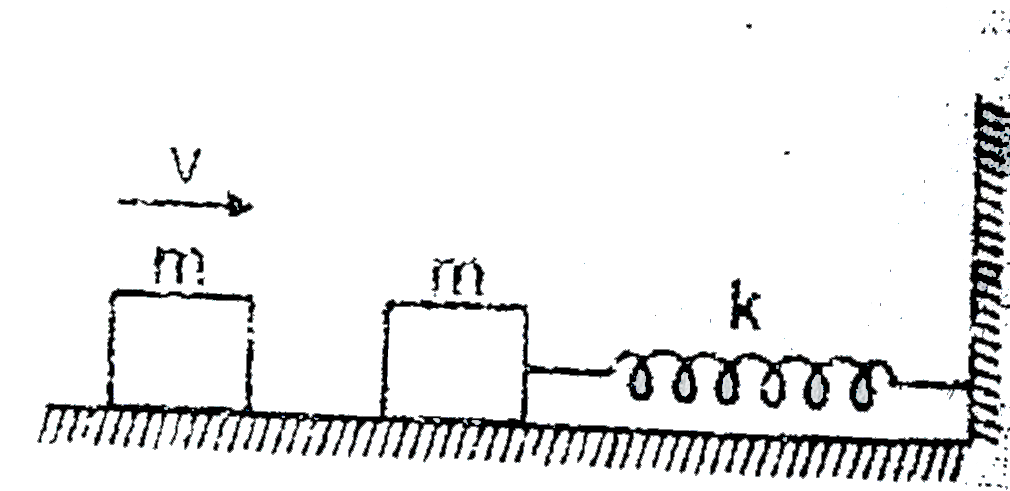
The left block in figure collides inelas...

The left block in figure collides inelastically with the right block and striks to it. Find the amplitude of the resulting simple harmonic motion

Text Solution

Verified by Experts

Assuming the collision to last for a small interval only, we can apply the principle of conservation momentum. The common velocity after the collision is `(v)/(2)`. The kinectic energy `= (1)/(2)(2m) ((v)/(2))^(2) = (1)/(4) mv^(2)`. This is also the total energy of viberation as the spring isunstretched at this moment. If the amplitude is `A`, the total energy cen also be written as `(1)/(2)kA^(2)`. Thus,
`(1)/(2)kA^(2) = (1)/(4)mv^(2)`, giving `A = sqrt((m)/(2k))v`.
Promotional Banner

Topper's Solved these Questions

  • SIMPLE HARMONIC MOTION

    RESONANCE|Exercise Solved Miscellaneous Problems|9 Videos
  • SIMPLE HARMONIC MOTION

    RESONANCE|Exercise Board Level Exercise|24 Videos
  • SEMICONDUCTORS

    RESONANCE|Exercise Exercise 3|88 Videos
  • TEST PAPERS

    RESONANCE|Exercise FST-3|30 Videos

Similar Questions

Explore conceptually related problems

The left block in figure collides inelastically with the right block and sticks to it. Find the amplitude of the resulting simple harmonic motion.

The left block in filgure collides inelastically with the right block and sticks to it. Find the amplitude of the resulting simple harmonic motion.

(a) The right block collides with left block and sticks to it. Find amplitude of the resulting SHM. (b) The block starts from left wall and moves with constant speed v. All collisions are elastic. Find time period of periodic motion.

In figure, k = 100 N//m, M = 1kg and F = 10 N (a) Find the compression of the spring in the equilibrium position (b) A sharp blow by some external agent imparts a speed of 2 m//s to the block towards left. Find the sum of the potential energy of the spring and the kinetic energy of the block at this instant. (c) Find the time period of the resulting simple harmonic motion. (d) Find the amplitude. (e) Write the potential energy of the spring when the block is at the left estreme. (f) Write the potential energy of the spring when the block is at the right extreme. The answers of (b), (e) and (f) are different. Explain why this does not violate the principle of conservation of energy ?

A block A of mass m_(1) is placed on a horizontal frictionless table. It is connected to one end of a light spring of force constant k whose other end is fixed to a wall. A small block B of mass m_(2) is placed on block A. The coefficient of static friction between the blocks is mu . The system is displaced slightly from its equilibrium position and released. What is the maximum amplitude of the resulting simple harmonic motion of the system so that the upper block does not slip over the lower block ?

In the figure shown, the block A of mass m collides with the identical block B and after collision they stick together. Calculate the amplitude of resulatant vibration.

A block A of mass m is placed on a frictionless horizontal surface. Another block B of the same mass is kept on A and connected to the wall with the helpf of a spring of force constant K as shown in the figure. The coefficient of friction between the blocks A and B is mu . The blocks move together execting simple harmonic motion of amplitude 'a'. What is the maximum value of the fricitional force between A and B ?

A block of mass 'm' collides perfectly inelastically with another identical block connected to a spring of of force constant 'K'. The amplitude of resulting SHM will be
