Home
Class 12
PHYSICS
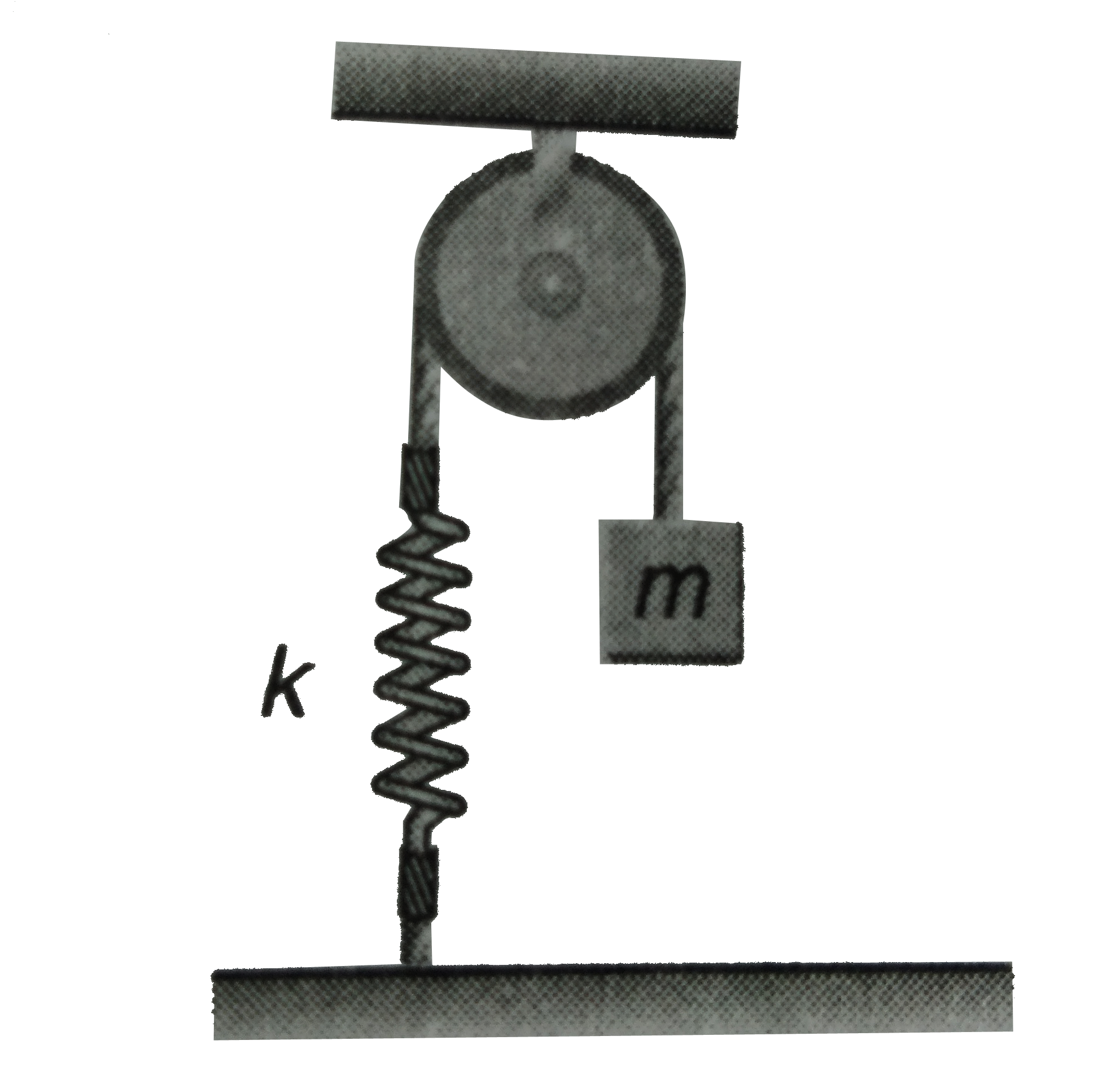
The string, spring and the pulley shown ...

The string, spring and the pulley shown in figure are light. Find the time period of the mass `m`.

Text Solution

Verified by Experts
Force Method
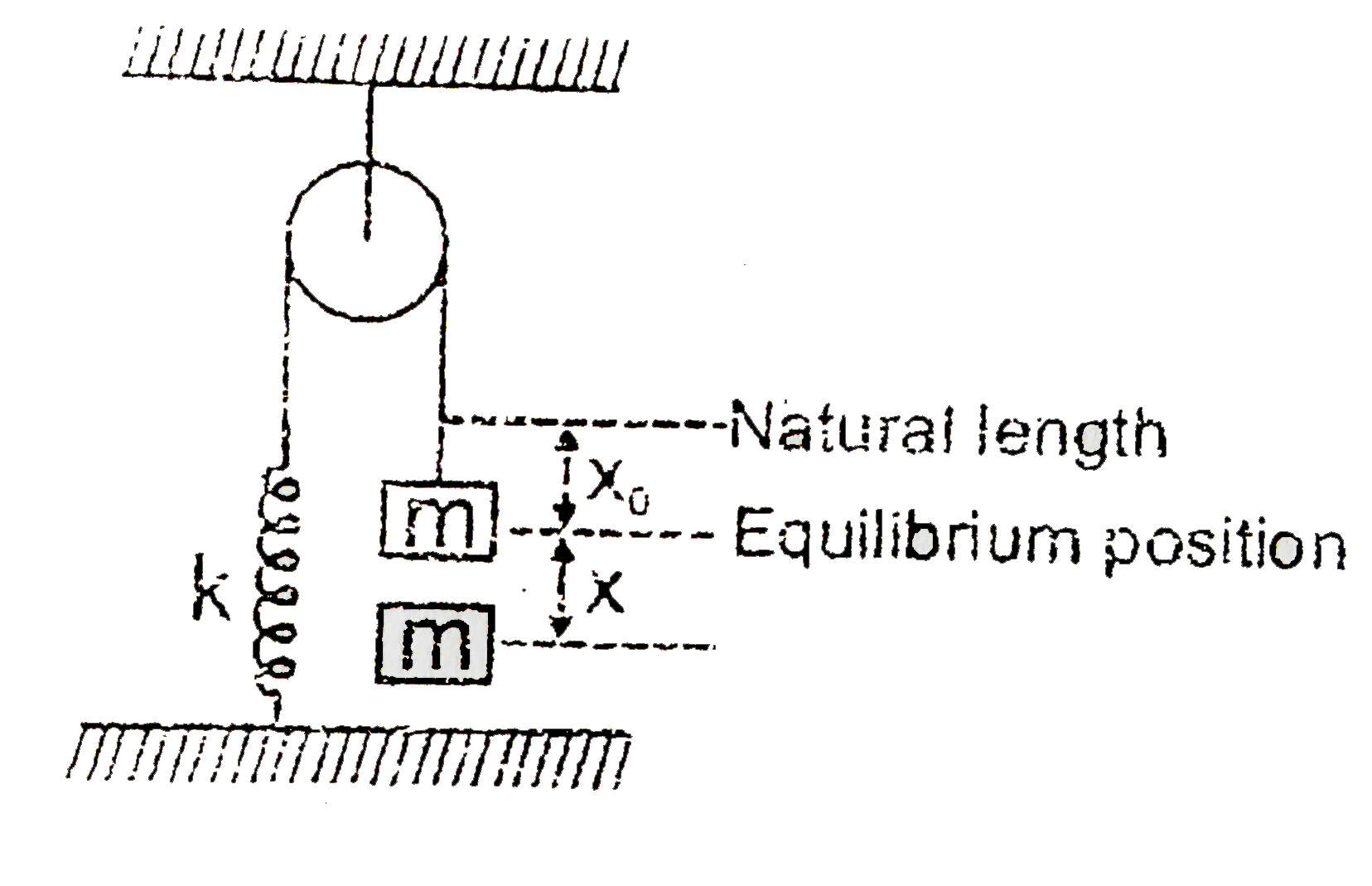
Let in equilibrium position of the block, extension in spring is `x_(0)`.
`:. Kx_(0) -1`
Now if we displace the block by `x` in the downward direction, net force on the block towards mean position is
`F = k(x + x_(0)) - mg, = kx` using `(1)`
Hence the net force is acting towards mean position and is also propotional to `x`. So, the particle will perform `S.H.M.` and its time period would be
`T = 2pi sqrt((m)/(k))`
(b) Energy Method
Let gravitational potential energy is to be zero at the level of the block when spring is in its natural length.
Now at a distance `x` below that level, let speed of the block be `v`.
Since total mechcanical energy is conserved in `S.H.M.`
`:. -mgx + (1)/(2)kx^(2) + (1)/(2)mv^(2) = constant`
Differentiating `w.r.t.` time, we get
`-mgv + kxv + mva = 0`
where `a` is accleration.
`:. F = ma = -kx + mg` or `F = -k(x - (mg)/(k))`
This shows that for the motion, force constant is `k` and equilibrium position is `x = (mg)/(k)`.
So, the particle will perform `S.H.M` and its timne period would be `T = 2pisqrt((m)/(k))`
Promotional Banner

Topper's Solved these Questions

  • SIMPLE HARMONIC MOTION

    RESONANCE|Exercise Solved Miscellaneous Problems|9 Videos
  • SIMPLE HARMONIC MOTION

    RESONANCE|Exercise Board Level Exercise|24 Videos
  • SEMICONDUCTORS

    RESONANCE|Exercise Exercise 3|88 Videos
  • TEST PAPERS

    RESONANCE|Exercise FST-3|30 Videos

Similar Questions

Explore conceptually related problems

The string, the spring and the pulley shown in figure are light. Find the time period of the mass m.

The string the spring and the puley shown in figure are light. Find the time period of the mass m.

A mass m is attached to the free end of a massless spring of spring constant k with its other end fixed to a rigid support as shown in figure. Find out the time period of the mass, if it is displaced slightly by an amount x downward.

Consider4 the situation shown in figure. Bothe the pulleys and the string are light and all the surfaces are friction less. a. Find the acceleration of the mass M. b. Find the tension in the string c. Calculate the force exerted by the clamp on the pulley A in the figure.

Consider the situation shown in the figure. The surface is smooth and the string and the pulley are light. Find the acceleration of each block and tension in the string.

Consider the situation shown in figure. All the surfaces are frictions and the string and the pulley are light. Find the magnitude of the acceleration of the two blocks.

Three blocks of masses m_1, m_2 and m_3 are connected as shown in the figure. All the surfaces are frictionless and the string and the pulleys are light. Find the acceleration of m_1

A constant force F=m_2g/s is applied on the block of mass m_1 as shown in figure. The string and the pulley are light and the surface of the table is smooth. Find the acceleration of m_1

A body of mass m is suspended from three springs as shown in figure. If mass m is displaced slightly then time period of oscillation is

