Home
Class 12
PHYSICS
Two particles A and B performing SHM alo...

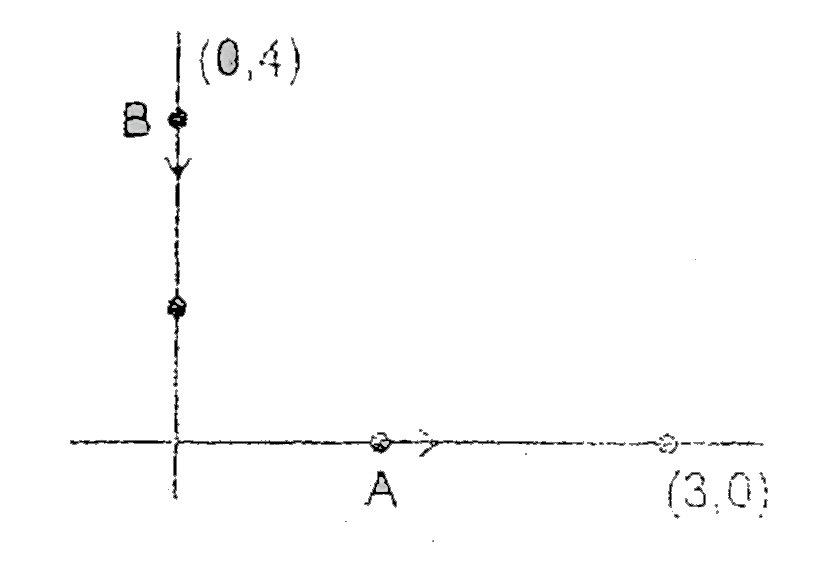
Two particles `A` and `B` performing `SHM` along `x` and `y-`axis respectively with equal amplitude and frequency of `2 cm` and `1 Hz` respectively. Equilibrium positions of the particles `A` and `B` are at the co-ordinates `(3, 0)` and `(0, 4)` respectively. At `t = 0, B` is at its equilibrium positions and moving towards the origin, while `A` is nearest to the origin and moving away from the origin. If the maximum and minimum distances between `A` and `B` is `s_(1)` and `s_(2)` then find `s_(1) + s_(2)` (in `cm`).

Text Solution

Verified by Experts

The correct Answer is:
10

At `t = 0` Particle `2` is at point `V` and mocing towards origin so displacement
`Y = 4 - A sin omegat`
`Y = 4 - 2 sin omegat`
and displacement of particle `1` is
`X = 3 - A cos omegat `
`X = 3 - 2 cos omegat`
So distance between them `= sqrt(X^(2) + Y^(2))`
`s^(2) = 29 - (16 sin omegat + 12 cos omegat) = 29 - 4 (4 sinomegat + 3 cosomegat)`
`rArr 29 - 20 (sinomegat + 37^(@))`
So `s_(max)^(2) = 49 rArr s_(max) = 7 cm = S_(1)`
`s_(min)^(2) = 9 rArr s_(min) = 3cm = S_(2)`
`:. S_(1) + S_(2) = 10 cm`
Promotional Banner

Topper's Solved these Questions

  • SIMPLE HARMONIC MOTION

    RESONANCE|Exercise Exercise- 2, PART - III|12 Videos
  • SIMPLE HARMONIC MOTION

    RESONANCE|Exercise Exercise- 2, PART - IV|8 Videos
  • SIMPLE HARMONIC MOTION

    RESONANCE|Exercise Exercise- 2, PART - I|26 Videos
  • SEMICONDUCTORS

    RESONANCE|Exercise Exercise 3|88 Videos
  • TEST PAPERS

    RESONANCE|Exercise FST-3|30 Videos

Similar Questions

Explore conceptually related problems

Two particles A and B are performing SHM along x and y-axis respectively with equal amplitude and frequency of 2 cm and 1 Hz respectively. Equilibrium positions of the particles A and B are at the coordinates [3 cm, 0] and (0, 4 cm) respectively. At t = 0 ,B is at its equilibrium position and moving towards the origin, while A is nearest to the origin and moving away from the origin- Minimum and maximum distance between A and B during the motion is-

Two particles A and B are performing SHM along x and y-axis respectively with equal amplitude and frequency of 2 cm and 1 Hz respectively. Equilibrium positions of the particles A and B are at the coordinates [3 cm, 0] and (0, 4 cm) respectively. At t = 0 ,B is at its equilibrium position and moving towards the origin, while A is nearest to the origin and moving away from the origin- Equation of motion of particle B can be written as-

Two particles A and B are performing SHM along x and y-axis respectively with equal amplitude and frequency of 2 cm and 1 Hz respectively. Equilibrium positions of the particles A and B are at the coordinates [3 cm, 0] and (0, 4 cm) respectively. At t = 0 ,B is at its equilibrium position and moving towards the origin, while A is nearest to the origin and moving away from the origin- Equation of motion of particle A can be written as-

(i) A particle of mass m executes SHM in xy- plane along a straight line AB. The points A (a, a) and B (- a, - a) are the two extreme positions of the particle. The particle takes time T to move from one extreme A to the other extreme B. Find the x component of the force acting on the particle as a function of time if at t = 0 the particle is at A. (ii) Two particle A and B are performing SHM along X-axis and Y-axis respectively with equal amplitude and frequency of 2 cm and 1 Hz respectively. Equilibrium positions for the particles A and B are at the coordinate (3, 0) and (0, 4) respectively. At t = 0, B is at its equilibrium position and moving toward the origin, while A is nearest to the origin. Find the maximum and minimum distances between A and B during their course of motion

Two particles A and B move along the straight lines x+2y+3=0 and 2x+y-3=0 respectively. Their positive vector, at the time of meeting will be

A mass m is moving with a constant velocity along a line parallel to the x-axis, away from the origin. Its angular momentum with respect to the origin.

A mass m moving with a constant velocity along a line parallel to the axis, away from the origin. Its anguarl momentum with respect to the origin

A body of mass m is moving with a constant velocity along a line parallel to the x-axis, away from the origin. Its angular momentum with respect to the origin

Two particles A and B oscillates in SHM having same amplitude and frequencies f_(A) and f_(B) respectively. At t=0 the particle A is at positive extreme position while the particle B is at a distance half of the amplitude on the positive side of the mean position and is moving away from the mean position.

A particle performs uniform circular velocity along a line parallel to the x-axis, away from the origin. Its angular momentum with respect to the origin.

