Home
Class 12
PHYSICS
A particle of mass 'm' moves on a horizo...

A particle of mass `'m'` moves on a horizont smooth line `AB` of length `'a'` such that when particle is at any general point `P` on the line two force act on it. A force `(mg(AP))/(a)` towards `A` and another force `(2mg(BP))/(a)` towards `B`.
Find the minimum distance of the particle from `B` during the motion.

A

`(a)/(6)`

B

`(a)/(4)`

C

`(a)/(3)`

D

`(a)/(8)`

Text Solution

Verified by Experts

The correct Answer is:
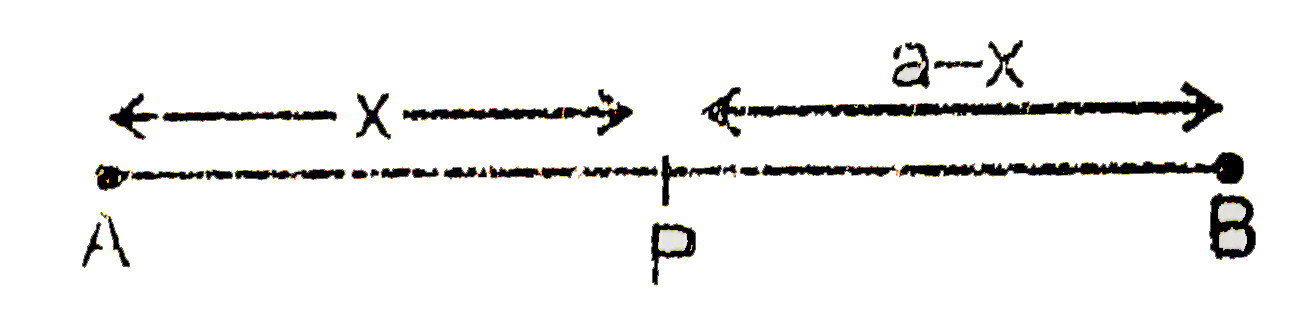
A

`(i)` force on particle at point `P`
`f = (2mg(a-x))/(a)-(mg(x))/(a)`
`F = (mg)/(a)(2a - 3x)`
m `F = (-3mg)/(a)(x - 2a//3)`

`(ii)` So this is equation of `S.H.M. (F = momega^(2)x)` so particle
Perform `S.H.M.` with mean position `x - 2a//3 = 0`
So `omega^(2) = (3g)/(a) rArr omega = sqrt(3g//a)`
So Time period `T = 2pi sqrt(a//3g)`
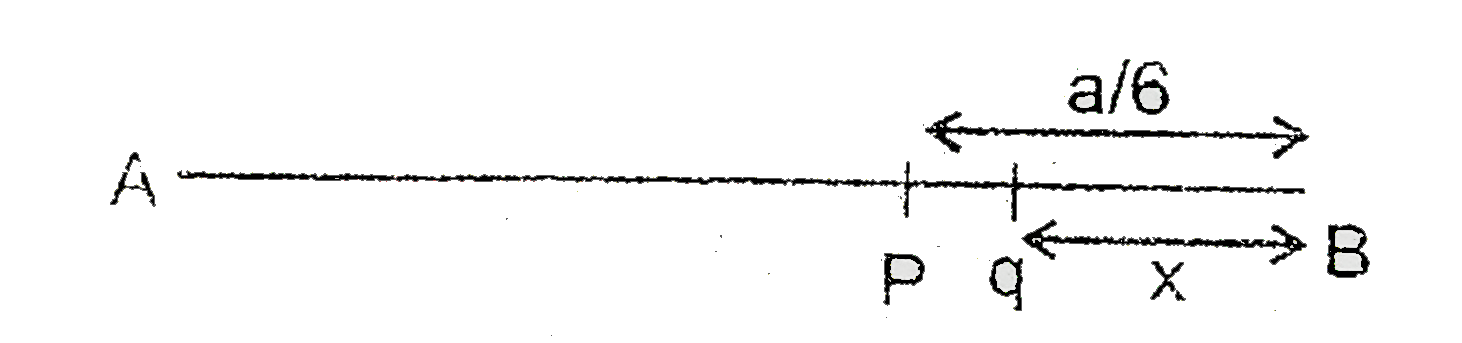
and amplitude `= 2a//3 - a//2 = a//6`
`(iii)` minimum distance from `B`
`= a - (2a//3 + a//6) = a//6`
`(iv)` at point `P` velocity of partivle `= 0`
and force `= (2mgx)/(a)`
(at point `q`)
acc. `= (2gx)/(a) rArr overset(v)underset(o)(int)vdv = overset(a//6)underset(o)(int)(2gxdx)/(a) rArr V = (sqrt(2ga))/(6)`
Promotional Banner

Topper's Solved these Questions

  • SIMPLE HARMONIC MOTION

    RESONANCE|Exercise Exercise- 3, PART - I|20 Videos
  • SIMPLE HARMONIC MOTION

    RESONANCE|Exercise Exercise- 3, PART - II|17 Videos
  • SIMPLE HARMONIC MOTION

    RESONANCE|Exercise Exercise- 2, PART - III|12 Videos
  • SEMICONDUCTORS

    RESONANCE|Exercise Exercise 3|88 Videos
  • TEST PAPERS

    RESONANCE|Exercise FST-3|30 Videos

Similar Questions

Explore conceptually related problems

A particle of mass 'm' moves on a horizont smooth line AB of length 'a' such that when particle is at any general point P on the line two force act on it. A force (mg(AP))/(a) towards A and another force (2mg(BP))/(a) towards B . If the force acting towards A stops acting when the particle is nearest to B then find the velocity with which it crosses point B.

A particle of mass 'm' moves on a horizont smooth line AB of length 'a' such that when particle is at any general point P on the line two force act on it. A force (mg(AP))/(a) towards A and another force 2(mg(BP))/(a) towards B . Find its time period when released from rest from mid-point of line AB .

A paricle of mass m is tied to a light string of length L and moving in a horizontal circle of radius r with speed v as shown. The forces acting on the particle are

A particle of mass m moves along a circle of 'R'. The modulus of the average vector of force acting on the particle over the distance equal to a quarter of the circle is :

Two strange particles A and B in space, exert no force on each other when they are at a separation greater than x_(0) = 1.0 m. When they are at a distance less than x_(0) , they repel one another along the line joining them. The repulsion force is constant and does not depend on the distance between the particles. This repulsive force produces an acceleration of 6 ms^(–2) in A and 2 ms^(–2) in B when the particles are at separation less than x_(0) . In one experiment particle B is projected towards A with a velocity of 2 ms^(–1) from a large distance so as to hit A head on. The particle A is originally at rest and the system of two particles do not experience any external force. (a) Find the ratio of mass of A to that of B. (b) Find the minimum distance between the particles during subsequent motion. (c) Find the final velocity of the two particles.

A particle P is moving along a straight line as shown in the figure. During the motion of the particle from A to B the angular momentum of the particle about O

A particle of mass m oscillates along the horizontal diameter AB inside a smooth spherical shell of radius R . At any instant K.E. of the partical is K . Then force applied by particle on the shell at this instant is:

Force acting on a particle of mass m moving in straight line varies with the velocity of the particle as F=K//V K is constant then speed of the particle in time t