Home
Class 12
PHYSICS
A particle of mass 'm' is moving in the ...

A particle of mass `'m'` is moving in the `x-y` plane such that its `x` and `y` coordinate very according to the law `x = a sin omega t` and `y = a cos omega t` where `'a'` and `'omega'` are positive constants and `'t'` is time. Find
(a) equation of the path. Name the trajectory (path)
(b) whether the particle moves in clockwise or anticlockwise direction
magnitude of the force on the particle at any time `t`.

Text Solution

Verified by Experts

The correct Answer is:
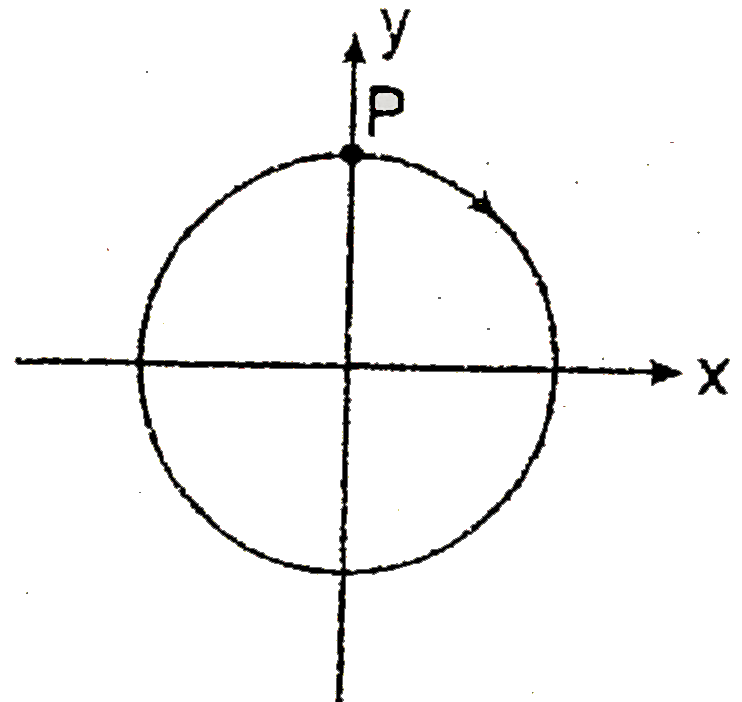
(a) `x^(2) + y^(2) = a^(2)`, circle
(b) The particle moves in clock wise sense.
(C) The magnitude of force `= msqrt(a_(x)^(2) + a_(y)^(2)) = momega^(2)del`

(a) `x^(2) + y^(2) = a^(2) (sin^(2)omegat + cos^(2)(omegat)) = a^(2)`
Hence the particle moves in a circle of radius `'a'` with centre at origin.
(b) At `t = 0` sec, `x = 0` and `y = +a`. Hence the particle is at `P` as shown in figure.

As `'t'` increases `'x'` increases and `'y'` decreases
`:.` the particle moves in clock wise sense.
(c) The `'x'` and `'y'` compoenents of acceleration are
`a_(x) = (d^(2)x)/(dt^(2)) = - omega^(2)x , a_(y) = (d^(2)y)/(dt^(2)) = -omega^(2)y`
The magnitude of force `= m sqrt(a_(x)^(2) + a_(y)^(2)) = momega^(2)a`
Promotional Banner

Topper's Solved these Questions

  • SIMPLE HARMONIC MOTION

    RESONANCE|Exercise Exercise- 3, PART - II|17 Videos
  • SEMICONDUCTORS

    RESONANCE|Exercise Exercise 3|88 Videos
  • TEST PAPERS

    RESONANCE|Exercise FST-3|30 Videos

Similar Questions

Explore conceptually related problems

A particle of mass 'm' is moving in the x-y plane such that its x and y coordinate vary according to the law x= a sin omegat and y= a cos omegat where 'a' and 'omega' are positive constants and 't' is time. Find (a) equation of the path. Name the trajectory (path). (b) whether the particle moves in clockwise or anticlockwise direction (c) magnitude of the force on the particle at any time t.

A particle moves in xy plane according to the law x = a sin omegat and y = a(1 – cos omega t) where a and omega are constants. The particle traces

A point moves in the plane xy according to the law x = alpha sin omega t, y = alpha(1 - cos omega t) , where alpha and omega are positive constant and t is time. Find the distance traversed by point in time t_(0) .

A point moves in the plane y according to the law x = A sin omegat, y = B cos omegat , where A,B & omega are positive constant. The velocity of particle is given by

A point moves in the plane y according to the law x = A sin omegat, y = B cos omegat , where A,B & omega are positive constant. The equation for trajectroy for path taken by particle is

For a particle moving in the x-y plane, the x and y coordinates are changing as x=a sin omega t and y = a ( 1-cos omega t ) , where 'a' and omega constants. Then, what can be inferred for the trajectory of the particle ?

A particle moves in the XY-plane according to the law x = kt, y = kt (1- alphat) , where k and alpha are positive constants and t is time. The trajectory of the particle is

A point moves in the plane y according to the law x = A sin omegat, y = B cos omegat , where A,B & omega are positive constant. The acceleration of particle is given by [ :' barr is position vector]

